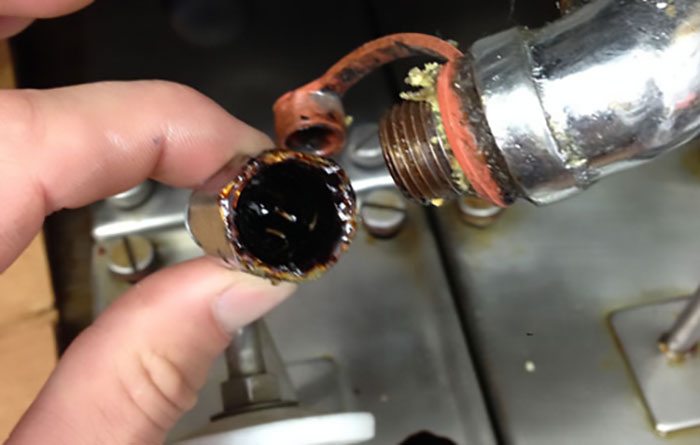
A nozzle cap is the small removable cover fitted over the discharge opening of a kitchen fire suppression nozzle. Its only job is keeping grease, moisture and cooking debris out of that opening between service visits, so the extinguishing agent leaves the nozzle in the exact pattern the system was designed and listed to spray. A missing, cracked or painted over cap is not a cosmetic problem. It changes what happens in the first seconds of a fire, which is why Boss Fire Protection checks every cap on every visit and writes up a bad one as a fire suppression inspection finding in kitchens across Dallas-Fort Worth.
- The job: keep grease, moisture and debris out of the nozzle’s discharge orifice until the system fires.
- The standard: NFPA 96 requires a trained technician to inspect and service a kitchen fire suppression system at least every six months.
- The two types: a blow-off cap built to release the instant the system discharges, or a foil or membrane seal built to rupture.
- The finding: a missing or degraded cap gets written up at inspection, and it does not wait for the next visit.
What Does a Nozzle Cap Actually Do?
A nozzle cap covers the small discharge opening at the tip of a fire suppression nozzle so grease, moisture, dust and cooking residue cannot collect inside it while the system sits idle, which is nearly all the time between fires. Every nozzle in a UL 300-listed system is tested with that opening clear, and the cap keeps it that way in a kitchen full of airborne grease. It is not welded in place. It comes off one of two ways: a technician removes it during service, or the system removes it itself the moment it discharges.
A Blocked Cap Changes the Discharge Pattern
Every listed nozzle is tested to put a specific amount of agent onto a specific surface in a specific pattern, and that testing is what makes the assembly UL 300-listed rather than a good guess. A cap holding grease buildup, or a replacement cap of the wrong size or material, changes the opening the agent has to pass through. The spray can slow, narrow, or throw off to one side instead of landing flat across the appliance surface it was aimed at, and none of that shows up until the system fires. A missing cap looks like nothing happened. A blocked one looks even more like nothing happened. Neither is nothing.
The agent has one chance to reach the fryer in the pattern the system was listed to spray. A blocked cap is what stands between that chance and a fire that keeps burning.
The Two Types of Nozzle Caps Boss Fire Sees in Dallas-Fort Worth Kitchens
Every suppression manufacturer, ANSUL, Amerex, Pyro-Chem, Buckeye, Kidde, Protex and Lehavot among them, lists its own nozzle caps as part of the tested assembly. The cap that ships with a nozzle is the only cap that nozzle is listed with, and in the field it takes one of two forms.
| Cap type | How it is built | How it is meant to work |
|---|---|---|
| Blow-off cap | A small plastic, rubber or metal cap fitted over the nozzle tip, sized to that nozzle’s manufacturer and model. | Pops free the instant the system discharges, clearing the opening before the agent reaches it. |
| Foil or membrane seal | A thin foil or film bonded across the opening rather than fitted over it. | Ruptures under discharge pressure rather than coming off as one piece. |
Neither type is universal. A cap pulled from a parts bin because it looked close enough was never tested on that nozzle, and it is one of the more common findings a technician documents on a visit. A nozzle’s own type and placement follow the manufacturer’s configuration rules, and the cap follows the same rule. Amerex, for one, fits a high temperature metal cap to every new KP nozzle and limits its standard cap to spots where exposure temperatures do not exceed 350°F, according to the Amerex KP component overview.
350°F
The highest exposure temperature at which Amerex allows its standard nozzle cap. Hotter spots need its high temperature cap.
Sourced to Amerex, KP Component Overview, Nozzle Caps
How Caps Actually Go Missing in a Working Kitchen
A cap rarely disappears from neglect. A handful of ordinary things happen around it, week after week.
- Cleaning removes them. Hood and filter cleaning uses pressure washing and degreasing chemicals directly above the nozzles, and a cap that comes loose is not always noticed or replaced by whoever was cleaning the hood.
- A cap gets reused past its life. A cap designed to blow off once gets pressed back into place and left there after a discharge or a cleaning, instead of being swapped for a new one.
- The wrong part goes on. A cap from a different nozzle, a different brand, or a parts bin gets fitted because it looks close enough, without being matched to that nozzle.
- Paint covers them. A kitchen repaint or an equipment refinish coats the cap along with everything else, changing whether it releases.
Grease does not stop at the nozzle. The same buildup that fouls a cap is already a known risk further down the system, in the conduit that carries the detection line.
What Happens to Nozzle Caps at the Semi-Annual Inspection?
A Boss Fire technician checks every nozzle cap in the system, confirms it is the correct part for that nozzle, and replaces it on the spot if it is missing, cracked, warped from heat, or degraded in a way that would change how it releases. That check happens at the same visit where the rest of the system is tested against the manufacturer’s service manual and NFPA 96, so a cap problem does not sit undiscovered by default. If a matching cap is not in stock that day, the finding is documented with a photo and the fix is scheduled rather than left open, treated the same as a corroded cylinder or an outdated hydrostatic test, not a note filed away for later.
Whose Job Is It, the Hood Cleaning Crew or the Suppression Contractor?
The suppression contractor is the one trained, licensed and responsible for the fire suppression system and its components, caps included, even though the hood cleaning crew is often the one whose hands are on the nozzle that week. The two run on different schedules, at different companies, working on the same equipment. The cleaning crew’s job is grease removal from the hood, filters and duct, on whatever frequency the kitchen’s cooking volume requires, and that puts a cleaner’s hands directly on or near the nozzle heads. The suppression contractor’s job is the system itself, and a semi-annual visit is often the only time a cap’s condition gets a trained eye. A cap that comes loose early in that gap is not usually anybody’s fault. It is a gap between two schedules never built around each other, closed by a cleaning crew that reports a loose or missing cap instead of working around it, and a contractor who checks every cap on every visit.
What an Owner Can Check From the Floor
None of this requires touching the system. A short daily walk through the kitchen, looking up, catches most of it.
- Stand under each hood and look at the nozzle above every fryer, griddle, char broiler and range. A cap or seal should be visible on the tip of each one.
- An exposed metal opening with nothing over it is a missing cap, not a design feature.
- A cap that looks bent, melted, cracked or painted the same color as the hood interior is a cap to report, not one to leave alone.
- If a hood cleaning crew was just in, take the same look afterward, the single most common time a cap goes missing.
- Report what is seen to the suppression contractor rather than replacing a cap by hand. A wrong part fitted without a match is one more finding at the next visit.
What Boss Fire Protection Does About It
Every semi-annual visit includes a check of every nozzle cap in the system, not a sample of them. A cap that is missing, damaged or the wrong part gets documented with a photo and replaced with the part listed for that nozzle and manufacturer, drawn from ANSUL, Amerex, Pyro-Chem, Buckeye, Kidde, Protex and Lehavot stock as the system requires. A finding goes into the inspection report the same day, not held for a future visit. Call 972-704-1821 with questions about a specific kitchen or system.
Sources: NFPA 96, Standard for Ventilation Control and Fire Protection of Commercial Cooking Operations (nfpa.org), and UL, which maintains the UL 300 listing standard commercial kitchen fire suppression systems and their nozzles are tested against.
Put a Licensed Fire Protection Team on Your Side
Inspections, service, red-tag repair, and new installs for commercial kitchens across Dallas-Fort Worth. Photo-documented work and a written report, every visit.

Jeff Ralston is the President of Boss Fire Protection, a Texas-licensed fire suppression company (License ECR-2481913) based in Dallas. He leads a team with over 40 years of combined experience inspecting, servicing, and installing commercial kitchen fire suppression systems and fire extinguishers across Dallas-Fort Worth.
Meet the Boss Fire team →