
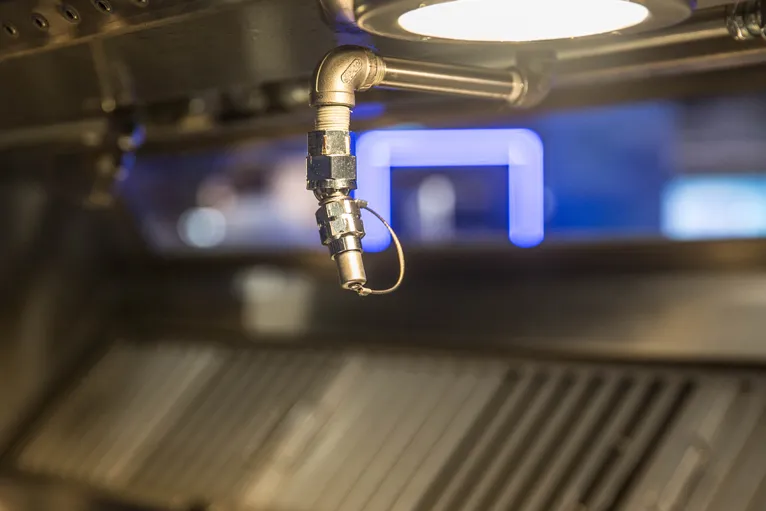
A commercial kitchen’s fire safety comes down to a short list of things done consistently, not one big system doing all the work on its own. The suppression system over the cooking line, its inspection schedule, fresh fusible links, nozzles that still match the equipment underneath them, the Class K extinguisher beside the line, clean filters and a clean plenum, and staff who actually know the pull station all have to hold together at once. Skip one and the others cannot cover for it.
The interval that matters most. NFPA 96 requires the fire suppression system over a commercial cooking line to be inspected at least once every six months, by a licensed technician, whatever the kitchen’s size. The table further down lays out who is responsible for each of the other keys, and how often.
Staff Habits That Prevent a Fire Before It Starts
Most kitchen fires start with something ordinary left unattended, not a faulty system. Cooking oil left on the stove or in the oven should never go unwatched, flammable items like towels and aprons belong away from heat sources, and a timer catches what a busy line cannot. The same habit of paying attention applies to the equipment itself. A frayed cord, a loose connection, or a burner that no longer sits flush are wear signs a walk-through catches early, and catching them early is what keeps ordinary equipment from becoming the fire’s starting point.
The Suppression System Over the Cooking Line Does the Actual Work
The system mounted above a fryer, griddle, or char broiler line is built to do one thing automatically, without anyone in the kitchen reacting fast enough to matter on their own. Heat from a fire melts a fusible link, the system releases its agent onto the cooking surface, and it cuts fuel or power to the appliance at the same moment, so the fire is not still being fed while it is being fought. None of that happens if the system was never designed correctly for the equipment underneath it, or if it has gone long enough without service that a part has quietly stopped working. A kitchen with no suppression system, or one that has quietly stopped working, is relying on a person and a handheld extinguisher to catch a grease fire in its first seconds, which is exactly what the automatic system exists to take out of a staff member’s hands.
How Often Does the System Need to Be Inspected?
At least every six months, by a technician working for a company licensed by the state, never by kitchen staff and never stretched to an annual visit because the kitchen looks clean. NFPA 96 sets that interval and it does not bend for a kitchen that runs light. The visit works through the tank charge, the detection line, the nozzles, and the shutoff, not just a glance at the cylinder. A kitchen running past its inspection date has no current, dated proof the system still works, and that gap is exactly what a fire marshal’s walkthrough or an insurance adjuster’s file review is built to find.
Every 6 months
How often the fire suppression system over a commercial cooking line must be inspected by a licensed technician, whatever the kitchen’s size.
Sourced to NFPA 96, Standard for Ventilation Control and Fire Protection of Commercial Cooking Operations
Why Fusible Links Get Replaced, Not Just Inspected
A fusible link is a one-time part. It holds the system in its ready state until heat reaches its rated melting point, and once it has done that job, or spent years absorbing kitchen heat and grease, it does not go back to being reliable. NFPA 17A is why links are changed on the same six-month cycle as the inspection itself, whether or not the old ones still look fine, and why the replacement has to be rated for the heat of the exact appliance sitting under it. Our own guide to fusible link replacement covers what that swap actually involves and why it gets skipped more often than any other item on the visit.
Keep the Nozzles Matched to What Is Actually Under the Hood
A suppression system is engineered around the specific fryers, griddles, and broilers it was designed to protect, with each nozzle positioned and aimed for that equipment, not a generic pattern over the whole hood. Swap a fryer for a bigger one, add a char broiler where a prep table used to sit, or move an appliance a few inches, and the nozzle coverage that was correct on install day may no longer reach what is actually cooking underneath it. That gap does not show up on a walk-through. It shows up the day the system fires and the agent lands where the old equipment used to be. Any equipment change is a reason to have a licensed technician check and adjust the coverage before the new appliance goes into service, not at the next scheduled visit.
The Class K Extinguisher Beside the Line
A Class K extinguisher is built for cooking oil and grease fires specifically, the kind of fire a water or standard ABC extinguisher can spread instead of putting out. It belongs mounted within reach of the cooking line, not in a back room or an office. NFPA 10 is why it gets a monthly visual check, on top of its own professional service schedule, confirming the gauge still reads full and nothing blocks access to it. Staff should know the PASS sequence. Pull the pin. Aim at the base of the fire. Squeeze the handle. Sweep side to side. And staff should know the extinguisher is the first response, tried before the manual pull station, not instead of it.
Grease Management, on the Filters and Inside the Plenum
Grease is the fuel a kitchen fire feeds on once it starts, and it collects in two places most kitchens do not think about the same way. The hood filters trap grease as it rises off the cooking line, and staff clean or swap those on a routine that matches how hard the kitchen actually cooks, a light-volume kitchen needs it less often than a line running fryers and char broilers all day. The plenum, the enclosed space inside the hood between the filters and the duct opening, catches whatever gets past the filters, and it is not something a kitchen crew can reach with a rag. That is a job for a licensed hood and duct cleaning company, matched to how hard the kitchen cooks rather than a fixed date on the calendar, because a heavy-volume line builds grease inside the duct far faster than a kitchen that runs light. Boss Fire refers hood and duct cleaning to Hood Boss, which handles that side of the system.
The Pull Station Is the One Thing a Staff Member Will Ever Operate
Every other part of the system above is designed to work without a person doing anything. The manual pull station is the one exception, the backup a staff member reaches for if the automatic system does not activate on its own or the fire needs faster help than it is giving. It sits on the path toward the kitchen exit specifically, so reaching it does not mean walking toward the fire, and most kitchens have exactly one, which means most staff have never touched it. Knowing where it is mounted is not the same as knowing what pulling it actually feels like, how much force the rod takes to break, or what happens in the kitchen the moment it fires. Training that only points at the station from across the room leaves staff with information they have never used under pressure. Training that has them actually pull a demonstration unit, once, is what makes the difference between hesitating and acting the one time it matters.
Clear Egress Keeps the Plan Usable
None of the above works if the path to the extinguisher, the pull station, or the door out of the kitchen is blocked by a rolling rack, a stack of boxes, or a chair left in the aisle during a rush. Egress paths around the cooking line have to stay clear during every shift, not just when an inspector is walking through, because the emergency they are built for does not wait for the kitchen to tidy up first.
Who Owns Each Key, and How Often
Everything above works together, and each piece has a different owner and a different clock. This is the same list laid out by who is responsible and how often it gets done.
| Key | Who is responsible | How often |
|---|---|---|
| Suppression system inspection | Licensed fire suppression technician | At least every six months (NFPA 96) |
| Fusible link replacement | Licensed fire suppression technician | Every six months (NFPA 17A), same visit as the inspection |
| Nozzle-to-appliance match | Licensed fire suppression technician | At each inspection, and any time equipment changes |
| Class K extinguisher | Kitchen staff or manager, with professional service on its own schedule | Monthly visual check (NFPA 10) |
| Hood filters | Kitchen staff | On a routine matched to cooking volume |
| Hood and duct interior | Hood Boss or a licensed hood cleaning partner | Matched to cooking volume, not a fixed date |
| Manual pull station | Kitchen staff, trained and practiced | Confirmed at onboarding and after any layout change |
| Egress paths | Kitchen staff and management | Kept clear every shift |
What Boss Fire Protection Does About It
Boss Fire Protection installs, inspects, and services the suppression systems behind every key above across Dallas-Fort Worth, replacing fusible links and checking nozzle coverage against whatever is actually cooking under the hood that day, not what the original design drawing assumed. When a kitchen changes equipment, that is a reason to call before the new appliance goes into service, not after the next scheduled visit finds the gap.
Sourced from NFPA 96, Standard for Ventilation Control and Fire Protection of Commercial Cooking Operations (nfpa.org), and NFPA 17A, Standard for Wet Chemical Extinguishing Systems (nfpa.org). And NFPA 10, Standard for Portable Fire Extinguishers (nfpa.org).
Put a Licensed Fire Protection Team on Your Side
Inspections, service, red-tag repair, and new installs for commercial kitchens across Dallas-Fort Worth. Photo-documented work and a written report, every visit.

Jeff Ralston is the President of Boss Fire Protection, a Texas-licensed fire suppression company (License ECR-2481913) based in Dallas. He leads a team with over 40 years of combined experience inspecting, servicing, and installing commercial kitchen fire suppression systems and fire extinguishers across Dallas-Fort Worth.
Meet the Boss Fire team →