
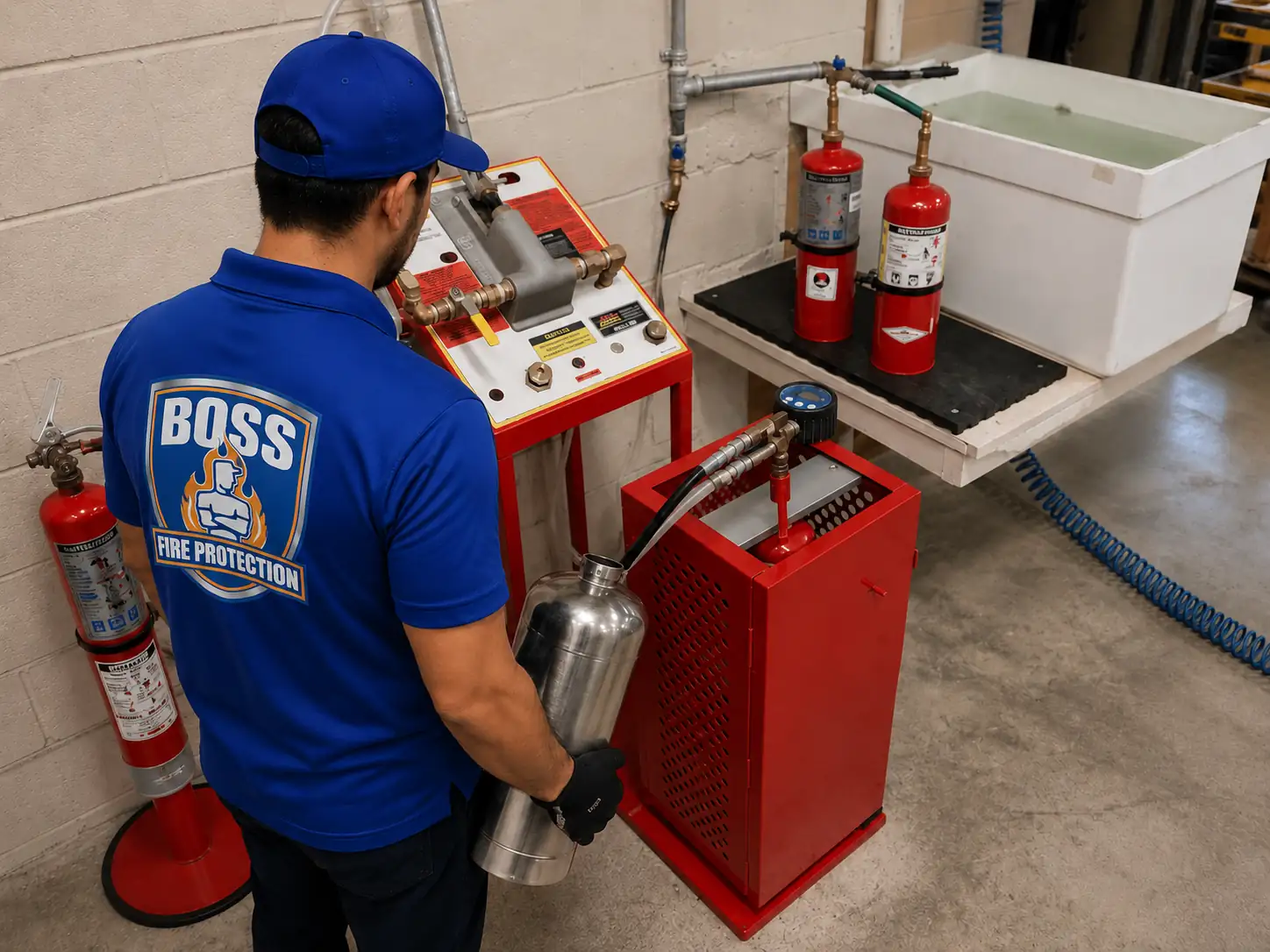
A refillable fire extinguisher has no expiration date. It stays in service for as long as it keeps passing its monthly check, its yearly maintenance and its pressure tests, and it comes out of service when it fails one of them, reaches a date the standard sets, or can no longer be serviced. Disposable extinguishers are different, with a hard limit of 12 years from the date they were made. Boss Fire Protection’s fire extinguisher service reads those dates on every unit it services across Dallas-Fort Worth.
- Refillable units have no fixed expiry, only tests they must keep passing
- Disposable units come out of service 12 years after manufacture
- Pressure tests fall every 5 or 12 years, depending on the type
- Some old designs must be removed whatever their condition
Do Fire Extinguishers Expire?
Refillable fire extinguishers do not expire on a set date. NFPA 10, the national standard for portable extinguishers, keeps them in service while they pass inspection, maintenance and hydrostatic testing. Disposable extinguishers do have a limit, and NFPA 10 removes them from service no more than 12 years after the date of manufacture.
The gauge being in the green is not the whole story. An extinguisher can hold pressure and still be overdue for a test, damaged, or one of the designs the standard no longer allows. The standard’s own text is on the NFPA 10 standard page, and NFPA 10 in plain words sets out what it asks of a business. Texas enforces the 2018 edition, listed in the Texas Department of Insurance rule adopting the NFPA standards.
How Long Does a Fire Extinguisher Last?
A well-kept refillable extinguisher can stay in service for decades, as long as it keeps passing its checks and tests. A disposable one lasts at most 12 years from manufacture. Either kind comes out of service sooner if it is damaged, used, fails a pressure test, or can no longer be serviced to its manual.
What decides the life of a refillable unit is the cycle of checks below. Each one is a point where it either carries on or comes out.
| Check | How often | What it can find |
|---|---|---|
| Visual inspection | Every month | Low pressure, a broken seal, damage or a missing unit |
| Maintenance | Every year | Worn parts, a blocked hose, a label or date coming due |
| Internal examination | Every 6 years, on most ABC units | Caked or wet agent, corrosion inside the shell |
| Hydrostatic test | Every 5 or 12 years, by type | A shell too weak to hold pressure safely |
The monthly check is the one a business does itself, and monthly fire extinguisher inspections shows how to do it in a few minutes per unit.
How Long Do Disposable Fire Extinguishers Last?
A disposable, or nonrechargeable, extinguisher must come out of service no more than 12 years after the date of manufacture. NFPA 10 does not require it to have the 6-year internal examination or a hydrostatic test. It is retired instead, and any disposable unit that has been used or found damaged comes out at once.
You can tell a disposable extinguisher by its label, which carries wording such as “Discharge and Dispose of After Any Use.” Some extinguishers that could physically be refilled are still labelled nonrechargeable, and NFPA 10 treats them as disposable. The manufacture date is printed on the label or stamped on the cylinder.
12 years
The longest a nonrechargeable fire extinguisher may stay in service, counted from its date of manufacture, under NFPA 10.
Sourced to NFPA 10, Standard for Portable Fire Extinguishers
Which Old Extinguishers Must Be Replaced Whatever Their Condition
NFPA 10 lists designs that are obsolete and must be removed from service even if they look and test fine. The ones a technician still finds in Dallas-Fort Worth buildings include these.
- Old dry chemical units. Stored-pressure dry chemical extinguishers with a manufacturing date of 1984 or earlier, apart from wheeled units.
- Anything made before 1955. Whatever the type.
- Units that must be turned upside down to work. Along with the old soda acid and chemical foam types.
- Low B ratings. Any extinguisher rated 4-B, 6-B, 8-B, 12-B or 16-B.
- Unserviceable units. Any extinguisher that can no longer be serviced to its manufacturer’s maintenance manual, often because parts are no longer made.
What Happens When an Extinguisher Fails a Hydrostatic Test?
It is condemned. NFPA 10 requires a shell that fails a hydrostatic test, or fails the visual examination before it, to be condemned or destroyed by the owner or the owner’s agent. The retester tells the owner in writing, the cylinder is stamped CONDEMNED, and it may not be repaired or put back in service.
An extinguisher with an aluminum cylinder or shell that may have been exposed to temperatures over 350°F, for example in a nearby fire or a paint oven, must also be taken out of service and hydrostatically tested before it is trusted again.
Does an Extinguisher Need Replacing After It Is Used?
A refillable extinguisher needs recharging, not replacing. NFPA 10 requires every rechargeable extinguisher to be recharged after any use, even a short squeeze, because the standard does not allow a partly discharged unit to stay in service. A disposable extinguisher is finished once it has been used and must be taken out of service.
Disposing of a retired unit safely is its own subject, covered in how to dispose of an old fire extinguisher in Dallas-Fort Worth.
Reading the Dates on Your Extinguishers
Every extinguisher a business owns carries the dates that decide its life. The manufacture date is on the label or stamped on the cylinder. The yearly maintenance tag records the month, the year, who did the work and for which company. A 6-year internal examination leaves its own label, and a hydrostatic test leaves a label or a stamp with the test date. At each yearly visit, Boss Fire Protection’s technicians read all of them, flag the units coming due in the next year, and explain which can be serviced and which have reached the end, before anything is replaced.
Sources: NFPA 10, Standard for Portable Fire Extinguishers (National Fire Protection Association), on obsolete extinguishers, the monthly inspection, annual maintenance and tags, the 6-year internal examination, the 12-year limit for nonrechargeable extinguishers, recharging after use, hydrostatic testing, exposure of aluminum shells above 350°F and condemning cylinders. Texas Department of Insurance, State Fire Marshal’s Office, adopted rule listing NFPA 10, 2018 edition (2023).
Put a Licensed Fire Protection Team on Your Side
Inspections, service, red-tag repair, and new installs for commercial kitchens across Dallas-Fort Worth. Photo-documented work and a written report, every visit.
