
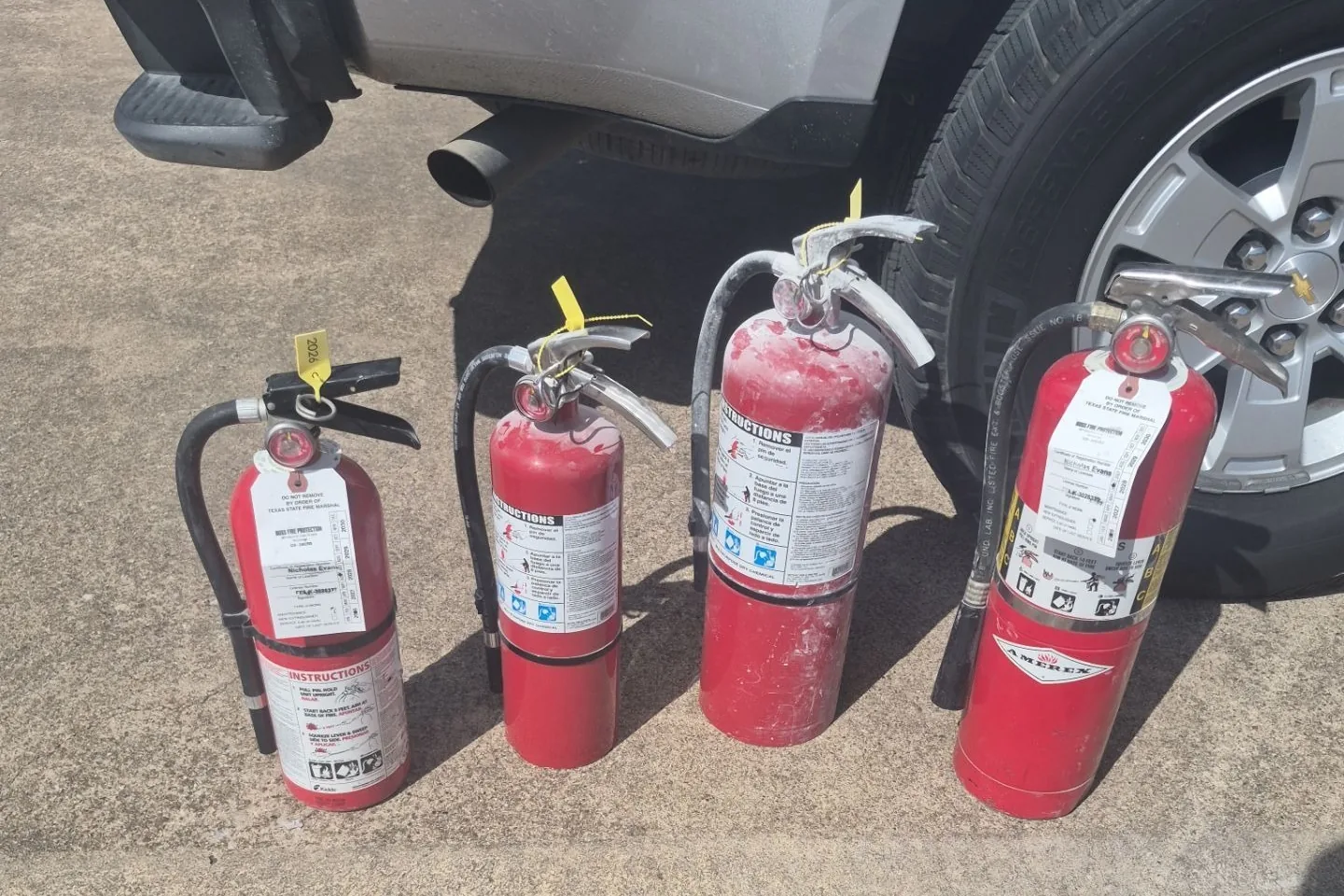
A business should not put an old fire extinguisher in the trash or the recycling bin while it still holds pressure or agent, and the household chemical drop-off centers run by Fort Worth and Dallas County are for residents, not businesses. The safe route is to have a fire extinguisher service company empty it, recover any agent that must not be released, and dispose of the shell. Before that, check whether it needs to go at all, because a refillable unit can often be serviced instead. Boss Fire Protection’s fire extinguisher service handles both decisions on site.
- A charged extinguisher is a pressure vessel, never ordinary trash
- Fort Worth’s household waste center does not take business waste
- Halon units must never be discharged, only returned for recovery
- A condemned cylinder may never be repaired or reused
How Do You Dispose of an Old Fire Extinguisher?
Hand it to a fire extinguisher service company. It confirms the unit really is finished, empties it safely, recovers any halon agent, and disposes of the empty shell. Do not throw a charged extinguisher in a dumpster, and do not discharge a halon unit. A business cannot use the Fort Worth or Dallas County household chemical drop-off centers.
The reason for the care is pressure. A typical stored-pressure ABC extinguisher works at about 195 pounds per square inch, and a charged cylinder crushed in a compactor or a garbage truck can release that pressure, and its powder, all at once.
195 psi
The nominal operating pressure of the stored-pressure ABC dry chemical extinguishers in one manufacturer’s range, from the smallest to the 20 pound model.
Sourced to the Amerex portable fire extinguisher catalog, ABC dry chemical specifications
Does It Need to Be Thrown Away at All?
Often not. A refillable extinguisher with no expiry date stays in service while it passes its checks, and one that has been used only needs recharging. It needs to go when it is disposable and has reached 12 years, has failed a pressure test, is an obsolete design, or can no longer be serviced to its manual.
The full list of reasons, and how to read the dates on the label, is in do fire extinguishers expire. Ask before you replace a whole row of extinguishers that only needed servicing.
Can a Business Use the City Drop-Off Center?
No. The household hazardous waste centers run by Fort Worth and Dallas County are for residents. The City of Fort Worth states that its Environmental Collection Center accepts residential waste only, and that commercial, business or industrial waste cannot be accepted under Texas regulations. Dallas County’s home chemical collection center is likewise a service for residents of its member cities.
An extinguisher a restaurant, office or warehouse retires is business waste, so it goes back through the trade, either to a fire extinguisher service company or to the manufacturer.
How Each Kind of Extinguisher Is Retired
NFPA 10, the national standard for portable extinguishers, sets out what happens to a unit when it comes out of service, and it depends on the kind. Which kind you have is on the label, and the guide to fire extinguisher classes, types and uses explains each one.
| Kind of extinguisher | What NFPA 10 says | What that means for you |
|---|---|---|
| Disposable dry chemical | Removed, discharged and destroyed at the owner’s direction, or returned to the maker | Hand it to a service company to empty and dispose of |
| Disposable halon | Not discharged, returned to the maker, a fire equipment dealer or a distributor | Never squeeze it out, the halon has to be recovered |
| Refillable halon | Agent removed only with a listed closed recovery system | A job for a service company with that equipment |
| Condemned cylinder | Stamped CONDEMNED, never repaired, destroyed by or for the owner | It cannot be sold on or put back on a wall |
The standard’s own text is on the NFPA 10 standard page.
The Trouble With Emptying It Yourself
Squeezing out a dry chemical extinguisher in the car park fills the air with fine powder that settles on everything nearby, and it still leaves you with a cylinder to get rid of. For a halon unit it is simply not allowed. A service company empties units with the right equipment, in one place, and confirms each one holds no pressure before it leaves for disposal.
Keep a Record of What Left the Building
NFPA 10 recommends keeping a record of cylinders and extinguishers recommended for destruction. For a business it also closes the loop at the next fire inspection, because the inspector sees which units were removed, why, and what replaced them. At a Boss Fire Protection service visit, the technician explains why each unit should be retired and which type and size should replace it, before any change is made.
Sources: NFPA 10, Standard for Portable Fire Extinguishers (National Fire Protection Association), on removing and destroying nonrechargeable extinguishers, returning halon units for recovery, the listed closed recovery system for halon, and condemning and recording cylinders. City of Fort Worth, Environmental Collection Center, on residential waste only. Dallas County, Household Hazardous Waste program, on service for residents of member cities. Amerex Corporation, Portable Fire Extinguisher Catalog, ABC dry chemical specifications.
Put a Licensed Fire Protection Team on Your Side
Inspections, service, red-tag repair, and new installs for commercial kitchens across Dallas-Fort Worth. Photo-documented work and a written report, every visit.
