
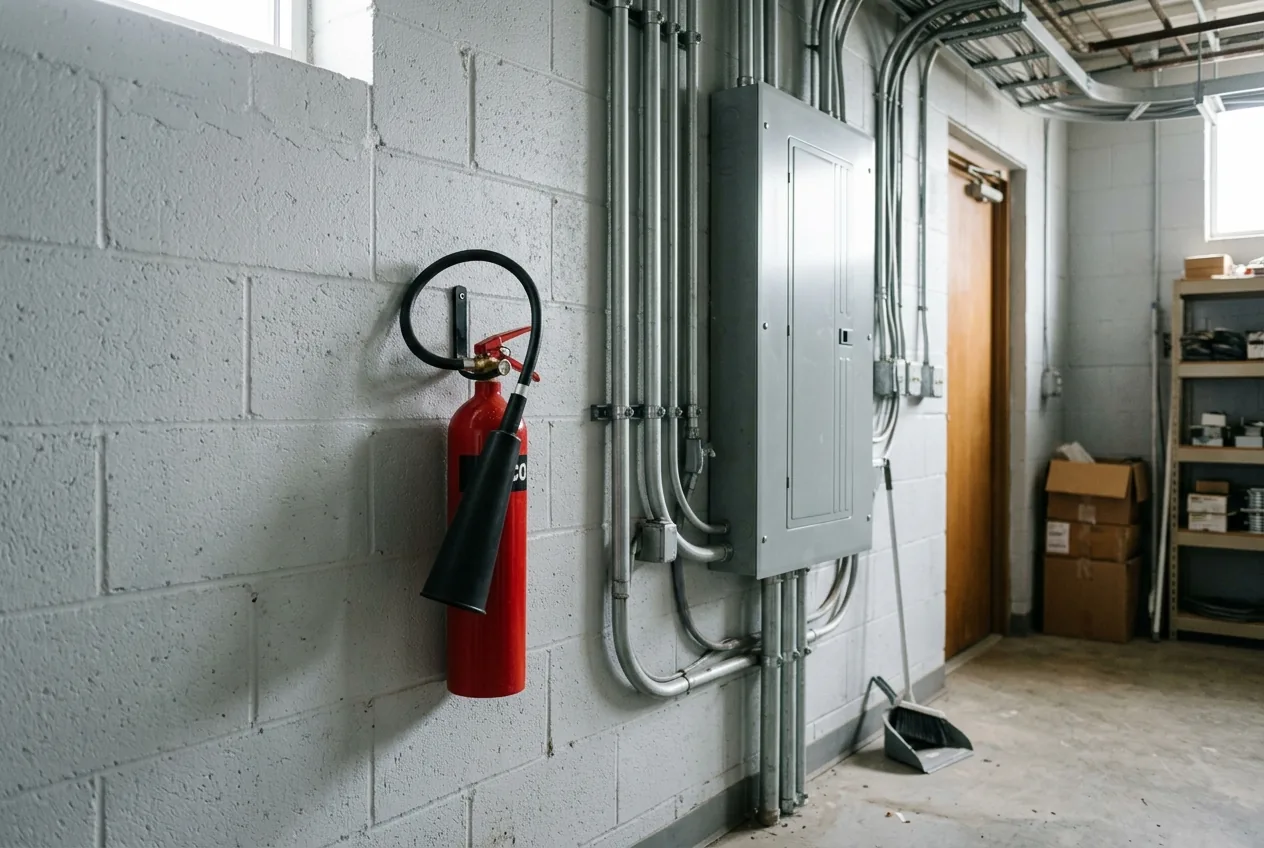
The right fire extinguisher for an electrical fire is one with a C on its label, which means it has been tested not to carry electricity back to the person using it. For most businesses that is an ABC dry chemical extinguisher, and for server rooms, electrical rooms and anywhere the equipment matters, a carbon dioxide or clean agent extinguisher that leaves no residue. Boss Fire Protection supplies, inspects and places commercial fire extinguishers rated for electrical hazards across Dallas-Fort Worth.
- Class C means energized electrical equipment
- Look for the letter C or the plug symbol on the label
- Carbon dioxide and clean agent units leave nothing on the equipment
- Never a plain water extinguisher on live equipment
What Does the C on a Fire Extinguisher Label Mean?
The C on a fire extinguisher label means the extinguisher has been tested on fires in energized electrical equipment, and its agent will not conduct electricity back to the person holding it. A C rating carries no number, because it is a pass or fail conductivity test, not a measure of size.
Fires are sorted into five classes by the fuel that is burning, and Class C is the one defined by electricity rather than by a material. Once the power is cut, an electrical fire becomes an ordinary Class A fire in the plastic and wiring, or a Class B fire if oil is involved. The full list of classes and the extinguishers rated for each is in our guide to fire extinguisher classes, types and uses.
Which Extinguishers Are Rated for Electrical Fires
| Extinguisher | Typical rating | Leaves residue | Best place for it |
|---|---|---|---|
| ABC dry chemical | A, B and C | Yes, a fine powder that is corrosive to electronics | General areas, offices, warehouses |
| Carbon dioxide | B and C | No | Electrical rooms, mechanical rooms, labs |
| Clean agent | B and C, larger units also A | No | Server rooms, network closets, control rooms |
| Water mist | A and C, using deionized water | Only clean water | Places where powder is unwelcome and the fire is mostly Class A |
| Plain water | A only | Water | Never on live electrical equipment |
Can You Use a Water Extinguisher on an Electrical Fire?
No, not a plain water extinguisher. Ordinary water conducts electricity, so a stream aimed at a live panel or appliance can carry current back to the person holding the extinguisher. The one water-based exception is a water mist extinguisher made with deionized water and labelled with a C, which has passed the conductivity test.
The same caution covers the Class K extinguisher in a kitchen. It is made for cooking oil, carries no C rating, and is the wrong unit for a burning mixer or a shorted outlet on the cook line.
Is CO2 or Dry Chemical Better for an Electrical Fire?
Both put out an electrical fire, so the choice depends on what is around it. Dry chemical is the better all-round unit for a general area because it also covers ordinary combustibles. Carbon dioxide is better beside sensitive equipment because it leaves no powder behind, while dry chemical residue can corrode circuit boards and connectors long after the fire.
This is where most advice goes wrong for a business. An ABC unit hung in a server closet will put a small fire out and then do more damage to the surrounding equipment than the fire did, because the powder gets into every fan and connector in the room. A carbon dioxide or clean agent extinguisher costs more to buy and protects the equipment it is there for. Carbon dioxide does have limits. It displaces oxygen in a small room, it carries no A rating, so smouldering cable insulation can relight, and the horn gets cold enough to hurt bare hands. For a room full of servers, a fixed system is the stronger answer, explained in clean agent fire suppression, how it protects rooms water would ruin.
How Many Electrical Fires Do U.S. Businesses Have?
Fire departments responded to an estimated average of 16,930 fires a year in U.S. properties other than homes that involved electrical distribution and lighting equipment, from 2012 to 2016, according to the National Fire Protection Association. Wiring and related equipment was involved in about half or more of them.
16,930
The estimated average number of fires a year, from 2012 to 2016, in U.S. properties other than homes that involved electrical distribution and lighting equipment.
Sourced to the National Fire Protection Association, Non-Home Electrical Fires
Where Electrical Fire Extinguishers Go
There is no separate distance rule for Class C hazards. OSHA’s portable extinguisher rule says extinguishers for Class C hazards are placed on the same pattern as the Class A or Class B extinguishers around them, so in practice the job is choosing the right unit for each spot rather than adding more. Put the carbon dioxide or clean agent unit at the door of the electrical room or server room, outside the hazard, so nobody has to walk past the fire to reach it. And the first step in any electrical fire, if it can be done safely, is to cut the power at the breaker or the disconnect. Battery charging areas need different advice, set out in lithium-ion battery fires and the extinguisher to keep near them.
How Boss Fire Equips Dallas-Fort Worth Electrical Rooms
A Boss Fire Protection technician walks the building, marks every electrical room, server closet and panel area, and recommends the extinguisher each one should have, then inspects and tags them on the annual schedule. Where an ABC unit is hanging beside equipment it would damage, we say so and offer the alternative.
Sources: National Fire Protection Association, Non-Home Electrical Fires (June 2019). OSHA, 29 CFR 1910.157, Portable Fire Extinguishers. NFPA 10, Standard for Portable Fire Extinguishers.
Put a Licensed Fire Protection Team on Your Side
Inspections, service, red-tag repair, and new installs for commercial kitchens across Dallas-Fort Worth. Photo-documented work and a written report, every visit.
