
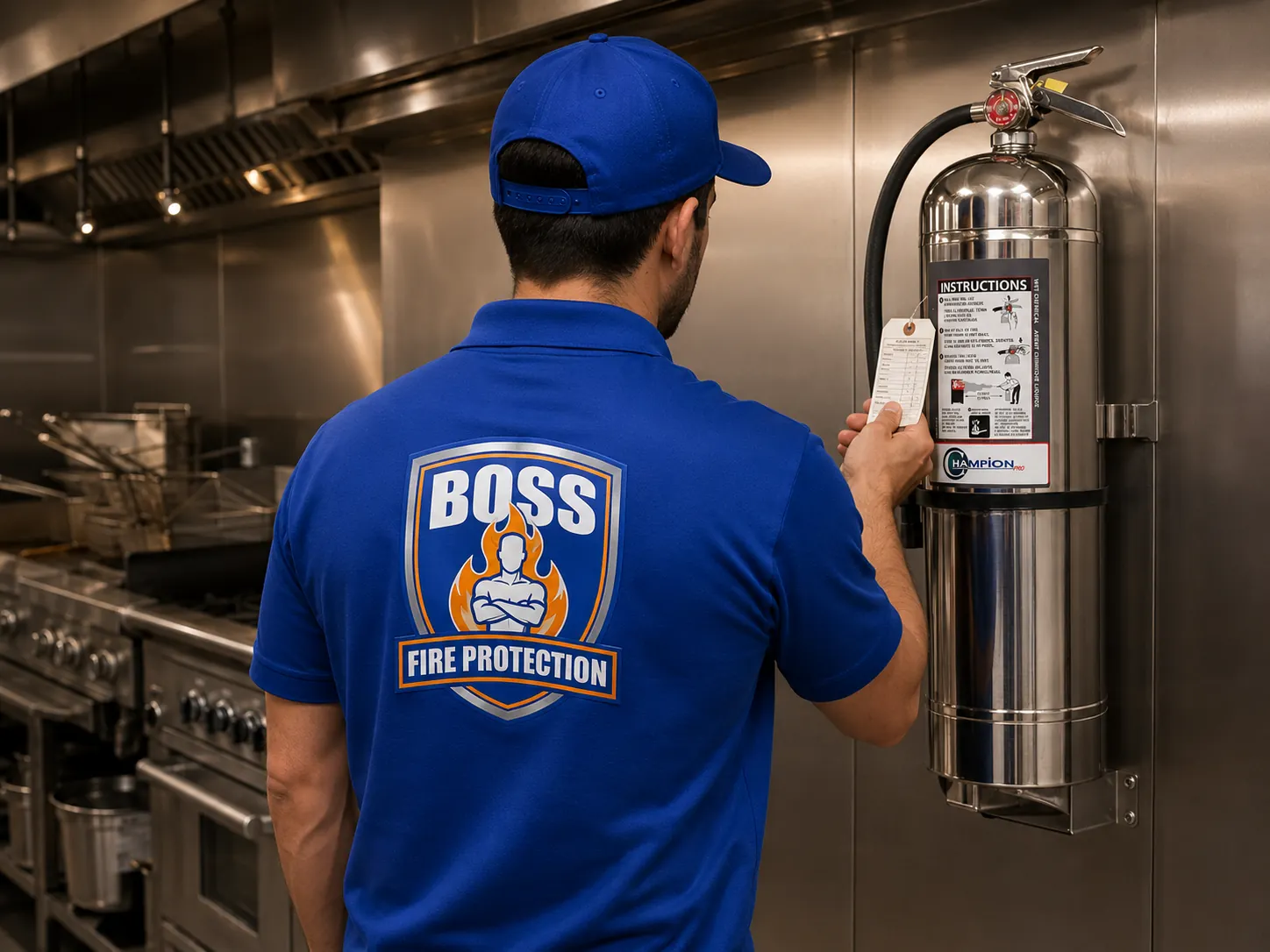
The string of numbers and letters on a fire extinguisher label, such as 2-A:10-B:C, tells you two things. The letters say which classes of fire it has been tested on, and the numbers in front of A and B say how big a test fire it put out. Reading it is the quickest way to know whether the extinguishers on your walls are big enough, and checking it is part of the commercial fire extinguisher service Boss Fire Protection provides in Dallas-Fort Worth.
- Each letter is a class of fire the extinguisher was tested on
- The number before A or B is its relative extinguishing effectiveness
- C, D and K carry no number at all
- One 2-A unit covers up to 3,000 square feet in an ordinary hazard area
How Do You Read a Fire Extinguisher Rating?
In a rating like 3-A:40-B:C, the 3-A is the score on ordinary combustibles, the 40-B the score on flammable liquids, and the C says it is safe on energized electrical equipment. Higher numbers mean it put out larger test fires, so a 3-A unit outperforms a 2-A one on wood and paper.
The ratings come from UL 711, the fire test standard for extinguishers. NFPA 10 explains the format with the example 1-A:5-B:C, a Class A fire size of 1, a Class B fire size of 5, and a Class C rating. Under NFPA 10, an extinguisher with more than one letter may be counted toward the requirements of each class it carries.
The Letters, Class by Class
| Letter | The fire it covers | Number in front? |
|---|---|---|
| A | Ordinary combustibles such as wood, cloth, paper, rubber and many plastics | Yes |
| B | Flammable liquids, combustible liquids and flammable gases | Yes |
| C | Energized electrical equipment | No |
| D | Combustible metals such as magnesium, titanium and sodium | No |
| K | Cooking appliances using vegetable or animal oils and fats | No |
NFPA 10 requires a number only before A and B. The C says the extinguisher is listed for use on energized electrical equipment, and NFPA 10 advises cutting the power to that equipment as soon as possible to prevent the fire reigniting. A D or K extinguisher is listed for its specific hazard instead. The full run of extinguisher types behind these letters is in our guide to fire extinguisher classes, types and uses.
What the Number in Front Means
NFPA 10 calls the number the extinguisher’s relative extinguishing effectiveness. It is set by the size of the test fire the model put out. The Class A test fires are built from ordinary combustibles, and the Class B test fires are flammable liquid burning in square pans.
That second point matters in a kitchen. NFPA 10 notes that the liquid in a Class B test pan is not in motion and has nothing in it to block the agent, which is a long way from a deep fryer full of hot oil. A high B number does not make an extinguisher right for cooking oil, and that is a Class K job.
3,000 sq ft
The floor area one 2-A rated extinguisher protects in an ordinary hazard occupancy under NFPA 10, doubling to 6,000 square feet in a light hazard occupancy, always within a 75-foot walk.
Sourced to NFPA 10, Standard for Portable Fire Extinguishers
How the Rating Decides How Many You Need
The A number decides how much floor each extinguisher can cover, and the walking distance decides where it goes. NFPA 10’s smallest acceptable single extinguisher is 2-A in light and ordinary hazard areas and 4-A in extra hazard areas. OSHA’s portable fire extinguisher rule sets the same kind of limits for the workplace, with no more than 75 feet of travel to an extinguisher for Class A fires and no more than 50 feet from a Class B hazard.
So a higher A rating can mean fewer units in a big open space, but never a longer walk. How capacity in pounds relates to these ratings is covered in fire extinguisher sizes and how to choose one.
Why Doesn’t a Class K Extinguisher Show a Number?
NFPA 10 requires a number only before A and B. A Class K extinguisher is listed for fires in cooking oils and fats, so the letter is enough. In a kitchen it backs up the hood suppression system, and NFPA 96 requires a placard beside it saying to activate that system first.
Why every commercial kitchen needs one is explained in why a Class K fire extinguisher is mandatory in a commercial kitchen.
Everything Else on the Label
- The listing mark. NFPA 10 requires every extinguisher used to meet the standard to be listed and labeled to UL 711. An unlisted unit does not meet the standard.
- Operating instructions. They must face outward when the extinguisher is mounted. Maintenance, hydrostatic test and hazardous material labels may not be stuck over the front.
- Temperature range. Manufacturers print the range the unit is listed for. Amerex’s catalog, for example, lists ranges as narrow as 40°F to 120°F on some water models and as wide as -65°F to 120°F on others, which matters for an unheated warehouse or a loading dock.
- Date of manufacture. NFPA 10 removes stored-pressure dry chemical extinguishers made in 1984 or earlier from service, and the date also starts the clock on the 6-year and hydrostatic test intervals.
Checking the Ratings on Your Walls in Dallas-Fort Worth
Boss Fire Protection can check that every extinguisher carries the right class for the area it guards, that the ratings add up to the floor area, and that no walk to the nearest unit is too long. If you have moved walls, added a kitchen line or taken on more floor space since your last inspection, ask us to check the ratings before the fire marshal does.
Sources: NFPA 10, Standard for Portable Fire Extinguishers (National Fire Protection Association), on the fire classes, the classification letters and the number before A and B, the 1-A:5-B:C example, multiple letter classifications, listing and labeling to UL 711, the Class B test pans, the minimum single extinguisher ratings, coverage of 3,000 and 6,000 square feet per 2-A unit, the 75-foot travel distance, label placement and the 1984 removal date. OSHA 29 CFR 1910.157, Portable Fire Extinguishers, on travel distances of 75 feet for Class A and 50 feet for Class B. NFPA 96, on the placard beside a Class K extinguisher. Amerex portable fire extinguisher catalog, on listed temperature ranges.
Put a Licensed Fire Protection Team on Your Side
Inspections, service, red-tag repair, and new installs for commercial kitchens across Dallas-Fort Worth. Photo-documented work and a written report, every visit.
