
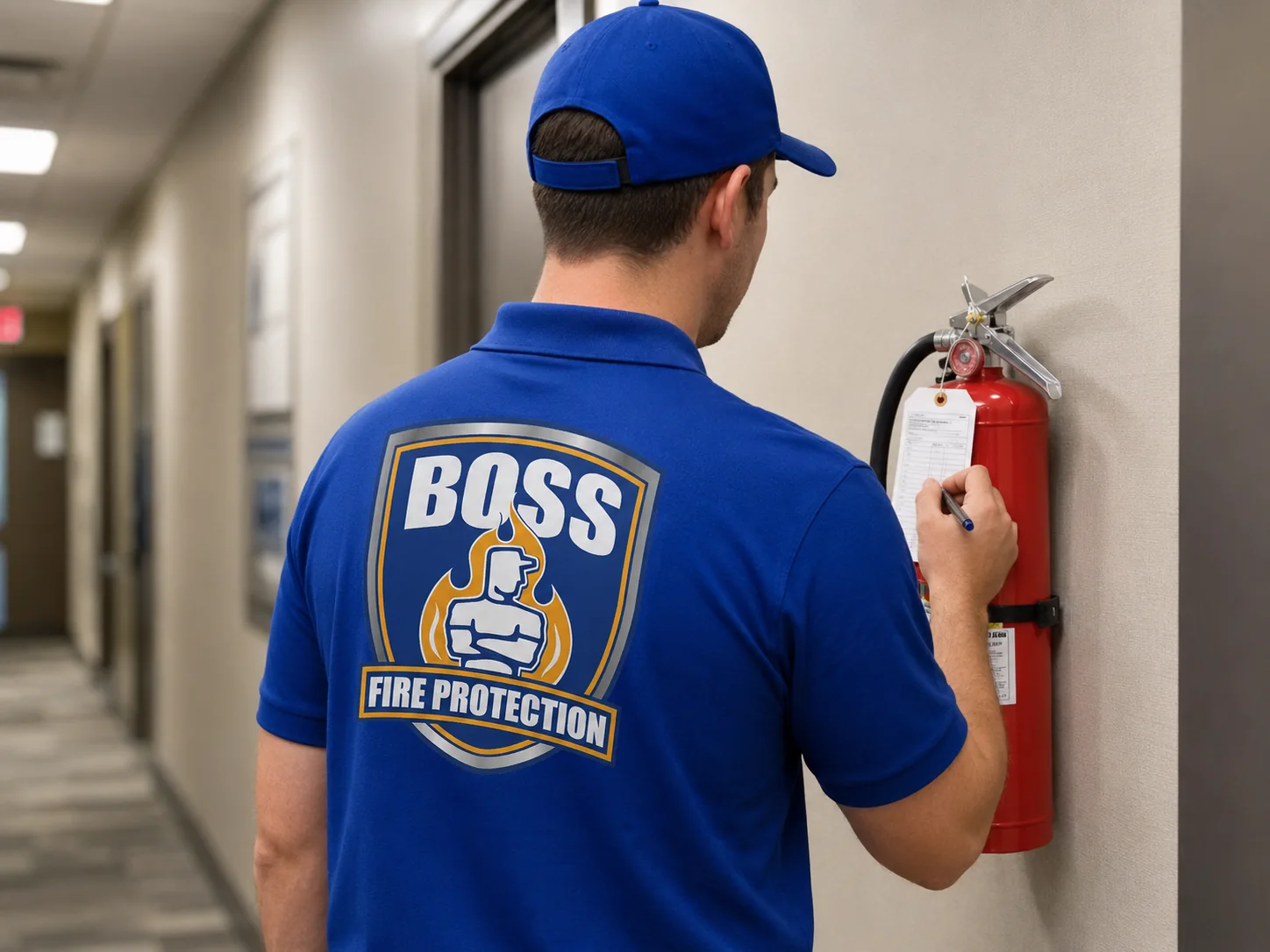
The pound figure on a fire extinguisher is the weight of agent inside it, but the fire code does not count pounds. It counts the rating on the label, such as 2-A:10-B:C or 4-A:80-B:C, which says how big a fire the extinguisher was tested against. A 5 pound ABC unit suits offices, shops and dining rooms, while a 10 pound unit covers more floor, reaches farther and meets the stricter rules for workshops, vehicle repair shops and cooking areas. Boss Fire Protection’s fire extinguisher service sizes each one to the room it guards across Dallas-Fort Worth.
- The code counts the rating on the label, not the weight
- No one should walk more than 75 feet to a Class A extinguisher
- Higher hazard rooms need a higher rating, often a 10 pound unit
- Kitchens also need a Class K within 30 feet of the cooking
What Do Fire Extinguisher Sizes Mean?
The size, such as 5 pound or 10 pound, is the weight of extinguishing agent in the cylinder. The rating on the label is what matters for the code. In 4-A:80-B:C, the 4-A measures its power on ordinary combustibles, the 80-B its power on flammable liquids, and the C shows it is safe on live electrical equipment.
Two extinguishers of the same weight can carry different ratings. In one manufacturer’s range of ABC dry chemical extinguishers, two 5 pound models carry different ratings, as the table shows. How to read each part of a rating is explained in what the numbers on a fire extinguisher label mean.
| Agent weight | Rating on the label | Initial range | Discharge time |
|---|---|---|---|
| 5 pound, basic model | 2-A:10-B:C | 12 to 18 feet | About 14 seconds |
| 5 pound, higher rated model | 3-A:40-B:C | 12 to 18 feet | About 14 seconds |
| 10 pound | 4-A:80-B:C | 15 to 21 feet | About 22 seconds |
The figures are from the Amerex portable fire extinguisher catalog. Other makers’ models differ, so read the label on the unit itself. What each letter class covers is explained in the guide to fire extinguisher classes, types and uses.
How NFPA 10 Sizes an Extinguisher to the Room
NFPA 10, the national standard for portable extinguishers, sorts every area into one of three hazard levels and sets a minimum rating for each. Its own examples of each level are these.
- Light hazard. Offices, classrooms, churches, assembly halls and hotel guest rooms, with little to burn and under a gallon of flammable liquid in any room.
- Ordinary hazard. Dining areas, shops and their storage, light manufacturing, auto showrooms, parking garages and many warehouses.
- Extra hazard. Woodworking, vehicle repair, aircraft and boat servicing, cooking areas, and anywhere flammable liquids are handled in quantity.
| Hazard level | Class A minimum | Floor area per unit of A | Class B minimum, by travel distance |
|---|---|---|---|
| Light | 2-A | 3,000 square feet | 5-B within 30 feet, or 10-B within 50 feet |
| Ordinary | 2-A | 1,500 square feet | 10-B within 30 feet, or 20-B within 50 feet |
| Extra | 4-A | 1,000 square feet | 40-B within 30 feet, or 80-B within 50 feet |
On top of the rating, nobody may have to walk more than 75 feet to reach a Class A extinguisher, and no single extinguisher may be counted for more than 11,250 square feet. The tables are in the standard itself, on the NFPA 10 standard page, and how the rest of it applies to a business is in NFPA 10 in plain words.
4-A
The smallest Class A rating NFPA 10 accepts from a single extinguisher in an extra hazard area, which NFPA 10’s examples say includes a cooking area or a vehicle repair bay, more than the 5 pound units in the table above carry.
Sourced to NFPA 10, Standard for Portable Fire Extinguishers, Table 6.2.1.1
Is a 5 Pound or a 10 Pound Fire Extinguisher Better?
Neither is better everywhere. A 5 pound ABC unit rated 2-A:10-B:C meets NFPA 10’s minimum for offices, shops and dining rooms. A 10 pound unit rated 4-A:80-B:C meets the minimum for every hazard level, covers more floor per unit, and sprays longer, but it is heavier to lift and carry.
A higher rated extinguisher can stand in for a lower one, as long as the travel distance still works, so many businesses standardize on one size throughout. A 10 pound unit is the safer choice wherever a room might later become a workshop, a store room for flammable liquids, or a vehicle repair bay.
Where Each Size Belongs in a Typical Business
- Offices, reception and corridors. A 5 pound 2-A:10-B:C unit usually meets the minimum, placed so that no one walks more than 75 feet to reach one.
- Dining rooms and retail floors. A 5 pound unit meets the Class A minimum, but each 2-A unit counts for only 3,000 square feet, so a large floor may need more units or larger ones.
- Workshops and vehicle repair bays. Extra hazard, so 4-A or better, which in practice means a 10 pound unit, and 40-B within 30 feet or 80-B within 50 feet.
- Vehicles and tight spaces. Smaller units fit, but they may be rated too low to count toward the building’s requirement. A 2.5 pound unit rated 1-A:10-B:C, for example, falls below the 2-A minimum.
What Size Extinguisher Does a Commercial Kitchen Need?
Two kinds. NFPA 10’s own examples put cooking areas in the extra hazard class, so a kitchen’s general extinguisher needs at least a 4-A rating, usually a 10 pound ABC unit. Separately, NFPA 10 requires a Class K extinguisher wherever cooking oils and fats could burn, within 30 feet of the cooking hazard.
Why the Class K is required, and where it goes, is explained in K-Class fire extinguishers in commercial kitchens.
Sizing a Building in Dallas-Fort Worth
At a survey or a yearly service, Boss Fire Protection’s technicians classify each area, check the rating and travel distance for every unit, and point out any extinguisher too small for the room it is in, with the reason, before anything is changed or added.
Sources: NFPA 10, Standard for Portable Fire Extinguishers (National Fire Protection Association), on hazard classification and its annex examples, Table 6.2.1.1 for Class A hazards, Table 6.3.1.1 for Class B hazards, and the 75 foot travel distance. Amerex Corporation, Portable Fire Extinguisher Catalog, ABC dry chemical specifications for models B500, B402 and B456.
Put a Licensed Fire Protection Team on Your Side
Inspections, service, red-tag repair, and new installs for commercial kitchens across Dallas-Fort Worth. Photo-documented work and a written report, every visit.
