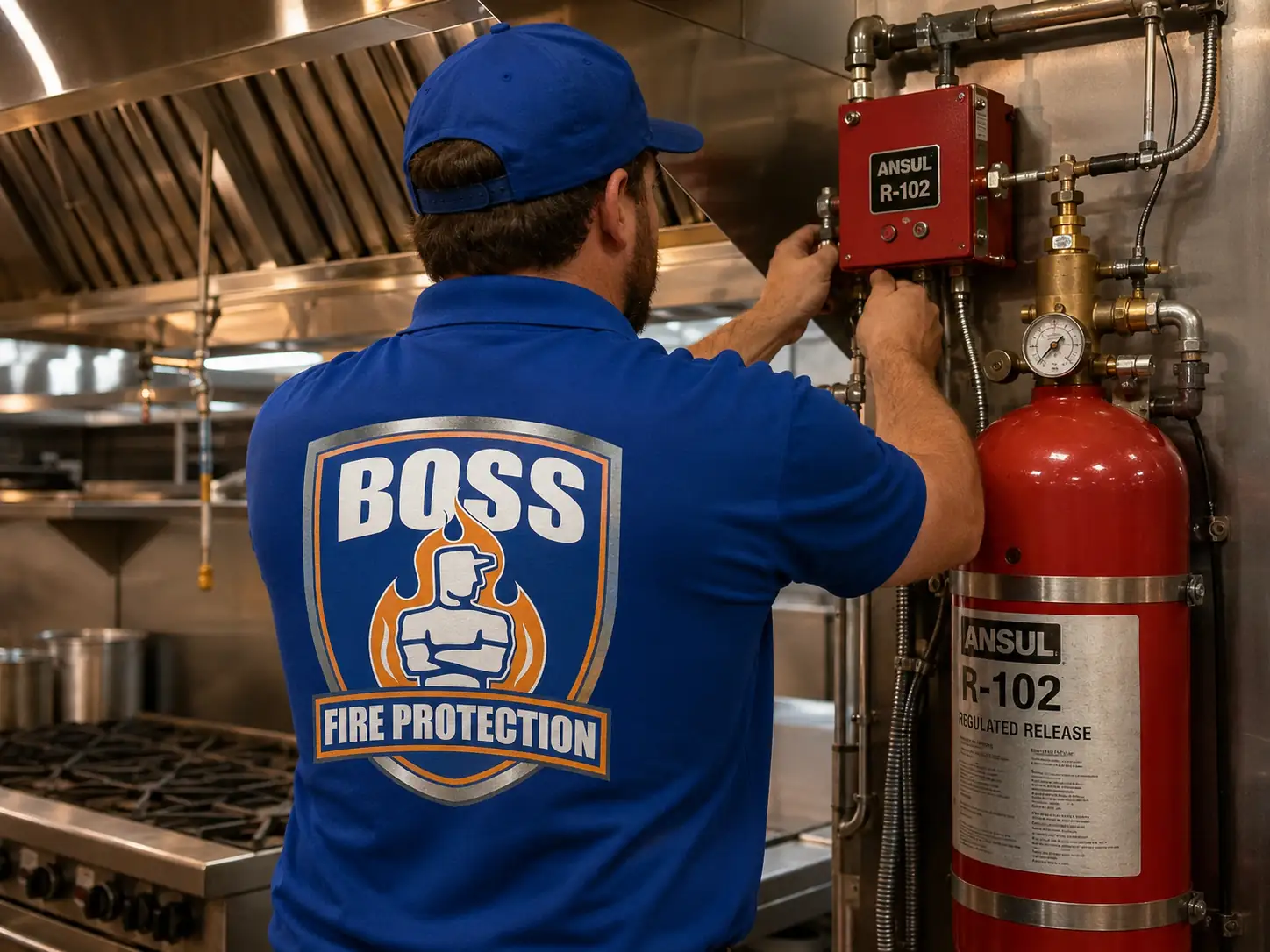
Before a new restaurant in Dallas-Fort Worth can cook for customers, its kitchen hood suppression system has to be designed, permitted, installed and then tested in front of the city fire marshal. That acceptance test, along with the fire alarm connection and the Class K extinguisher, is the fire inspection most new owners mean when they ask what stands between them and opening day. Boss Fire Protection handles kitchen fire suppression system installation from the plans to the acceptance test, and the order below is the order the work happens in.
- Plans are approved and a permit issued before installation starts
- Plans are signed by a designer licensed by the state
- The fire marshal watches an acceptance test of the finished system
- Your city adds its own steps, so ask before the kitchen is built
What Fire Inspections Does a New Restaurant Need Before It Opens?
A kitchen with a grease hood needs its suppression system approved on plans, then tested in front of the fire marshal before cooking starts. That acceptance test covers the pull station, the shutoffs, the alarms and the fire alarm connection. The building’s alarm, sprinklers and extinguishers are normally part of the final fire inspection, so ask your city.
Whether your concept needs a suppression system at all depends on what you cook, and the answer for Texas is set out in when a kitchen fire suppression system is required in Texas. If the menu runs on fryers, griddles, charbroilers or woks under a hood, plan on one.
Step One, Plans and a Permit
Cities in Dallas-Fort Worth, such as Arlington, review the suppression system on paper before it is built. The City of Arlington’s construction guide for kitchen hood suppression systems is a clear example of what a fire marshal’s office asks for.
- A permit first. Installing the system without approved plans and a permit is prohibited, and the approved plans and permit stay on the job site until the final inspection.
- A licensed designer. The plans are signed by a person holding the right Texas Department of Insurance license, and the installing company shows its own state registration.
- The whole kitchen on the drawing. The hood, the appliances under it, the nozzles, the pull station, the agent cylinder and the Class K extinguisher are all located on the plan.
Arlington aims to finish a plan review within 10 business days of receiving a complete package, and does not offer an expedited review. Other cities set their own targets, so build the review time into your opening date.
10 business days
The time the City of Arlington’s Fire Marshal’s Office aims to take to review a complete kitchen hood suppression plan, with no expedited option.
Sourced to the City of Arlington Fire Marshal’s Office, Construction Guide for Kitchen Hood and Spray Booth Suppression Systems (2021 IFC edition, updated March 2025)
How Must a Hood Suppression System Be Installed?
Installation follows the system’s listing and the standards Texas applies. The State Fire Marshal’s 2023 adopted rule lists NFPA 96 and NFPA 17A, both 2021 editions, for fire extinguishing system work, and NFPA 96 requires a system that meets UL 300 or an equivalent standard, automatic and manual ways to fire it, and automatic shutoff of fuel and power to the cooking appliances.
Cities add their own details. Arlington, for example, places the manual pull station in the path of egress, between 10 and 20 feet from the hood and no higher than five feet, and a Class K extinguisher within 30 feet of the hood.
What Happens at the Acceptance Test?
The installer runs the finished system through a set of tests while the fire marshal watches. The pull station fires the system with a test cartridge, the gas and power shut off, the alarms sound, and the building fire alarm receives the signal. When every test passes, the system is reset, tagged and placed into service.
Arlington lists its acceptance tests in order, and they are a fair guide to what any Dallas-Fort Worth fire marshal will want to see.
| Test | What it proves |
|---|---|
| Manual pull station | Pulling the station operates the whole system, with a test cartridge for a blow-off test |
| Heat detector | The exhaust fan starts by itself when cooking starts |
| Fusible link and makeup air | Cutting a link keeps the exhaust running and turns off what should stop |
| Utility shutoff | Every utility feeding the protected appliances shuts off automatically |
| Alarms | The audible and visual notification devices work |
| Fire alarm connection | The building fire alarm receives the signal, in line with NFPA 72 |
| Final inspection | The system is reset, tagged and placed into service |
In Arlington, the request for this inspection goes in at least 48 hours ahead and names the lead technician and, in a building with a fire alarm, the alarm company and its technician, who attend the test as well. Bring the approved plans and the permit.
What Else Does the Fire Marshal Check Before Opening?
The hood system is the part a new kitchen adds, but the fire marshal looks at the whole space before the final sign-off. Exits clear and marked, extinguishers mounted and tagged, the fire alarm and any sprinklers working, and the paperwork for each of them on hand.
What a fire marshal checks and how to prepare is covered in your guide to a successful fire marshal inspection.
Opening a Kitchen in Dallas-Fort Worth
Boss Fire Protection is registered with the Texas Department of Insurance under Fire Extinguisher Certificate of Registration TX ECR-2481913. We draw the system for your cooking line, submit it for the permit, install it and run the acceptance test with your fire marshal. A single-hood kitchen is usually a one-day install, plus the test once the city schedules it. Send us the equipment list and the address while the kitchen is still on paper, and we will size the system for your cooking line.
Sources: City of Arlington Fire Rescue, Fire Marshal’s Office, Construction Guide for Kitchen Hood and Spray Booth Suppression Systems (2021 IFC edition, updated March 2025), on permits before installation, plans signed by a Texas Department of Insurance licensee, plan contents, the 10 business day review target, pull station and Class K extinguisher placement, the fire alarm connection, inspection requests 48 hours ahead, and the acceptance tests. Texas Department of Insurance, State Fire Marshal’s Office, 2023 adopted rule listing NFPA 96 and NFPA 17A, 2021 editions, for fire extinguishing systems. NFPA 96, Standard for Ventilation Control and Fire Protection of Commercial Cooking Operations (National Fire Protection Association), on UL 300, automatic and manual actuation, and fuel and electric power shutoff. NFPA 72, National Fire Alarm and Signaling Code, named as the code the alarm connection follows.
Put a Licensed Fire Protection Team on Your Side
Inspections, service, red-tag repair, and new installs for commercial kitchens across Dallas-Fort Worth. Photo-documented work and a written report, every visit.