
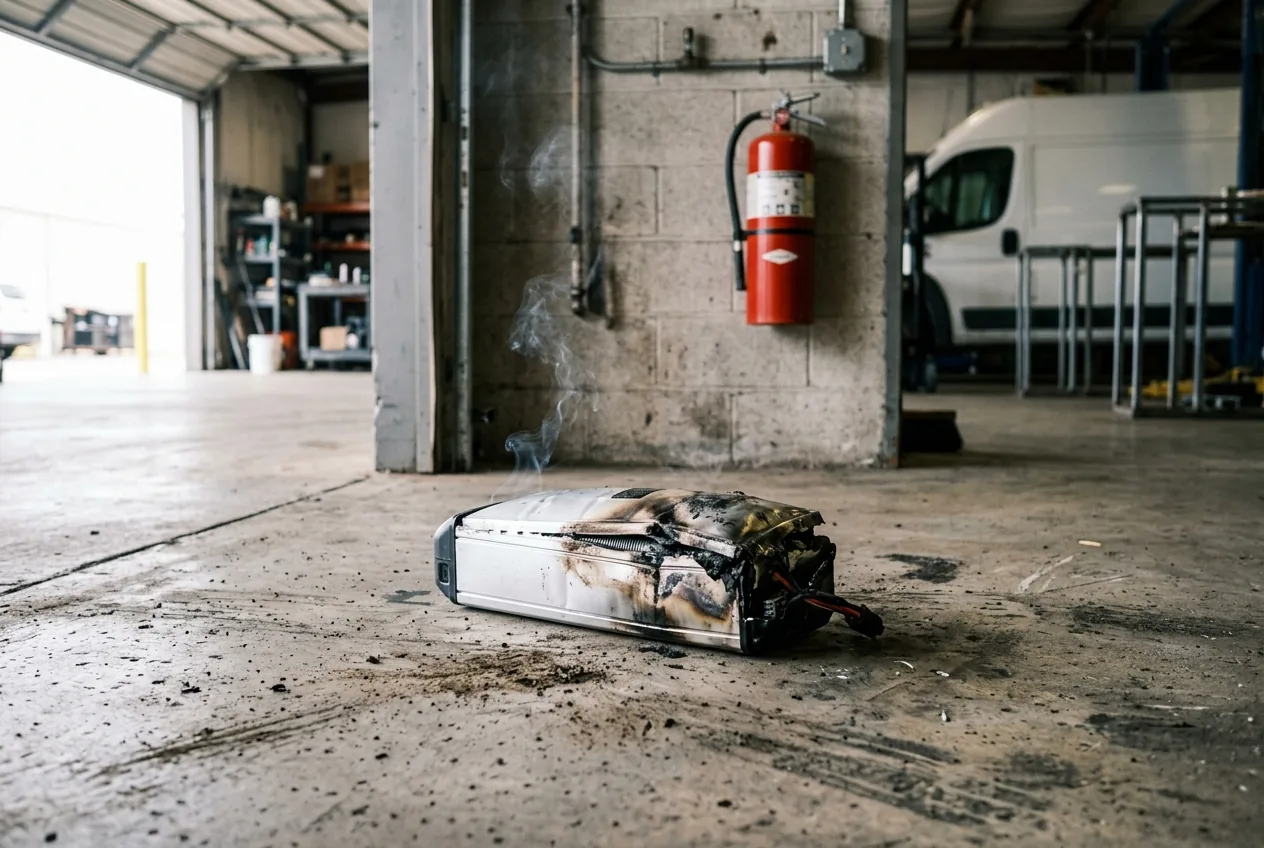
Lithium-ion batteries now charge in nearly every workplace, in e-bikes, scooters, power tools, radios, laptops and phones. When one fails, the advice from the U.S. Fire Administration is plain. Do not try to put a lithium-ion battery fire out, get everyone out and call 911. So the extinguisher you keep near a charging area has a different job, the fire around the battery, and choosing it is part of the commercial fire extinguisher service Boss Fire Protection provides in Dallas-Fort Worth.
- A burning battery is not one to fight, so get out and call 911
- Stop using a battery that smells, swells, leaks, changes color, runs hot or makes odd noises
- Charge between 32°F and 105°F, never blocking an exit
- Keep a multipurpose ABC extinguisher for the room around the chargers
What Kind of Fire Is a Lithium-Ion Battery Fire?
It starts as thermal runaway, a chain reaction inside the battery in which heat from one failing cell damages the cells next to it. Once the reaction starts it can vent gas and smoke, catch fire and keep going from cell to cell.
OSHA’s fact sheet on lithium-ion battery safety lists the warning signs of thermal runaway as a rise in battery temperature, gas, vapor or smoke venting from the battery, or fire. It names the usual triggers as a manufacturing defect, physical damage, too much heat or cold, and improper charging. The smoke from a battery fire can carry hydrogen fluoride and carbon monoxide, which is one more reason to leave the room rather than stand over it.
It also does not fit neatly into the fire classes on an extinguisher label. NFPA 10 lists lithium among the combustible metals of a Class D fire, but OSHA points out that a lithium-ion battery holds its lithium in ionic form, not as solid metal. The classes themselves are explained in our guide to fire extinguisher classes, types and uses.
Can a Fire Extinguisher Put Out a Lithium-Ion Battery Fire?
Do not try. The U.S. Fire Administration’s advice is that if a lithium-ion battery fire occurs, you should not try to put it out, but evacuate and call 911. Knocking down the flames on the outside of a pack may not stop the chain reaction inside it, which is why the advice is to leave.
OSHA tells employers to follow the battery manufacturer’s guidance on how to extinguish small battery fires, and to write lithium battery incidents into the emergency action plan, so staff know in advance what is expected of them. That guidance varies by product, which is why it belongs in the plan and not in someone’s memory during an emergency.
You will see extinguishers sold specifically for battery fires. Before you rely on one, ask what it is listed for. NFPA 10 requires every portable extinguisher used to meet the standard to be listed and labeled to UL 711, and the label tells you which classes of fire it was tested on.
The Extinguisher to Keep Near a Charging Area
A charging area is still a room full of ordinary fuel. Boxes, packaging, pallets, furniture and the bikes themselves will burn long before anyone thinks about the battery, and the chargers plugged into the wall are energized electrical equipment. A multipurpose dry chemical extinguisher rated for Class A, B and C fires covers all of that, which is why NFPA 10 requires extinguishers for building protection to be selected for Class A fires whatever else is installed.
For the electrical side, which fire extinguisher is right for an electrical fire explains what the C on the label means and why water is wrong on a live circuit. If batteries ride in your vans or power your forklifts, fire extinguishers for work trucks, vans and forklifts covers what each vehicle needs.
| What you see | What to do |
|---|---|
| Battery hot while charging | Unplug it if you can do so safely, and stop using it |
| Smell, swelling or leaking | Stop using it and keep it away from anything that burns |
| Smoke, hissing or popping | Get everyone out and call 911 |
| Flames on the battery | Do not try to put it out. Evacuate and call 911 |
| Fire in nearby boxes | Only a trained person with a clear exit behind them uses the ABC extinguisher, and never stands over the battery. Otherwise get out |
Charging Batteries Safely at Work
The safety guidance is mostly about charging, not firefighting. The U.S. Fire Administration’s battery guidance gives these points.
- Temperature. Store batteries at room temperature when possible, and do not charge them below 32°F or above 105°F. A closed truck or an unconditioned storage room in a Dallas-Fort Worth summer can pass 105°F.
- Place. Charge and store in a cool, dry place, and do not leave a battery charging for too long.
- Exits. Never park a charging e-bike or scooter where it blocks an exit route.
- Heat. If a device is noticeably hot while it charges, unplug it.
- Disposal. Do not put lithium-ion batteries in the trash. Take them to a battery recycling location.
OSHA adds three things an employer controls. Follow the manufacturer’s instructions for storage, use, charging and maintenance. Limit how many batteries are stored in one place. And store batteries and devices in dry, cool locations.
105°F
The highest temperature at which the U.S. Fire Administration says a lithium-ion battery should be charged. The lowest is 32°F.
Training Staff for a Battery Fire
Write the battery rules into your emergency action plan, as OSHA’s lithium-ion battery safety fact sheet recommends, and train staff on them. The first lesson is the hardest one, that a burning battery is a reason to leave, not a reason to reach for the extinguisher. Where staff are expected to use extinguishers on other fires, OSHA requires training when they are hired and at least once a year after that, and how to use a fire extinguisher covers what that training should teach.
Getting Your Charging Area Checked in Dallas-Fort Worth
Boss Fire Protection can check that the extinguishers near your chargers are the right class, mounted where staff can reach them on the way out, and inspected and tagged on schedule. Ask us at your next extinguisher inspection, or call to have a new charging area looked at before it fills up with batteries.
Sources: U.S. Fire Administration, Educating Your Community (lithium-ion batteries), on not trying to put out a lithium-ion battery fire, evacuating and calling 911, unplugging a device that is hot while charging, charging and storing in a cool, dry place, and not blocking an exit route. U.S. Fire Administration, Battery Fire Safety, on the warning signs, charging only between 32°F and 105°F, and recycling rather than trashing batteries. OSHA, Lithium-ion Battery Safety fact sheet FS-4480 (January 2025), on thermal runaway, its warning signs and causes, the ionic form of lithium, the gases released, manufacturer guidance on small battery fires, storage, and emergency action plans. NFPA 10, Standard for Portable Fire Extinguishers (National Fire Protection Association), on the fire classes, listing and labeling to UL 711, and selecting building protection for Class A fires. OSHA 29 CFR 1910.157, on extinguisher training at hire and at least annually.
Put a Licensed Fire Protection Team on Your Side
Inspections, service, red-tag repair, and new installs for commercial kitchens across Dallas-Fort Worth. Photo-documented work and a written report, every visit.
