
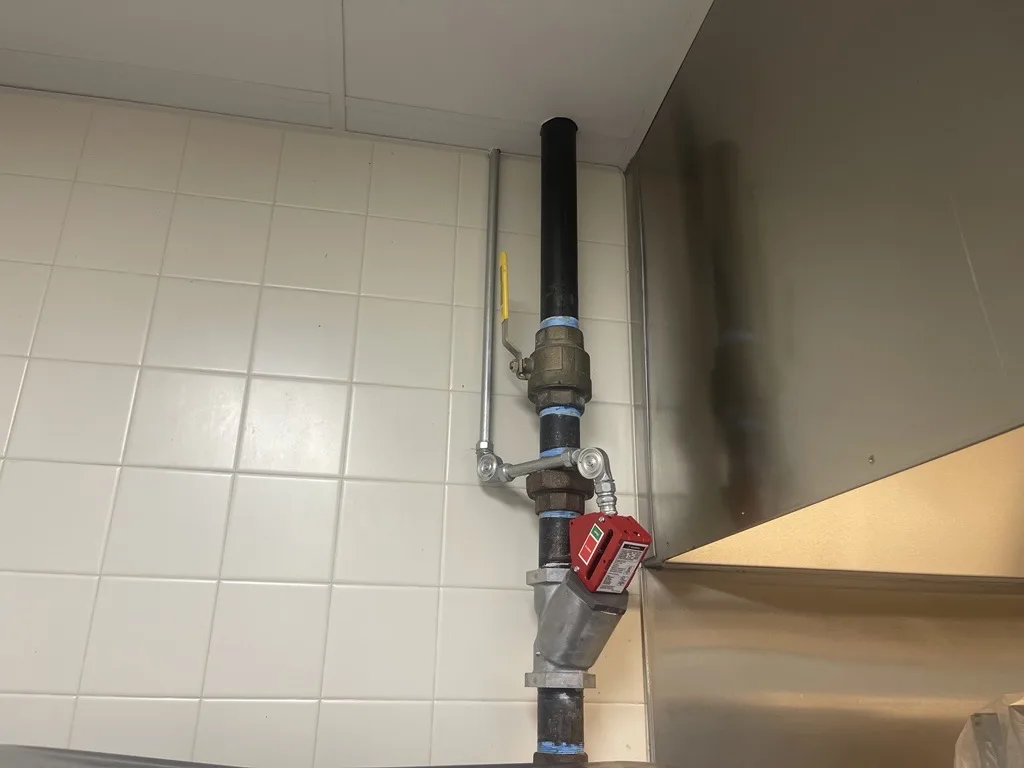
The gas shut-off valve on a hood system is the part that stops the fire from being fed. When the kitchen fire suppression system fires, the valve closes the gas to every appliance under the hood, and it stays closed until someone resets it by hand. Checking that it closes is part of every fire suppression system service visit Boss Fire Protection makes in Dallas-Fort Worth, because a system that puts agent on a fryer while the burners keep running is fighting a fire that keeps relighting.
- It closes automatically the moment the suppression system fires
- It shuts off unprotected gas appliances under the same hood too
- It must be reset by hand before the gas comes back on
- It is tested at every semiannual inspection, every 6 months
What Does the Gas Shut-Off Valve on a Hood System Do?
It cuts the fuel to the cooking line when the suppression system fires. NFPA 96 requires every source of fuel and electric power that heats the protected equipment to shut off automatically when the system actuates, so the agent is not fighting burners that are still lit. The valve then stays shut until it is reset by hand.
The valve sits on the gas line that feeds the appliances under the hood, usually on the riser where the line drops down the wall, as in the photograph above. It is part of the suppression system, not a separate safety device, and it is tied to the same release that sends wet chemical agent to the nozzles. If you are not sure how the parts of your system fit together, what an ANSUL system is and how it works walks through the whole system.
Mechanical and Electrical Gas Valves
Kitchen systems use one of two kinds of valve, and which one you have changes how it is reset.
- A mechanical gas valve is closed by the suppression system’s own release, usually through a cable run from the release to the valve. It needs no electricity to close, and it is opened again by hand at the valve.
- An electrical gas valve stays open only while it has power. When the system fires, a switch in the release cuts that power and the valve closes. NFPA 96 requires a manually reset relay to restore the power, so the valve cannot reopen on its own when the power comes back.
Either kind is used, provided it is part of the system’s listing. What is never acceptable is a valve that reopens by itself. The fire code says the same thing as NFPA 96, as summarised in the International Code Council’s guide to Type I hoods. Actuation shall automatically shut down the fuel or electrical power supply to the cooking equipment, and the reset shall be manual.
6 months
How often NFPA 96 requires the system to be serviced, with every actuation and control component, the mechanical and electrical devices among them, tested for proper operation at each visit.
Sourced to NFPA 96, Ventilation Control and Fire Protection of Commercial Cooking Operations
Which Appliances Have to Shut Off
The rule reaches further than the appliances with nozzles over them. NFPA 96 sets out who shuts off and who does not.
| Fuel or power source | Shuts off when the system fires? |
|---|---|
| Gas to protected appliances | Yes, automatically |
| Power to protected appliances | Yes, automatically, for electric fryers, griddles and ranges |
| Gas to other hood appliances | Yes, automatically, even when they need no protection and have no nozzle of their own |
| Steam from an outside supply | Not required to shut off |
| Solid fuel cooking | Not required to be shut down |
The third row is the one that catches kitchens out. A gas appliance moved under the hood after the system was installed has to be tied into the shutoff as well, even if it needs no nozzle, and that is a change to the system that a technician should make.
Why Won’t the Gas Come Back On After the System Fires?
Because the valve is built not to. NFPA 96 requires every shutoff device to be reset by hand before fuel or power is restored, so the gas stays off until someone resets it on purpose. That reset should come after the system is recharged and re-armed, so the kitchen never cooks under an empty system.
After a discharge, cleaning up is only the first step. In practice, following the manufacturer’s manual, the agent tank has to be refilled, the release re-armed, the fusible links replaced and the nozzles checked before the gas is turned back on. If you do not know why the system went off in the first place, why a kitchen suppression system goes off covers the usual causes, from a real flare-up to a knocked pull station.
Resist the temptation to wedge the valve open or bypass the relay to get through a busy service. A kitchen cooking with a bypassed valve has a system that will put agent on a fire and leave the gas feeding it.
How the Gas Valve Is Tested
At each semiannual inspection the technician trips the system with the agent tank isolated and confirms the gas and the electric power to the appliances shut off. The trip is made from the remote pull station as well as through the automatic release, following the manufacturer’s test procedure, which NFPA 96 requires. If your staff are not sure where that pull station is or when to use it, remote pull station training for restaurant staff covers it.
Cities check the same thing when a new system goes in. The City of Arlington’s construction guide for kitchen hood suppression systems, for example, lists a utility shut-off test among its acceptance tests, requires shutoff valves and switches to need a manual action to reset, and asks the installer to send a short video of the system tripped from the pull station showing the gas and electric shutting off.
Signs the Gas Valve Needs Attention
- The burners stay lit during a test, or relight on their own afterwards.
- The valve has been propped, tied or bypassed so it cannot close.
- A gas appliance has been added under the hood since the last inspection.
- The gas came back on after a discharge without anyone resetting the valve.
- The valve shows heavy corrosion or physical damage on the riser.
Any one of these is a reason to call before the next inspection rather than wait for it.
Getting the Gas Valve Checked in Dallas-Fort Worth
Boss Fire Protection tests the gas valve, the electric shutoffs and the pull station at every semiannual visit and resets the valve after a discharge once the system is recharged and re-armed. If your gas will not come back on, or a valve was bypassed to get through a shift, call us and we will put the system back to the way the standard requires.
Sources: NFPA 96, Standard for Ventilation Control and Fire Protection of Commercial Cooking Operations (National Fire Protection Association), on automatic fuel and electric power shutoff, unprotected gas appliances under the same ventilation, the manual reset requirement and the manually reset relay for an electrical gas valve, the exceptions for outside steam and solid fuel, and testing of actuation and control components every 6 months. International Code Council, Type I Hoods, Commercial Cooking Operations, quoting the International Fire Code on automatic shutdown and manual reset of the fuel and electrical supply. City of Arlington Fire Rescue, Fire Marshal’s Office, Construction Guide for Kitchen Hood and Spray Booth Suppression Systems (2021 IFC edition, updated March 2025), on the manual action to reset, the utility shut-off acceptance test and the activation video.
Put a Licensed Fire Protection Team on Your Side
Inspections, service, red-tag repair, and new installs for commercial kitchens across Dallas-Fort Worth. Photo-documented work and a written report, every visit.
