
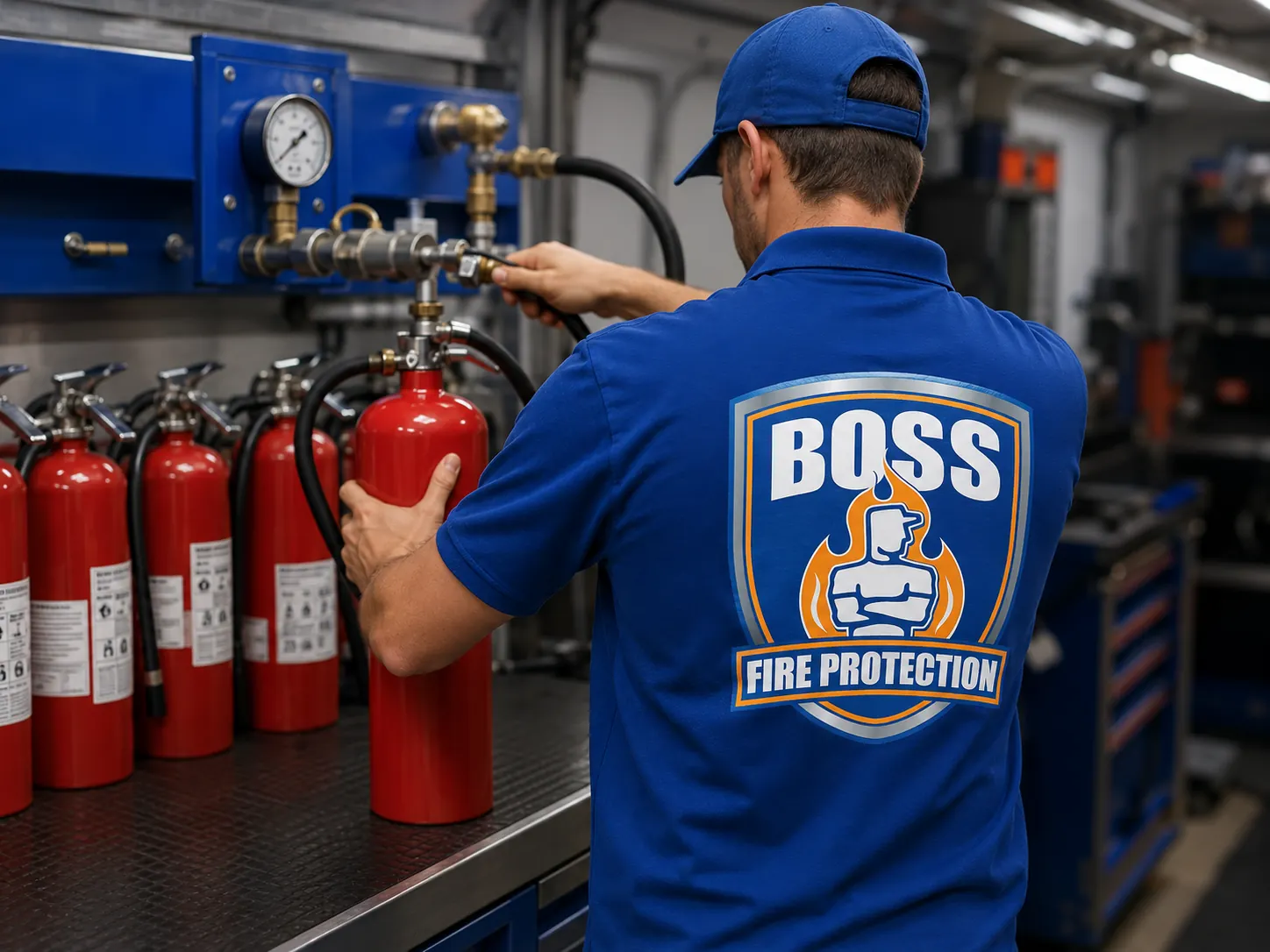
Once a year every portable fire extinguisher in your building needs more than the quick look your staff give it each month. NFPA 10 calls it maintenance, most people call it the annual inspection, and it is done by a trained, certified technician with the manufacturer’s service manual, the right tools and listed parts. It is the core of the commercial fire extinguisher service Boss Fire Protection provides in Dallas-Fort Worth, and this article walks through what the technician actually checks.
- Required at intervals of not more than 1 year
- Done by a trained, certified technician, not by staff
- Ends with a tag showing the month, year, technician and company
- Some types also need internal examinations every 1 to 6 years
How Is the Annual Inspection Different From the Monthly Check?
The monthly check is a quick look that anyone trained can do, confirming each extinguisher is in place, visible, reachable and showing pressure in the green. The annual inspection is maintenance by a certified technician who takes the extinguisher down, examines it against the manufacturer’s service manual, fixes what is wrong and records it on a tag.
NFPA 10 is clear that the two should not be confused. The monthly check is done at least once a calendar month, never more than 31 days apart, and in the month the annual inspection is done the technician’s visit covers it. What the monthly check involves is in monthly fire extinguisher inspections.
What the Technician Checks
NFPA 10’s appendix lists the steps for a rechargeable, stored-pressure extinguisher, the most common kind on a commercial wall. Grouped by part, they cover the following.
| Part | What is checked |
|---|---|
| Mount and location | The right hanger, bracket or cabinet, secure and undamaged, with the extinguisher in its place, visible and reachable |
| Cylinder | Taken down and examined for dents, damage, repairs and corrosion, with any boot or foot ring removed |
| Labels | Operating instructions legible and facing out, and the model checked against recalls and the obsolete list |
| Gauge | In the operable range, matching the nameplate pressure and the agent type |
| Pin, handle and seal | Pull pin removed and checked, handle and levers working, and a new tamper seal fitted |
| Nozzle and hose | Removed, unobstructed, correct for the model, and free of cuts and cracks |
| Weight | Weighed against the weight on the nameplate |
| Records | Internal examination and hydrostatic test due dates checked, and the work recorded on the tag |
Any deficiency the inspection finds calls for immediate corrective action, so a good technician leaves every unit either passed or replaced, never just noted.
1 year
The longest NFPA 10 allows between maintenance visits on any portable fire extinguisher. Maintenance is also due at a hydrostatic test, or whenever a monthly check turns up a problem.
Sourced to NFPA 10, Standard for Portable Fire Extinguishers
Extinguishers That Need More Than an Outside Check
Some types have to be opened up on a schedule of their own. NFPA 10 sets these intervals for an internal examination.
- Every year. Cartridge-operated and cylinder-operated dry chemical units with mild steel shells, loaded stream and wetting agent units, and pump tanks.
- Every 5 years. Wet chemical, carbon dioxide and stored-pressure water extinguishers.
- Every 6 years. Stored-pressure dry chemical extinguishers with steel, brass or aluminum shells that take a 12-year hydrostatic test. They are emptied and examined inside, then given a 6-year label.
Disposable, nonrechargeable extinguishers are not opened up or hydrostatically tested. NFPA 10 removes them from service 12 years after the date of manufacture. How these dates add up over an extinguisher’s life is covered in do fire extinguishers expire, and the standard behind them in NFPA 10 explained in plain words.
What the Tag Has to Say
NFPA 10 requires a tag or label on every extinguisher showing the month and year of the maintenance, the person who did it, and the name and address of the company. An extinguisher that has been opened up for an internal examination also gets a verification-of-service collar around the neck, except cartridge-operated and pump-tank types, and a 6-year examination adds its own weatherproof label to the shell.
Keep the records as well as the tags. OSHA’s portable fire extinguisher rule makes the employer responsible for the inspection, maintenance and testing of every extinguisher in the workplace, and requires the annual maintenance record to be kept for one year after the last entry or for the life of the shell, whichever is less.
What Happens to an Extinguisher That Fails?
NFPA 10 requires immediate corrective action. Depending on the fault, the technician recharges it, replaces a part such as the hose, gauge or seal, or takes it out of service and replaces it. A model that is recalled or on the obsolete list is replaced, never repaired, and nothing failed should be left on the wall.
Texas enforces the 2018 edition of NFPA 10, and the annual maintenance requirement is the same in it. If your tags are due, the whole building’s extinguishers can usually be done in one visit. What each kind of extinguisher work costs, and how to read a quote, is covered in what fire extinguisher service costs.
Booking Your Annual Inspection in Dallas-Fort Worth
Boss Fire Protection inspects, tags and services commercial extinguishers across Dallas-Fort Worth, and tells you in writing which units need recharging or replacing. Tell us how many extinguishers you have and where, and we will schedule the inspection around your hours.
Sources: NFPA 10, Standard for Portable Fire Extinguishers (National Fire Protection Association), on maintenance at intervals of not more than 1 year, the difference between monthly inspection and annual maintenance, the appendix list of maintenance steps, corrective action, internal examination intervals, the 6-year examination and label, nonrechargeable extinguishers removed at 12 years, and the tag, collar and label requirements. OSHA 29 CFR 1910.157, Portable Fire Extinguishers, on employer responsibility and keeping the annual maintenance record. Texas Department of Insurance 2023 adopted rule, adopting NFPA 10, 2018 edition.
Put a Licensed Fire Protection Team on Your Side
Inspections, service, red-tag repair, and new installs for commercial kitchens across Dallas-Fort Worth. Photo-documented work and a written report, every visit.
