
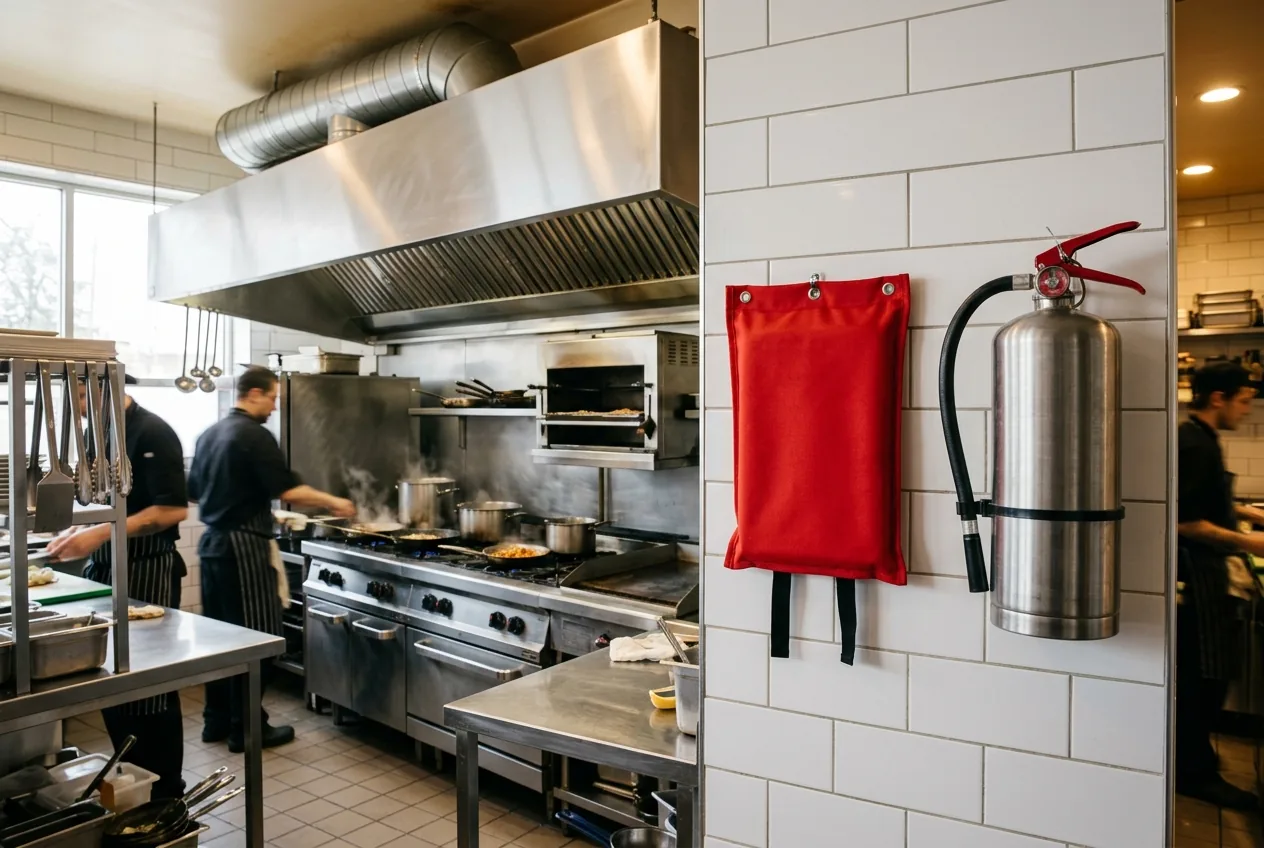
A fire blanket can smother a small pan fire on a range top, but in a commercial kitchen it is an extra, never a substitute. NFPA 10 requires a Class K extinguisher within 30 feet of any cooking appliance that uses vegetable or animal oils, and NFPA 96 requires the automatic hood system over the line, and a blanket counts toward neither. If you are deciding what to hang beside the fryer, start with the Class K, which is part of the commercial fire extinguisher service Boss Fire Protection provides across Dallas-Fort Worth.
- Useful for a small pan fire on a range top
- Not a replacement for the Class K extinguisher NFPA 10 requires
- Not a replacement for the hood suppression system NFPA 96 requires
- Never the first response to a fryer fire
What Is a Fire Blanket?
A fire blanket is a sheet of fire-resistant fabric, usually folded into a wall pouch with pull tabs, that is laid over a small fire to cut off its air. Blankets meant for cooking fires can be made and tested to ASTM F1989, the specification for cooking fire suppression blankets, which covers putting out accidental cooking fires.
A blanket works the same way as a metal lid slid over a burning pan. It only works if it covers the whole pan and stays in place until the oil has cooled, because lifting it early lets air back in and the oil can flare up again.
Is a Fire Blanket Required in a Commercial Kitchen?
No. Neither NFPA 10 nor NFPA 96 requires a fire blanket in a commercial kitchen. What they require is an automatic hood suppression system over the appliances as the primary protection, and a Class K extinguisher within 30 feet of the cooking oil hazards as the backup. A blanket can be added, but it satisfies neither requirement.
NFPA 96 makes the hood system the primary protection and portable extinguishers the backup, and NFPA 10 is specific about the extinguisher. Class K extinguishers are provided wherever there is a potential for fires in vegetable or animal cooking oils and fats, and any extinguisher installed to protect those appliances without a Class K rating is removed from service. The reasons a Class K is mandatory, and where it goes, are covered in why a K class fire extinguisher is mandatory in a commercial kitchen.
30 feet
The farthest a Class K extinguisher can be from the cooking appliances it protects. NFPA 10 and NFPA 96 set no travel distance, or any other requirement, for a fire blanket.
Sourced to NFPA 10, Standard for Portable Fire Extinguishers
Can a Fire Blanket Put Out a Fryer Fire?
It is not something to rely on. A commercial fryer holds far more burning oil than the pan a blanket is made to cover, and laying it means reaching right over the fire. On a fryer, the pull station that fires the hood system and the Class K extinguisher are the tools made for the job.
The Class K agent cools the oil and forms a foam layer on its surface that stops it reigniting, which a blanket cannot do to a deep vat. That is also why NFPA 10 requires a placard beside the Class K extinguisher saying the hood system is to be activated before the extinguisher is used.
Blanket, Class K or Hood System
| Tool | What it is for | Required in a commercial kitchen |
|---|---|---|
| Hood suppression system | Every appliance under the hood, plus the hood, filters and duct, with the gas or power shut off | Yes, under NFPA 96 |
| Class K extinguisher | Backup on a cooking oil fire after the hood system is activated | Yes, within 30 feet under NFPA 10 |
| Fire blanket | A small pan fire on a range top | No |
If You Do Keep a Fire Blanket
A blanket can still earn its place for small pan fires at a range, as long as everyone understands it comes after the pull station, not before. These points keep it useful.
- Hang it where the range is. On the wall near the range top and the exit, never above the fryers, so nobody reaches over a fire to get it.
- Follow its instructions. Read the instructions printed on the pouch, turn off the heat, and leave the blanket in place until the pan is cool.
- Train with the right order. Pull station first, Class K second, blanket only for a small pan away from the fryers.
The full order for a kitchen grease fire, and why water must never go near one, is in how to put out a grease fire in a commercial kitchen.
Getting the Required Protection Right in Dallas-Fort Worth
Boss Fire Protection inspects, tags and replaces Class K extinguishers and services kitchen hood suppression systems across Dallas-Fort Worth. If you are not sure your kitchen has the right extinguisher in the right place, we will check it, and the placard beside it, at your next visit.
Sources: NFPA 10, Standard for Portable Fire Extinguishers (National Fire Protection Association), on Class K extinguishers wherever cooking oils and fats are used, removing non-Class K units installed for those appliances, the 30-foot maximum travel distance, the placard requiring the fixed system to be activated first, and how wet chemical agent cools the oil and forms a foam blanket. NFPA 96, Standard for Ventilation Control and Fire Protection of Commercial Cooking Operations, on automatic fire-extinguishing systems as primary protection and portable extinguishers as secondary backup. ASTM F1989, Standard Specification for Cooking Fire Suppression Blankets (ASTM International).
Put a Licensed Fire Protection Team on Your Side
Inspections, service, red-tag repair, and new installs for commercial kitchens across Dallas-Fort Worth. Photo-documented work and a written report, every visit.
