
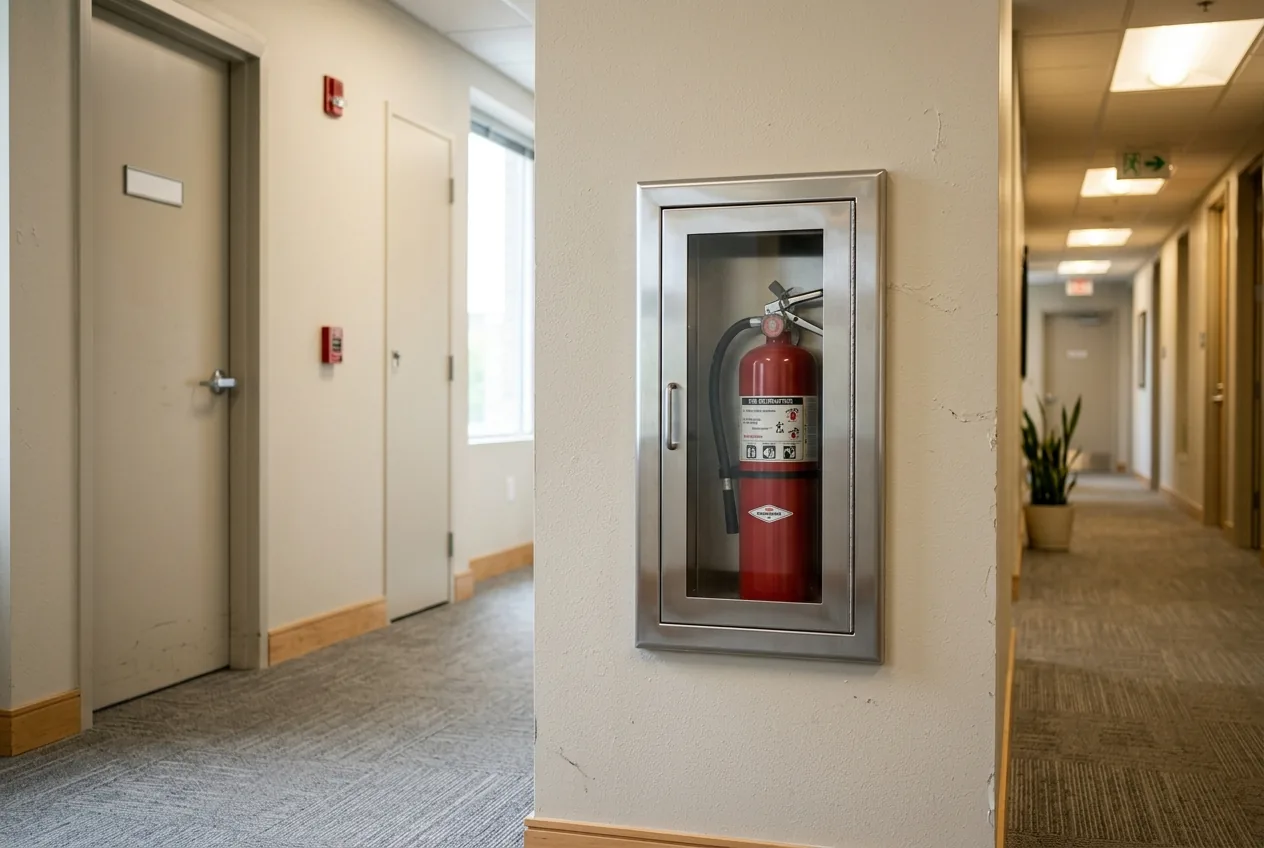
NFPA 10 never names a cabinet as the required mount, but it does require protection where an extinguisher could be damaged, and a cabinet is usually how that is met. Use one where an extinguisher could be knocked, stolen, tampered with or weathered, and in corridors and lobbies where a bracket-mounted extinguisher would stick out too far into the walkway. The choice comes down to how the cabinet mounts, surface, semi-recessed or fully recessed, and whether the wall is fire-rated. Boss Fire Protection supplies and services extinguishers across Dallas-Fort Worth, and its fire extinguisher service checks the cabinets they sit in.
- NFPA 10 accepts approved cabinets or wall recesses as a way to mount an extinguisher
- Cabinets are not locked unless tampering is a real risk, and then need emergency access
- A fire-rated wall takes a surface-mounted or listed fire-rated cabinet
- The normal extinguisher heights still apply inside a cabinet
When Do You Need a Fire Extinguisher Cabinet?
You need one when a bracket alone would leave the extinguisher at risk or in the way. The usual cases are public areas where people may tamper with or take it, corridors where a wall-hung unit would stick out more than 4 inches, outdoor spots exposed to weather, and loading areas where carts and forklifts could hit it.
The standard that governs this is NFPA 10, Standard for Portable Fire Extinguishers, and its own notes put it plainly. Besides storage, a cabinet protects the extinguisher and stops it being bumped. Where a hidden or stolen extinguisher is the worry, NFPA 10 also allows a cabinet with a switch and a local alarm that sounds when the extinguisher is taken out.
Why Do Corridors Often Need a Recessed Cabinet?
Because of the accessibility rules on objects that stick out from walls. Under the 2010 ADA Standards, anything mounted with its leading edge between 27 and 80 inches above the floor may project no more than 4 inches into a walkway, and many extinguishers hung on a bracket stick out further than that.
The US Access Board guide to protruding objects explains the limit, which exists so that someone who is blind or has low vision does not walk into an object a cane would miss. A semi-recessed or fully recessed cabinet keeps the extinguisher within the wall line, and a deep surface cabinet has the same problem as the bracket.
4 inches
The most a wall-mounted object between 27 and 80 inches above the floor may stick out into a walkway, which is why corridor extinguishers often go in recessed cabinets.
Sourced to US Access Board, Guide to the ADA Standards, Protruding Objects
Which Kind of Cabinet Is Right?
| Cabinet | How it mounts | Best for |
|---|---|---|
| Surface-mounted | Fixed to the face of the wall | Warehouses, back-of-house areas, and fire-rated walls that cannot be cut into |
| Semi-recessed | Partly set into the wall, with a shallow lip in front | Corridors and lobbies where the wall is too thin for a full recess |
| Fully recessed | Set flush into the wall cavity | Finished public areas where nothing may stick out |
| Listed fire-rated | Recessed into a fire-rated wall, built to keep its rating | Corridors and stairwells with fire-rated walls |
NFPA 10’s notes explain why the fire-rated choice matters. A cabinet that is not fire-rated, set into a fire-rated wall, makes the whole wall noncompliant. The rule applies to new installations, so an existing cabinet is not automatically a violation, but any new one in that wall should be listed for it.
Can a Fire Extinguisher Cabinet Be Locked?
Only where the extinguisher is likely to be misused, and then the cabinet must still offer a way in during an emergency. NFPA 10 says extinguisher cabinets are not locked otherwise. A break-front cabinet, the kind with a glass or plastic panel, must come with a breaker bar or hammer for opening it in a fire.
What Else NFPA 10 Asks of a Cabinet
- Size. Choose the extinguisher first, then a cabinet with room to lift it out easily.
- Height. The cabinet must still let the extinguisher meet the normal heights, its top no more than 5 feet up for a unit of 40 pounds or less, and its bottom at least 4 inches above the floor.
- Instructions facing out. The label with the operating instructions faces the front.
- Heat. A closed cabinet in a hot spot needs screened openings and drains. NFPA 10’s notes say a vented cabinet with tinted glass runs 10°F to 15°F cooler inside.
- Visibility. A cabinet that hides the extinguisher needs a sign visible from the walkway, as covered in fire extinguisher signs and what the code requires.
The full set of placement and inspection rules is in NFPA 10 in plain words, and which extinguisher belongs in the cabinet in the first place is in the guide to fire extinguisher classes, types and uses. Whether it should be a 5 pound or a 10 pound unit is covered in fire extinguisher sizes and where each belongs.
How Boss Fire Handles Extinguisher Cabinets in Dallas-Fort Worth
At each extinguisher service, Boss Fire Protection’s technicians check that every cabinet opens freely, is not locked without a reason, holds the right extinguisher at the right height, and is visible or marked. When a cabinet is needed for a new space or a corridor, they can advise on the type before the wall is finished, which costs far less than cutting into it later.
Sources: NFPA 10, Standard for Portable Fire Extinguishers (National Fire Protection Association), on mounting, cabinets, locking, fire-rated walls and installation height. US Access Board, Guide to the ADA Standards, Chapter 3, Protruding Objects. Texas Department of Insurance, State Fire Marshal’s Office, adopted rule listing NFPA 10, 2018 edition, and summarising its clarifications on extinguisher mounting equipment and cabinets (2023).
Put a Licensed Fire Protection Team on Your Side
Inspections, service, red-tag repair, and new installs for commercial kitchens across Dallas-Fort Worth. Photo-documented work and a written report, every visit.
