
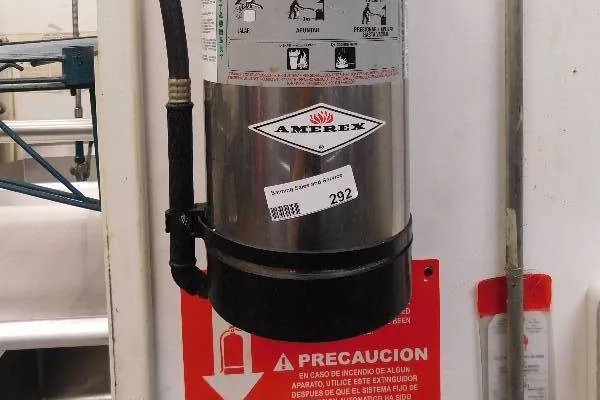
A fire extinguisher sign is required wherever the extinguisher itself cannot be seen from the normal path of travel. NFPA 10, the national standard for portable extinguishers, says extinguishers go where they are visible, and where a wall, shelving, a column or a cabinet hides one, a sign or other marking must show where it is. A kitchen with a hood system needs one more, a placard beside the Class K extinguisher. Boss Fire Protection checks both on every fire extinguisher inspection and service it carries out in Dallas-Fort Worth.
- Required where the extinguisher is hidden from the normal path of travel
- The sign itself must be visible from that path
- A Class K extinguisher under a hood system needs its own placard
- Texas enforces the 2018 edition of NFPA 10, which clarified the rules on signs
When Is a Fire Extinguisher Sign Required?
A sign is required whenever the extinguisher cannot be seen from the normal path of travel. NFPA 10 lets you skip the sign only where the extinguisher is in plain view. If a column, rack, door, partition or closed cabinet blocks it, the location has to be marked by a sign or another clear means.
The rule comes from NFPA 10, Standard for Portable Fire Extinguishers, which Texas adopts for the State Fire Marshal. Its explanatory notes say the main way to mark a hidden extinguisher should be a sign made for that purpose, and that arrows, lights or a painted band on a wall or column also count. Federal workplace rules point the same way. The OSHA portable fire extinguisher rule tells employers to mount, locate and identify extinguishers so employees can reach them without being put at risk.
Where Should a Fire Extinguisher Sign Go?
Put the sign where someone walking the normal route through the space will see it, usually high on the wall directly above the extinguisher so it shows over people, shelving and equipment. In long aisles and warehouses a sign that sticks out from the wall, or one hung from a column, can be read from further away.
NFPA 10 sets no single sign height. What it requires is the result, a sign that can be seen from the path of travel. The extinguisher under the sign does have fixed heights, and those matter when you place the sign, because the sign marks the spot where someone will reach for it.
5 feet
The highest the top of a portable extinguisher weighing 40 pounds or less may sit above the floor, with at least 4 inches of clearance below it.
Sourced to NFPA 10, Standard for Portable Fire Extinguishers
Which Places Usually Need a Sign
| Location | Sign needed? | Why |
|---|---|---|
| Open office or dining room wall | Usually not | The extinguisher is in plain view from the walkway |
| Warehouse aisle or stockroom | Yes | Racking and stacked goods hide it from most of the floor |
| Behind a column or around a corner | Yes | It cannot be seen from the normal route |
| Closed cabinet with a solid door | Yes, a sign or clear lettering on the door | NFPA 10 requires a sign or other marking for a cabinet that hides the extinguisher |
| Kitchen with a hood system | Yes, a Class K placard | Staff must be told to fire the hood system before using the extinguisher |
What Does the Class K Placard Say?
Where a cooking hazard is protected by an automatic suppression system, NFPA 10 requires a placard near the Class K extinguisher saying the system must be activated before the extinguisher is used. The standard’s notes show a typical placard in English and Spanish, about 7 5/8 by 11 inches.
The order matters. Pulling the hood system first shuts off the fuel and floods the appliances with agent, and the Class K extinguisher then finishes any fire that is left. Why every commercial kitchen needs that extinguisher in the first place is covered in why a Class K fire extinguisher is mandatory in a commercial kitchen, and which extinguisher suits which fire is in the guide to fire extinguisher classes, types and uses.
Do Extinguishers in Cabinets Need a Sign?
Yes, when the cabinet hides the extinguisher. A cabinet with a clear window that shows the extinguisher may not need one, but a solid door or a cabinet set back out of the line of sight does, and the sign must be visible from the normal path of travel just like any other.
Cabinets bring rules of their own on locking, break-glass doors and fire-rated walls, all explained in fire extinguisher cabinets, when you need one and which kind.
Missing Signs and the Fire Marshal
A hidden extinguisher with no sign is one of the simpler notes a fire marshal writes, and one of the easiest to clear before the visit. Walk the space the way a stranger would, from each door, and check you can see either the extinguisher or a sign pointing at it. The guide to a successful fire marshal inspection lists the other items worth checking the same day.
How Boss Fire Handles Extinguisher Signs in Dallas-Fort Worth
At each extinguisher service, Boss Fire Protection’s technicians check that every unit is where it belongs, at the right height, visible or marked, and that each Class K extinguisher under a hood system has its placard. Missing signs and placards are flagged in the report and can usually be fitted on the same visit or the next, before the fire marshal finds them.
Sources: NFPA 10, Standard for Portable Fire Extinguishers (National Fire Protection Association), on visibility, signs, installation height, cabinets and the Class K placard. OSHA 29 CFR 1910.157, Portable Fire Extinguishers. Texas Department of Insurance, State Fire Marshal’s Office, adopted rule listing NFPA 10, 2018 edition, and summarising its clarifications on extinguisher signs (2023).
Put a Licensed Fire Protection Team on Your Side
Inspections, service, red-tag repair, and new installs for commercial kitchens across Dallas-Fort Worth. Photo-documented work and a written report, every visit.
