
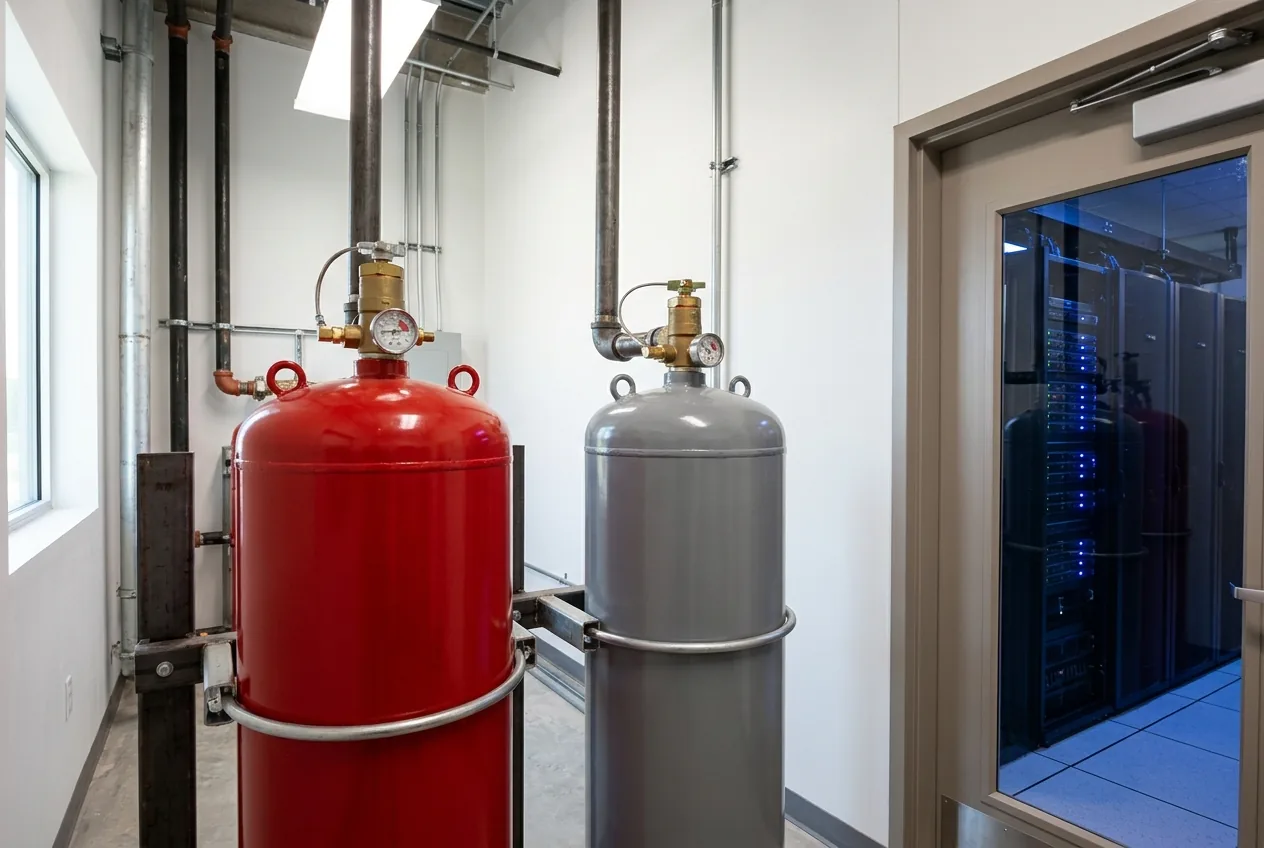
FM-200 and Novec 1230 are the two halocarbon clean agents most often quoted for a server room or electrical room, and both put a fire out in seconds without water or residue. The difference that matters in 2026 is supply, not performance. FM-200 is a hydrofluorocarbon, a family whose production the United States is cutting by 85% by 2036 under the AIM Act, as the U.S. Environmental Protection Agency sets out, and 3M, the maker of the Novec 1230 brand, stopped making it at the end of 2025, although the same agent is still sold by other makers under its chemical name. Boss Fire Protection installs and services Kidde clean agent systems in Dallas-Fort Worth and walks owners through this choice before a quote is signed. What the rest of a server room system needs, from detection to a sealed room, is covered in server room fire suppression.
- FM-200 is HFC-227ea, a hydrofluorocarbon
- Novec 1230 is FK-5-1-12, a fluoroketone
- Both discharge in 10 seconds under NFPA 2001 and leave no residue
- A system is built and listed for one agent, so they are not swapped in a refill
How FM-200 and Novec 1230 Compare
Both agents do the same job in the same way, by absorbing heat from the fire, which is why the comparison comes down to the chemistry, the rules around it and where the next refill will come from. The basics of how either one protects a room are in clean agent fire suppression, how it protects rooms water would ruin.
| Point of comparison | FM-200 | Novec 1230 |
|---|---|---|
| Chemical name | HFC-227ea (heptafluoropropane) | FK-5-1-12 (a fluorinated ketone) |
| Stored as | A liquefied gas under nitrogen pressure | A liquid under nitrogen pressure that vaporises at the nozzle |
| Discharge time | 10 seconds | 10 seconds |
| Residue and conductivity | None, and electrically non-conductive | None, and electrically non-conductive |
| Regulation | An HFC, so its production falls under the federal HFC phasedown | Not an HFC, so not under that phasedown |
| Supply | Still made, in a shrinking allowance | The 3M brand ended in 2025, the agent is sold by other makers |
Is FM-200 Being Banned?
FM-200 is not banned, and an existing FM-200 system can stay in service and be refilled. What is happening is a production cut. FM-200 is a hydrofluorocarbon, and the AIM Act requires an 85% cut in U.S. HFC production and consumption from its historic baseline by 2036, according to the U.S. Environmental Protection Agency.
The U.S. Environmental Protection Agency runs the phasedown through allowances, and lists fire suppression among the sectors that use HFCs. A shrinking supply usually means a rising price per pound of agent, which is the cost to weigh on a large room where a refill after a discharge could be a big bill.
85%
The cut in U.S. production and consumption of hydrofluorocarbons, the family FM-200 belongs to, from historic baseline levels by 2036 under the AIM Act.
Sourced to the U.S. Environmental Protection Agency
Is Novec 1230 Discontinued?
The Novec 1230 brand is. 3M announced in December 2022 that it would exit all PFAS manufacturing by the end of 2025, and its Novec 1230 fire protection fluid was part of that exit. The agent inside it, FK-5-1-12, is still made and sold by other manufacturers under their own names.
3M’s own announcement of its PFAS exit set the date. For an owner with a Novec system the practical question is no longer whether the agent exists but who supplies it to the system’s manufacturer, and whether that supply is approved for the system as it is listed. Ask that question of whoever quotes the refill.
Can an FM-200 System Be Refilled With Novec 1230?
No. A clean agent system is designed and listed for one agent, with the cylinder sizes, fill weights, pipe sizes and nozzles all calculated for that agent’s properties. Putting a different agent into it would leave the room at the wrong concentration. Changing agents means a new design, and usually new cylinders and nozzles.
That is why the choice made on the original quote follows the room for the life of the system. It is also why a conversion should be judged the way any old equipment is judged, on what the existing pipe and nozzles can still be used for and what has to be replaced.
Choosing Between Them for a New or an Existing System
Both agents face regulatory pressure. FM-200 is an HFC under a production cut, and FK-5-1-12 is a PFAS chemical, the family 3M left the market over. For a new system in 2026, the practical test is today’s supply chain, meaning who makes the agent the system is listed for and how a refill would reach you. For an existing FM-200 system in good order, there is rarely a reason to tear it out early. Keep it inspected, keep its room sealed, and plan the change for the day it needs major work. Neither agent belongs in a commercial kitchen, where the hazard is burning cooking oil and the answer is a wet chemical hood system, covered in our commercial kitchen fire suppression systems guide.
How Boss Fire Helps With the Choice in Dallas-Fort Worth
Boss Fire Protection designs and installs Kidde clean agent systems and services existing ones, so the advice is not tied to selling you a new system. We will tell you which agent your current system holds, what a refill would involve today, and what a replacement would cost, before any work starts.
Sources: U.S. Environmental Protection Agency, Frequent Questions on the Phasedown of Hydrofluorocarbons. 3M, announcement of its exit from PFAS manufacturing, 20 December 2022. NFPA 2001, Standard on Clean Agent Fire Extinguishing Systems (National Fire Protection Association).
Put a Licensed Fire Protection Team on Your Side
Inspections, service, red-tag repair, and new installs for commercial kitchens across Dallas-Fort Worth. Photo-documented work and a written report, every visit.
