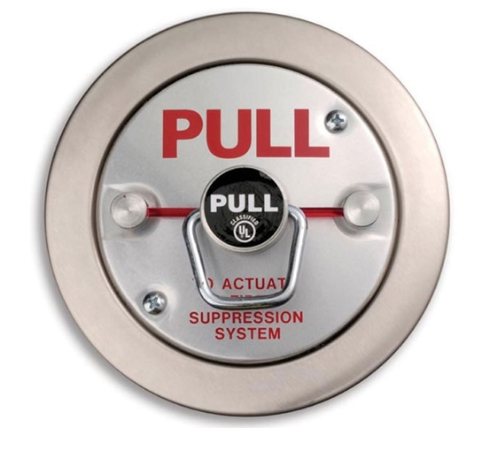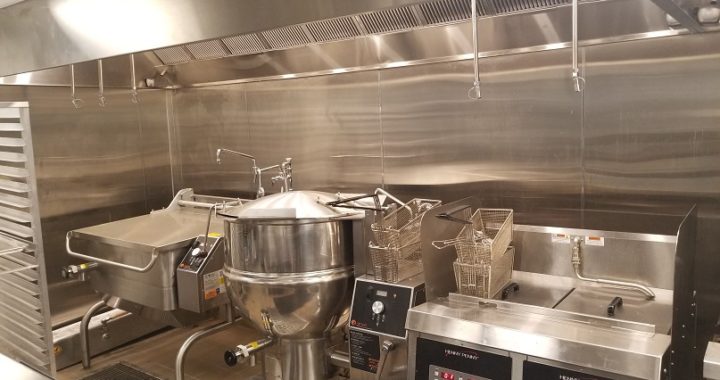
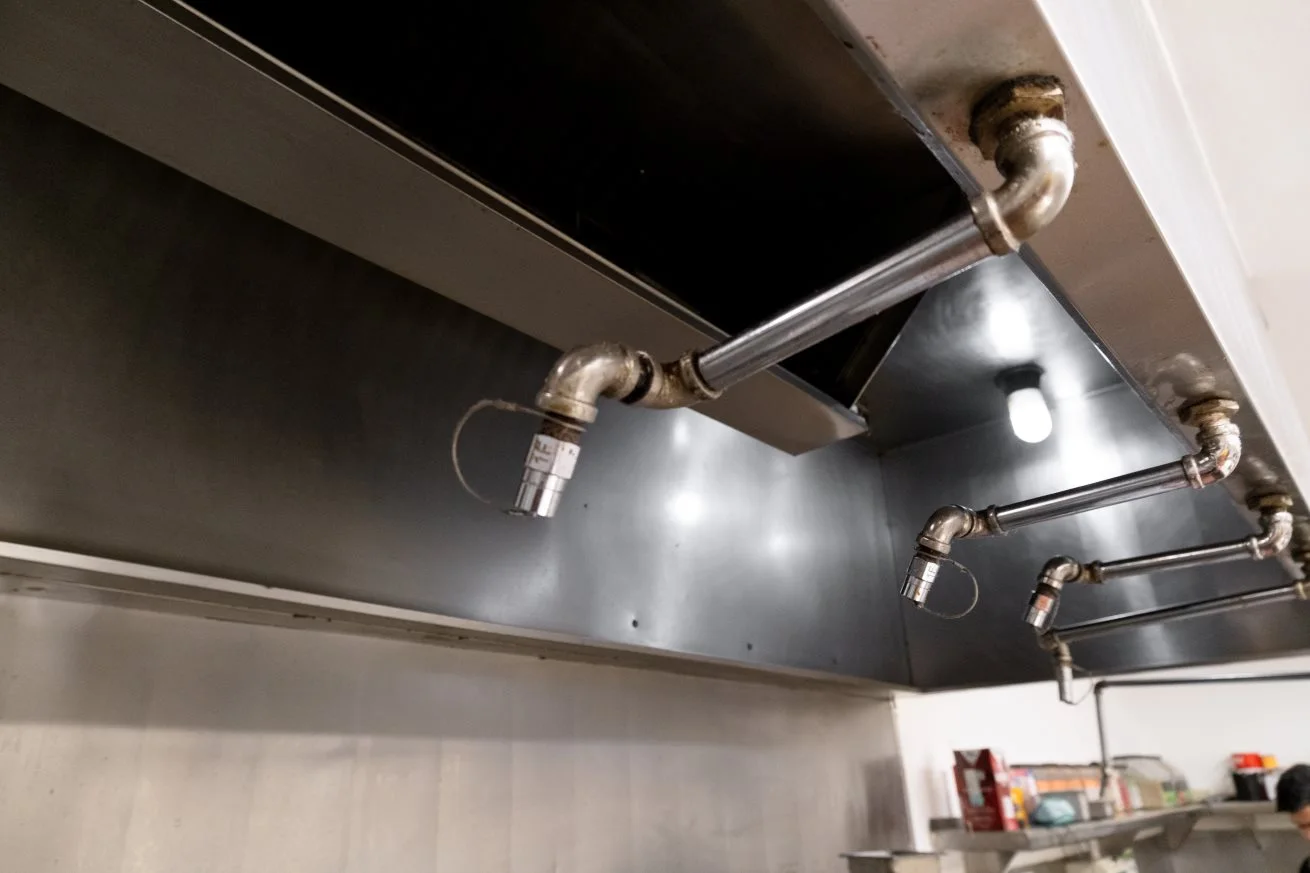
A restaurant fire suppression system is a fixed wet chemical system mounted above a commercial cook line that detects a fire at the appliance, shuts off the fuel, and discharges a liquid agent through fixed nozzles onto the cooking surfaces and into the hood and duct. It is not a sprinkler and it is not a portable extinguisher. It is plumbed to the hood it protects, aimed at the appliances underneath it, and designed to put out a grease fire without anybody being in the kitchen.
- Required by code, not optional, wherever grease-laden vapours are produced. The standard is NFPA 96.
- Inspected twice a year by a licensed company, with a tag left on the system.
- Must be UL 300 rated. An older dry chemical system is not compliant and cannot be brought up to standard by servicing it.
- Aimed at your appliances. Change a fryer for a char broiler and the nozzle layout is wrong until it is redesigned.
- Cylinders are pressure tested every twelve years and must be replaced or recertified on that schedule.
How Does a Restaurant Fire Suppression System Work?
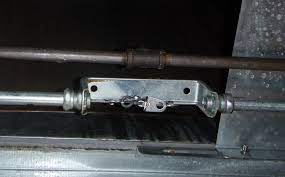
It works without electricity and without anybody pulling anything. A steel cable, the detection line, runs through the hood above each appliance and is held under tension by a spring. Threaded onto that line above each cooking appliance is a fusible link, a small metal tab soldered together so that it comes apart at a set temperature. When a fire raises the temperature at that appliance, the link melts, the tension releases, and a spring-loaded hammer drops.
That hammer punctures the seal on a compressed gas cartridge. The gas pressurises the agent tanks and pushes wet chemical through fixed piping to the nozzles over each appliance and into the duct. At the same moment the same mechanical movement shuts the gas valve feeding the cook line and trips the micro switch that cuts electrical power under the hood. The fuel stops and the agent lands, in that order, in a few seconds.
The wet chemical itself is not water. It is an alkaline liquid that reacts with hot cooking oil and forms a soapy crust across the surface, which both smothers the fire and stops the oil reigniting as it cools. That reaction is the reason the agent is specific to kitchens and the reason a dry chemical system is not an equivalent.
What Are the Parts of the System?
Seven parts do the work. Everything else is piping and brackets.
| Part | What it does |
|---|---|
| Regulated release | The mechanical heart of the system. Holds the detection line under tension, holds the hammer, and releases the cartridge when the tension goes. |
| Detection line | A steel cable running from the release through the hood to every fusible link. Set with a tension bar and spring, with a quarter-inch to three-eighths-inch clearance from the hammer to the hammer base. |
| Fusible links | The temperature sensors. One above each appliance, rated for the heat that appliance normally produces, and replaced on a schedule because grease and heat age them. |
| Gas valve | Shuts off every gas appliance under the hood the moment the system fires. Set by the compressed air the cartridge releases. |
| Micro switch | Cuts electrical power under the hood and to the makeup air, and signals the building fire alarm so the fire department is called. |
| Cartridges | Hold the compressed gas that pressurises the tanks. Pressure tested or replaced every twelve years. |
| Agent tanks | Hold the wet chemical that the gas pushes through the piping to the nozzles. |
The seven parts, and what each one does when the system fires.
The semiannual inspection is where each of those is checked, and NFPA 96, the standard covering ventilation and fire protection for commercial cooking, is what sets the interval at twice a year.
Every 6 months
How often a commercial kitchen fire suppression system must be inspected by a trained person, whether or not anything has gone wrong with it.
Sourced to NFPA 96, Standard for Ventilation Control and Fire Protection of Commercial Cooking Operations
Is an ANSUL System the Same Thing?
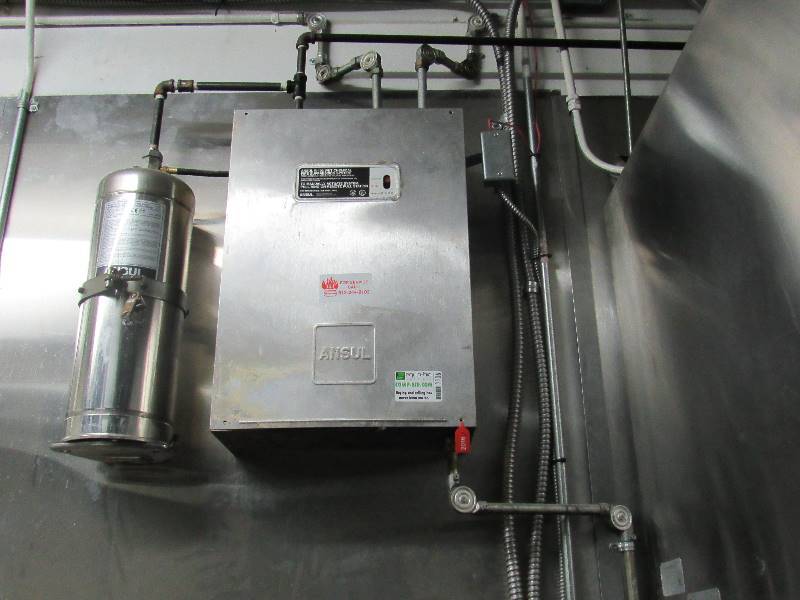
Usually, yes. ANSUL is a manufacturer, not a type of system, and its R-102 is the restaurant wet chemical system fitted in a very large share of commercial kitchens. It has been around long enough that plenty of owners and chefs call any kitchen suppression system “the Ansul”, the way people say they need a plaster rather than an adhesive bandage. If somebody tells you your kitchen has an Ansul system, they are describing a wet chemical hood system of the kind set out above.
It matters for parts and service rather than for how it works. Nozzles, links, cartridges and agent are specific to the manufacturer and the model, so a technician needs to know whether yours is an ANSUL, a Pyro-Chem, a CaptiveAire, an Amerex, a Buckeye, a Kidde, a Protex or a Lehavot before anything is replaced. The plate on the regulated release tells you which. If your system is going off, or you are trying to work out which one you have, that is the thing to photograph before you call anybody.
What Is a UL 300 System and Does Mine Qualify?
A UL 300 system is one that passed the fire test for wet chemical kitchen suppression. If your system discharges a dry powder rather than a liquid, it almost certainly predates that standard and does not qualify. The reason the standard exists is that restaurant cooking changed. Vegetable oils burn hotter and hold heat longer than the animal fats the older dry chemical systems were tested against, and those systems were putting fires out that then relit.
There is no upgrade path. A pre-UL 300 system cannot be serviced into compliance, because the agent, the nozzles and the piping were all designed around a different test. It is replaced. UL 300 is the standard listing itself if you want to read what the system was tested against.
Why a System Passes One Inspection and Fails the Next
Nothing on the cook line stays still. The three faults that come up most are all changes somebody made for a good reason without knowing the system was tied to them.
- The appliances moved. Nozzles are aimed at specific equipment in specific positions. Slide a fryer two feet to make room and it is no longer underneath the nozzle protecting it.
- An appliance was swapped for a hotter one. A fusible link rated for a griddle is the wrong rating above a char broiler, and the link either trips in normal service or does not trip soon enough.
- Grease reached the detection line. This is the quiet one. Grease creeping into the conduit stiffens the cable so the links cannot pull it, and the system looks completely normal from the outside. It is covered in detail in what grease in the detection line conduit does.
The links themselves are a scheduled replacement rather than a repair, for the reasons set out in the role of fusible links. Amerex, one of the manufacturers whose systems are serviced here, publishes its own account of grease reaching the mechanical parts and reaches the same conclusion.
Does the System Replace Fire Extinguishers?
No. The fixed system protects the cook line. The code still requires portable extinguishers in the kitchen, and in a commercial kitchen that means a K-class extinguisher rated for cooking oil within reach of the line. The two are counted separately at an inspection and a missing extinguisher fails the visit on its own. Which extinguisher, and why the ordinary red one on the wall does not satisfy it, is in K-class extinguishers in commercial kitchens.
What Boss Fire Does About It
Boss Fire Protection inspects, services, repairs and installs these systems across Dallas-Fort Worth, under a Texas fire suppression licence. At a semiannual visit the detection line is checked for tension and for grease, every fusible link is checked against the appliance under it, the gas valve and micro switch are tested rather than looked at, cartridge weights and tank pressures are recorded, and the nozzle layout is checked against the equipment actually standing there that day. Anything that fails is photographed so you can see it rather than take our word for it, and the tag goes on the system before we leave.
If the system turns out to be pre-UL 300, you get told that plainly and given the replacement cost, not a service bill for a system that cannot be made compliant. New installations and full replacements are fire suppression system installation.
Sourced to NFPA 96, NFPA 17A, Standard for Wet Chemical Extinguishing Systems, UL 300, and the Texas Department of Insurance on who may perform this work in Texas.