
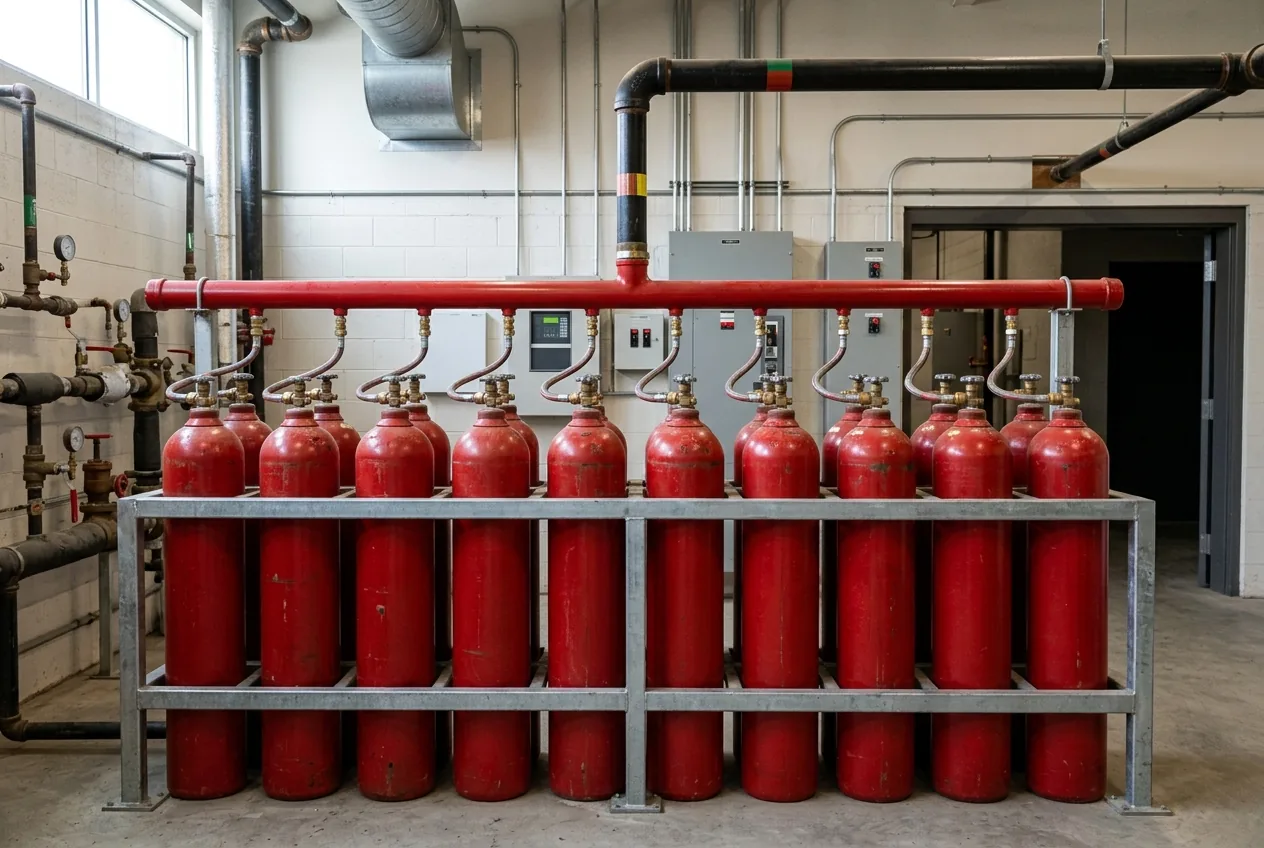
Water mist, carbon dioxide and dry chemical are three special hazard fire suppression systems, each chosen for a particular kind of fire. Water mist cools a fire with very fine droplets and little water, carbon dioxide smothers it by pushing the oxygen out of a closed space, and dry chemical knocks a flammable liquid fire down with a powder. Over a commercial cooking line the system is almost always a wet chemical system listed to UL 300 instead. Boss Fire Protection’s work across Dallas-Fort Worth is kitchen fire suppression system installation and clean agent systems, so this guide is about where each of the other three belongs and what to ask before choosing one.
- Water mist uses fine droplets and far less water than sprinklers
- Carbon dioxide floods a closed space and is deadly to people in it
- Dry chemical suits flammable liquids, as in paint spray booths
- Kitchens use wet chemical systems tested to UL 300 instead
The Three Side by Side
| Question | Water mist | Carbon dioxide | Dry chemical |
|---|---|---|---|
| How it puts out a fire | Cools the fire and the air around it | Lowers the oxygen below what a fire needs | Interrupts the burning on contact |
| Typical places | Machinery spaces, turbine enclosures, some buildings | Electrical rooms, printing presses, industrial process hazards | Paint spray booths, fuel dispensing, industrial hazards |
| Safe with people present | Generally yes, it is water | No, people must be out before discharge | Discharge can hide the way out |
| Cleanup | Light wetting | None, the gas disperses | Powder on everything |
| Main standard | NFPA 750 | NFPA 12 | NFPA 17 |
What Is a Water Mist Fire Suppression System?
A water mist fire suppression system sprays water as a fine mist rather than drops. The tiny droplets absorb heat fast and turn to steam, cooling the fire and the air around it with a fraction of the water a sprinkler uses. Water mist systems are designed and installed under NFPA 750.
NFPA 750 defines water mist by droplet size, a spray in which nearly all of the water arrives in droplets smaller than one millimeter. Getting droplets that small takes special nozzles and often higher pressure than a sprinkler system. Each water mist system is tested and listed for the kind of hazard it protects, so a system listed for a machinery space is not simply moved into a different room.
Is a CO2 Fire Suppression System Dangerous?
Yes, to anyone inside the space when it discharges. A carbon dioxide system floods a closed room at a concentration that puts out fire by displacing oxygen, and that same concentration is lethal to people. That is why CO2 systems carry a pre-discharge alarm and a time delay, so everyone is out before the gas is released.
The EPA’s review of carbon dioxide as a fire suppressant puts the minimum design concentration for a total flooding system at 34 percent, and notes that above 17 percent a person can lose consciousness and die within a minute. OSHA 29 CFR 1910.162 requires a distinctive pre-discharge alarm on carbon dioxide systems designed to 4 percent or more, and design concentration within 30 seconds of discharge. NFPA 12, the carbon dioxide standard, adds safeguards such as a lock-out that stops the system firing while people unfamiliar with it are in the space.
72 deaths
The deaths, with 145 injuries, found in 51 incident records of accidents involving the discharge of carbon dioxide fire extinguishing systems, in the EPA review’s search of incidents from 1975 to the time it was written.
Sourced to U.S. Environmental Protection Agency, Carbon Dioxide as a Fire Suppressant, Examining the Risks
Where Dry Chemical Systems Are Still Used
A dry chemical system stores a powder under pressure and discharges it through fixed nozzles onto the hazard. It is fast on flammable liquids and is common in industrial paint spray booths, fuel dispensing areas and some process equipment. OSHA’s rule for fixed dry chemical systems asks for the design concentration within 30 seconds of discharge, a pre-discharge alarm where the powder may hide the way out, and a yearly sample of the powder in all but stored pressure systems, to make sure it has not caked with moisture.
Dry chemical used to protect restaurant hoods too. Dry chemical kitchen systems that do not meet UL 300 have had to be replaced, in practice by wet chemical systems, because a wet agent cools the hot oil and seals its surface so it does not relight. In Texas every existing pre-engineered kitchen system has had to meet UL 300 since 1 January 2008 or carry a red tag, which is explained in UL 300 explained.
Which System Belongs in Which Room
The hazard decides the agent, and the people decide the safeguards. Most advice compares the agents as if they were brands of the same thing. They are not, and the question that settles most choices is simply whether people will be in the space when it fires.
- People present, equipment that water would ruin. A clean agent system, set out in clean agent fire suppression.
- People present, a hazard where water is acceptable. Sprinklers, or water mist where less water or a listed special design is needed.
- A space nobody normally enters, such as an enclosure or a pit. Carbon dioxide, with its alarms, delay and lock-out.
- A flammable liquid process, such as a spray booth. Dry chemical, or another agent listed for that hazard.
- A commercial cooking line. A wet chemical system listed to UL 300, always.
Getting the Right System in Dallas-Fort Worth
Boss Fire Protection designs, installs and services kitchen hood suppression systems and Kidde clean agent systems across Dallas-Fort Worth. If you are comparing systems for a room and are unsure which kind it needs, tell us what the room holds and who works in it, and we will tell you plainly whether it is a job we do.
Sources: OSHA 29 CFR 1910.162, Fixed extinguishing systems, gaseous agent, on design concentration within 30 seconds and the pre-discharge alarm for carbon dioxide systems at 4 percent or more. OSHA 29 CFR 1910.161, Fixed extinguishing systems, dry chemical, on the 30 second design concentration, the pre-discharge alarm where discharge may obscure vision, and the annual sampling of the dry chemical supply. U.S. Environmental Protection Agency, Carbon Dioxide as a Fire Suppressant, Examining the Risks, on the 34 percent minimum design concentration, the effects above 17 percent, NFPA 12’s safeguards including the lock-out, the uses of carbon dioxide systems, and the review of 51 incident records with 72 deaths and 145 injuries from 1975 to the time it was written. NFPA 750, Standard on Water Mist Fire Protection Systems, NFPA 12, Standard on Carbon Dioxide Extinguishing Systems, and NFPA 17, Standard for Dry Chemical Extinguishing Systems (National Fire Protection Association). Texas Department of Insurance, State Fire Marshal rule 28 TAC 34.517(f), on UL 300 for every existing pre-engineered commercial cooking system after 1 January 2008, or a red tag.
Put a Licensed Fire Protection Team on Your Side
Inspections, service, red-tag repair, and new installs for commercial kitchens across Dallas-Fort Worth. Photo-documented work and a written report, every visit.
