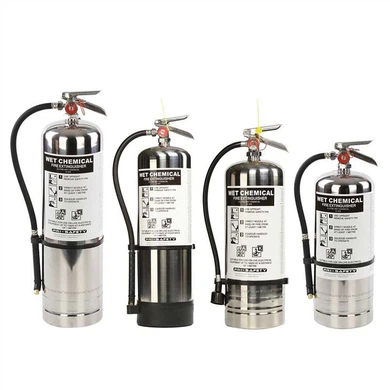
A Class K fire extinguisher is the portable unit built for fires in cooking oils, animal fats and grease, the fuel a commercial fryer or griddle burns through every shift. NFPA 10, the Standard for Portable Fire Extinguishers, requires one within 30 feet of the cookline in any commercial kitchen, working alongside the hood suppression system rather than replacing it.
- What it is A wet chemical extinguisher rated for fires in vegetable oil, animal fat and grease
- Where it goes Within 30 feet of the cookline, per NFPA 10
- What it is not A replacement for the kitchen’s hood suppression system
- How it is checked A monthly visual check by kitchen staff, a full annual inspection and tag by a licensed technician, and hydrostatic testing on the cycle NFPA 10 sets for that unit
What Is a Class K Fire Extinguisher Used For?
A Class K extinguisher is built for one job, putting out fires in the vegetable oil, animal fat and grease a commercial kitchen fries and grills with every shift. Restaurants, hotel kitchens, hospital cafeterias and any commercial cookline that fries or flat-tops food need one, because those oils burn hotter and behave differently from the fuels an ordinary extinguisher is rated for. Boss Fire installs, tags and services Class K fire extinguishers in commercial kitchens across Dallas-Fort Worth, alongside the ABC units the rest of a building needs.
Why Won’t an ABC Extinguisher Put Out a Grease Fire?
An ABC dry chemical extinguisher can knock the visible flames down for a moment, but it does not cool the burning oil. Oil that is still above its ignition temperature can reignite seconds after the powder cloud settles, so what looked like an extinguished fire flares back up. The dry chemical also spreads across the cookline, the food, the equipment and the hood filters, turning a grease fire into a cleanup and equipment problem on top of the fire itself. That is why a cooking line needs a wet chemical, Class K unit rather than relying on the building’s general-purpose extinguishers. A full breakdown of every extinguisher class and what each one is rated for is in our guide to fire extinguisher classes and types.
How Does a Wet Chemical Extinguisher Stop a Grease Fire?
A Class K unit discharges its agent as a fine mist rather than a jet, so it does not splash burning oil out of the fryer. The wet chemical cools the oil below its ignition temperature and reacts with the fatty acids in it through a process called saponification, the same chemistry that turns fat into soap. That reaction forms a soapy crust across the surface of the oil that seals it from the air, so the fire cannot draw the oxygen it needs to keep burning or to reignite once the extinguisher is empty.
Which Extinguisher Class Belongs Beside a Fryer?
Every portable extinguisher is rated for the fuels it can safely put out, and only one class belongs on a cooking line.
| Class | What it is for | Belongs beside a fryer |
|---|---|---|
| Class A | Ordinary combustibles, such as wood, paper, cardboard and cloth | No |
| Class B | Flammable liquids and gases, such as gasoline or solvents | No |
| Class C | Fires involving live electrical equipment | No |
| Class D | Combustible metals | No |
| Class K | Cooking oils, animal fats and grease media fires | Yes, required by NFPA 10 |
Does a K-Class Extinguisher Replace the Hood Suppression System?
No. The hood system mounted above the cookline is the kitchen’s primary protection. It detects heat automatically, discharges its own wet chemical agent over every appliance it covers, and shuts off the gas or electric supply to the line. The portable Class K extinguisher is the companion to that system, not a substitute for it. It is the backup a person reaches for if a fire starts before the hood system triggers, spreads outside what its nozzles cover, or needs to be finished off by hand. NFPA 96, the standard for ventilation control and fire protection of commercial cooking operations, is what governs the hood system itself. Boss Fire tags a kitchen’s Class K extinguisher on the same visit as its suppression system inspection, so the two are never checked on different schedules.
Where Should a Class K Extinguisher Be Mounted?
NFPA 10 requires a Class K extinguisher within 30 feet of travel distance from the cooking equipment it protects, close enough that a staff member can reach it without walking through the fire itself. Mounting location matters as much as the travel distance. A unit blocked by a rolling cart, a stack of supply boxes or a trash bin is not actually available in an emergency, whatever the tag on the wall says, and a unit mounted where reaching it means crossing in front of an active fryer puts the person reaching for it in the fire’s path. Boss Fire checks placement and clearance on every extinguisher visit, not only the unit itself.
How Often Does a K-Class Extinguisher Need to Be Inspected?
NFPA 10 sets three layers of service for every commercial extinguisher, Class K units included. Kitchen staff run a monthly visual check, confirming the unit is in its spot, the pressure gauge reads in the operating range, and the seal and pin are intact. A licensed technician performs a full annual inspection and tags the unit, checking it against the hazard it covers and recharging it if it is due. On top of that, the cylinder goes through hydrostatic testing on a longer cycle that NFPA 10 sets by the extinguisher’s construction, and the technician’s tag always shows that as a specific due date rather than a number a kitchen has to remember on its own.
What Does the Tag on a K-Class Extinguisher Tell You?
The tag fastened to every serviced extinguisher is a compliance record, not decoration. It shows the extinguisher’s class, the date of the last inspection, the technician’s initials or license information, and the date the next inspection is due, along with a punch or check mark for each month a staff visual check was completed. A missing or expired tag is one of the fastest things a fire marshal flags during an inspection, because it means nobody can prove the unit was ever checked at all.
How Do You Use a Class K Extinguisher on a Grease Fire?
Pull the safety pin, stand back from the fryer rather than leaning over it, and aim the nozzle at the base of the fire, where the oil itself is burning, rather than at the flames above it. Squeeze the handle and sweep the nozzle across the surface until the fire is out, then keep watching the oil for several minutes, because a fire that looked out can still reignite if the oil is still above its ignition temperature. Staying calm and moving deliberately matters more than speed. A rushed pass with the extinguisher can leave a Class K unit half discharged with the fire still burning.
What Boss Fire Protection Does About It
Boss Fire Protection is a Texas State Licensed fire protection company (ECR-2481913) that services and sells Class K and ABC extinguishers in commercial kitchens across Dallas-Fort Worth, using trusted brands including Amerex, Protex, Sentry, Buckeye, Victory and Kidde. Every Class K unit is tagged on the same visit as the kitchen’s hood suppression inspection, checked against the hazard it covers, and tracked for its next annual and hydrostatic dates so nothing lapses quietly. Kitchens that need a Class K extinguisher installed, tagged or brought current can reach Boss Fire at 972-704-1821.
Sources. NFPA 10, Standard for Portable Fire Extinguishers, and NFPA 96, Standard for Ventilation Control and Fire Protection of Commercial Cooking Operations, both at nfpa.org.

Jeff Ralston is the President of Boss Fire Protection, a Texas-licensed fire suppression company (License ECR-2481913) based in Dallas. He leads a team with over 40 years of combined experience inspecting, servicing, and installing commercial kitchen fire suppression systems and fire extinguishers across Dallas-Fort Worth.
Meet the Boss Fire team →
Put a Licensed Fire Protection Team on Your Side
Inspections, service, red-tag repair, and new installs for commercial kitchens across Dallas-Fort Worth. Photo-documented work and a written report, every visit.