When a Dallas-Fort Worth commercial kitchen fails a fire inspection, the inspector writes up exactly what they found, and if it is serious enough, the fire suppression system gets red tagged and taken out of service right there. Most failures do not go that far. Most end with a written notice and a window of days to fix the problem while the kitchen keeps cooking. Which outcome you get depends on what was found, how serious it is, and who found it, all covered below.
- A serious life-safety finding gets the suppression system red tagged and taken out of service that same visit
- A minor deficiency usually gets a written notice with days to fix it, not a shutdown
- The suppression system needs a semi-annual inspection, about six months apart, under NFPA 96, whether or not anyone has just failed one
What Happens in the First Few Minutes After You Fail?
The report comes first. Whoever inspected you, a fire marshal, a health inspector or the technician doing your suppression system’s semi-annual service, writes up exactly what they found and the code section it falls under. That report becomes the record for your correction, your re-inspection, and your insurance carrier if it ever comes up.
If what they found is serious, the fire suppression system gets red tagged on the spot, a physical tag stating the system is out of service. The cookline under it should not be used until the tag comes off. The system exists to catch a grease fire the moment it starts, and cooking without that protection is exactly what NFPA 96 exists to prevent. A red tag on the system does not automatically close the whole business. Whether it reaches that far is the next question.
Is It a Notice to Fix Something, or an Order to Stop Cooking Today?
Both outcomes are real, and which one you get is not random. A notice of deficiency lists the problem and gives a window of days, not hours, to correct it while the kitchen keeps operating, the usual outcome for a paperwork problem or an equipment issue that has not removed active fire protection from a hot cookline.
A stop-cook order is different, applying when the condition is dangerous enough that continuing to cook is an immediate hazard, for example a suppression system no longer protecting the appliances in use, or a blocked pull station on a running line. That call sits with the authority having jurisdiction, the local fire marshal or the inspector in front of the problem, and depends on their read of severity as much as the letter of the code.
Who Is Actually Standing in Your Kitchen?
Three different people show up, for three different reasons, and none of them carry the same authority.
The local fire marshal enforces the fire code. Across most of Dallas-Fort Worth that is a city or county authority rather than the state. The Texas State Fire Marshal’s Office steps in mainly where no local agency with certified inspectors covers the address, per the Texas Department of Insurance. A fire marshal can write violations, order a system out of service and, in a serious case, close the kitchen. Our guide to a successful fire marshal inspection covers what they check before they arrive.
The health inspector works from the food code, not the fire code. Their job is sanitation, temperature control and food handling. A sharp one may flag an obvious fire hazard in passing, but ordering a suppression system out of service is not what their inspection is for. A health department closure and a fire marshal closure are separate actions with separate reasons, even in the same week.
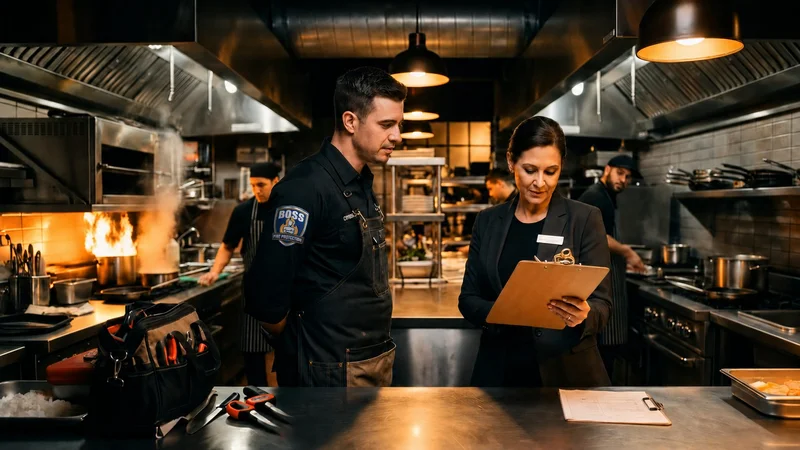
The contractor doing your semi-annual inspection is neither of the above, not a government official and unable to close your business, but able to red tag the system when it fails, document why, and withhold sign-off until it is fixed, because their name and license are what make that tag mean something to the fire marshal who checks it later.
Every 6 months
How often a commercial kitchen fire suppression system must be inspected, whether or not the kitchen has just failed one.
Sourced to NFPA 96, Standard for Ventilation Control and Fire Protection of Commercial Cooking Operations
What Actually Fails a Commercial Kitchen Inspection?
A fire marshal’s visit covers more than the suppression system. Blocked exits, missing signage, overloaded electrical panels, improper storage near heat and sprinkler coverage get checked too, worth a quarterly walk-through since a marshal checks them every visit. Inside the kitchen, the suppression system and extinguishers are usually where an actual failure turns up, almost none of it dramatic, just maintenance that slipped because the kitchen changed and the system did not.
| What failed | What it takes to clear it |
|---|---|
| An expired inspection tag | Book the semi-annual inspection and pass it. A new tag goes on the same visit. |
| Fusible links past their interval | The links get replaced, not just inspected, under NFPA 17A. See our guide to fusible links for how that works. |
| Nozzles not matching the line | The system is re-engineered against the current equipment, nozzles reset before it is approved again. |
| Missing nozzle caps | Caps replaced. They keep grease out of the piping so it cannot block a nozzle when the system discharges. |
| A pre-UL 300 system | Replaced or upgraded to a UL 300-listed wet chemical system built for today’s cooking oils, usually the most expensive item here, worth budgeting for ahead of an inspection rather than after one. |
| No K-class extinguisher on the line | A properly rated, tagged Class K extinguisher installed near the cookline, certified annually under NFPA 10. |
| A blocked manual pull station | The path cleared, permanently if it recurs. The station has to be reachable without moving anything first. |
| Grease past the cleaning interval | Professional hood and duct cleaning, documented for the inspector. Separate from the fire suppression system and not a Boss Fire service. |
How Do You Get the Tag Back?
The tag does not come back automatically once the item is fixed. Correct the specific item named in the write-up, nothing more. Fixing something uncited does not speed anything up. Call a fire protection company licensed by the Texas Department of Insurance to make the correction and the re-inspection. Once the system passes, a new tag goes on dated that day, and the technician documents what was found and fixed, paperwork you hand over if asked for proof. If the fire marshal or health department issued the original citation, ask them directly whether the corrected tag satisfies their notice or whether they need to see the kitchen themselves. A short call can save a wasted trip.
What Does a Failed Inspection Actually Cost the Business?
Three things matter here, none of them a scare tactic.
Insurance. A commercial policy assumes the business operates within code. Some carriers look closely at a claim, or decline one, when a documented violation existed at the time of a loss, and a pattern of violations can lead to a canceled policy or a non-renewal. Not every carrier handles this the same way, so ask your broker rather than assume either outcome. If a fire does happen, a violation documented beforehand is exactly what a liability claim afterward will focus on.
The lease. Most commercial kitchen leases, especially in a shared building or strip center, put code compliance on the tenant and require notifying the landlord of a violation. A red tag or closure can put a tenant in breach even though the landlord had nothing to do with causing it, so check your own lease rather than assume it says nothing about this.
The practical cost of not cooking is the one easiest to underestimate. There can be fines and a re-inspection fee on top of the correction itself, the amount set by whichever authority issued the citation. Payroll keeps running whether or not the kitchen is open, perishable inventory does not wait for a re-inspection date, and a closure on a busy weekend costs more than the same closure on a slow Tuesday. A closure customers can see, a sign on the door, a canceled reservation, is reputational too, harder to measure than a fine but just as real in food service and hospitality.
The First Hour After a Failed Inspection
- Read the full report before anything else, noting the exact code section cited and whether it reads as a notice with a deadline or an order to stop cooking.
- If a system is red tagged, keep the cookline under it out of use. A red tag on the system is not optional.
- Call a licensed fire protection company to schedule the correction and re-inspection. Boss Fire can be reached at 972-704-1821.
- Photograph the cited condition before it is corrected and keep the paperwork from the fix. It is what proves the timeline later.
- Check the lease for a landlord-notification clause, and call your insurance broker if the citation touches anything they would ask about.
What Boss Fire Does During This Process
Boss Fire Protection performs the semi-annual wet chemical fire suppression inspection commercial kitchens across Dallas-Fort Worth need under NFPA 96, tags what passes, documents what does not, and can usually make a same-day repair on a red-tagged system instead of a second visit. The report is written the way a fire marshal expects, photo-documented, so it holds up when asked for. Kitchens that go years without a red tag are usually on a routine rather than scrambling before a surprise visit, a semi-annual system service, an annual extinguisher renewal and a fire marshal inspection that never catches them off guard, handled by one company instead of several.
The interval facts above are sourced to NFPA 96 and NFPA 10, the inspection-authority facts to the Texas Department of Insurance, both linked where they appear.
Put a Licensed Fire Protection Team on Your Side
Inspections, service, red-tag repair, and new installs for commercial kitchens across Dallas-Fort Worth. Photo-documented work and a written report, every visit.

Jeff Ralston is the President of Boss Fire Protection, a Texas-licensed fire suppression company (License ECR-2481913) based in Dallas. He leads a team with over 40 years of combined experience inspecting, servicing, and installing commercial kitchen fire suppression systems and fire extinguishers across Dallas-Fort Worth.
Meet the Boss Fire team →