
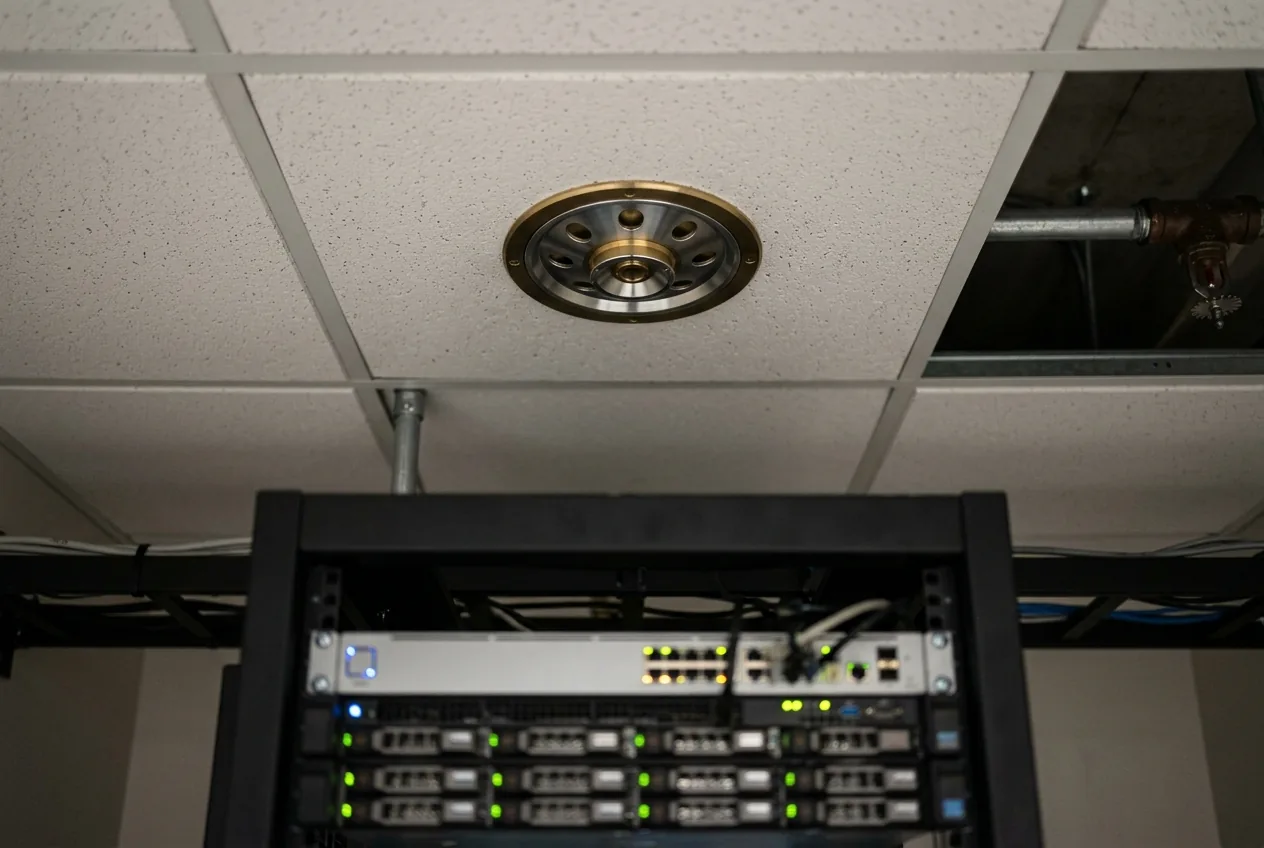
A clean agent fire suppression system protects a room by flooding it with a gas that puts out a fire in seconds and leaves nothing behind, with no water, no powder and no residue to clean off a server, a records shelf or a switchboard. Clean agent systems are built for the rooms where the water from a sprinkler would do more damage than the fire. Boss Fire Protection installs and services Kidde clean agent fire suppression systems for server rooms, telecom closets, electrical rooms and archives across Dallas-Fort Worth.
- A gas or vaporising liquid that leaves no residue and does not conduct electricity
- Governed by NFPA 2001, which Texas has adopted for these systems
- Halocarbon agents must discharge within 10 seconds, inert gases are allowed longer
- The room must hold the gas, so its walls and ceiling are part of the design
What Is a Clean Agent Fire Suppression System?
A clean agent fire suppression system is a fixed system that floods a room with an electrically non-conductive gas to stop a fire. It detects the fire and discharges stored agent through nozzles until the room reaches the concentration that puts it out. The agent evaporates or disperses afterward and leaves no residue on equipment or paper.
The definition comes from NFPA 2001, the Standard on Clean Agent Fire Extinguishing Systems, which describes a clean agent as an electrically non-conducting, volatile or gaseous extinguishant that leaves no residue on evaporation. A typical system has three parts, namely smoke detectors wired to a release panel, cylinders of agent stored in or beside the room, and a network of pipe and nozzles sized so the whole volume reaches its design concentration at once. It is a total flooding system, which means it protects the room as a whole rather than one appliance the way a kitchen hood system does. For how that kitchen kind works, see our guide to commercial kitchen fire suppression systems.
10 seconds
The time in which a halocarbon clean agent system must discharge its agent into the protected room. Inert gas systems are allowed longer, 60 seconds for most hazards.
Sourced to NFPA 2001, Standard on Clean Agent Fire Extinguishing Systems
Halocarbon and Inert Gas, the Two Families
Every clean agent on the market belongs to one of two families, and the family decides how much space the cylinders take and how fast the agent has to reach the fire.
| Family | How it works | Discharge time under NFPA 2001 | Common agents |
|---|---|---|---|
| Halocarbon | Stored as a liquid, vaporises at the nozzle and removes heat from the fire | 10 seconds | FM-200 (HFC-227ea) and FK-5-1-12, sold for years as Novec 1230 |
| Inert gas | Stored as a compressed gas and lowers the oxygen in the room below what a fire needs | 60 seconds for most hazards, longer for some | Blends of nitrogen, argon and carbon dioxide |
Halocarbon systems need far fewer cylinders for the same room, which is why they are the usual choice in a small server room or closet. Inert gas systems take more cylinder space but use gases that occur naturally in air. Choosing between the two halocarbons is its own decision, covered in FM-200 or Novec 1230, choosing a clean agent.
Is a Clean Agent System Safe for People in the Room?
Clean agents listed for occupied rooms are designed to concentrations NFPA 2001 sets below the level shown to harm people, so a person caught in a discharge is not the goal or the expected risk. The system still sounds an alarm and counts down before it fires, so everyone leaves the room first.
The countdown matters as much as the chemistry. A fire produces smoke and breakdown products of its own, and nobody should stay to watch. The warning signs, the alarm horns and, where one is fitted, the abort switch beside the door are part of the installed system and are checked at every inspection.
Where Clean Agent Belongs, and Where It Does Not
Clean agent earns its cost where the contents of a room are worth more than the room, or where downtime is the real loss.
- Server rooms and network closets, where water on live equipment means a rebuild rather than a cleanup
- Electrical and switchgear rooms, where the agent does not conduct and nothing has to dry out before power is restored
- Records rooms and archives, where paper that survives the fire would not survive a soaking
- Control rooms that keep a building, a plant or a network running
It is the wrong tool for a commercial kitchen. A grease fire needs a wet chemical agent that cools the oil and seals its surface, which is why every compliant hood system in Texas is a wet chemical system listed to UL 300. It is also no substitute for a sprinkler system where the building code requires sprinklers. Clean agent protects one room, and the sprinklers protect the building.
The Room Is Part of the System
The part most owners do not expect is that the room itself has to be sealed. A total flooding agent works only if it stays at its design concentration long enough to put the fire out and stop it relighting, so an open cable hole above the ceiling tiles or a door wedged open can let the agent drain out before the job is done. With an older system the cylinders are seldom the weak point. The room around them is what changes. A new conduit is run through the wall, a vent is added, a door closer is removed, and nobody tells whoever services the system. When a room has been altered like that, the honest answer is sometimes a redesign rather than a refill, the same replace or repair decision that comes up with any older fire protection equipment.
How Often Does a Clean Agent System Need Inspection?
A clean agent system needs a full inspection and test at least once a year under NFPA 2001. That visit includes a check of the room for new openings, and the agent quantity and pressure in the cylinders are checked at least every six months. A cylinder that has lost agent or pressure is refilled or replaced.
Texas enforces this through the State Fire Marshal’s adopted standards, which list NFPA 2001 among the codes that registered fire extinguishing system firms work to. The annual visit covers the detectors, the release panel, the alarms and abort switch, the cylinders and their pressure, the piping and nozzles, and the room’s seal.
What Boss Fire Does for Clean Agent Systems in Dallas-Fort Worth
Boss Fire Protection installs new Kidde clean agent systems, inspects and tests existing ones on the NFPA 2001 schedule, and tells you plainly whether a system that has sat untouched for years can be brought back into service or needs to be redesigned for the room it now protects. Before any work starts you get the agent, the cylinder count and the cost in writing.
Sources: NFPA 2001, Standard on Clean Agent Fire Extinguishing Systems (National Fire Protection Association). Texas Department of Insurance, State Fire Marshal’s Office, adopted rule listing the NFPA standards applied to fire extinguishing systems (2023).
Put a Licensed Fire Protection Team on Your Side
Inspections, service, red-tag repair, and new installs for commercial kitchens across Dallas-Fort Worth. Photo-documented work and a written report, every visit.
