
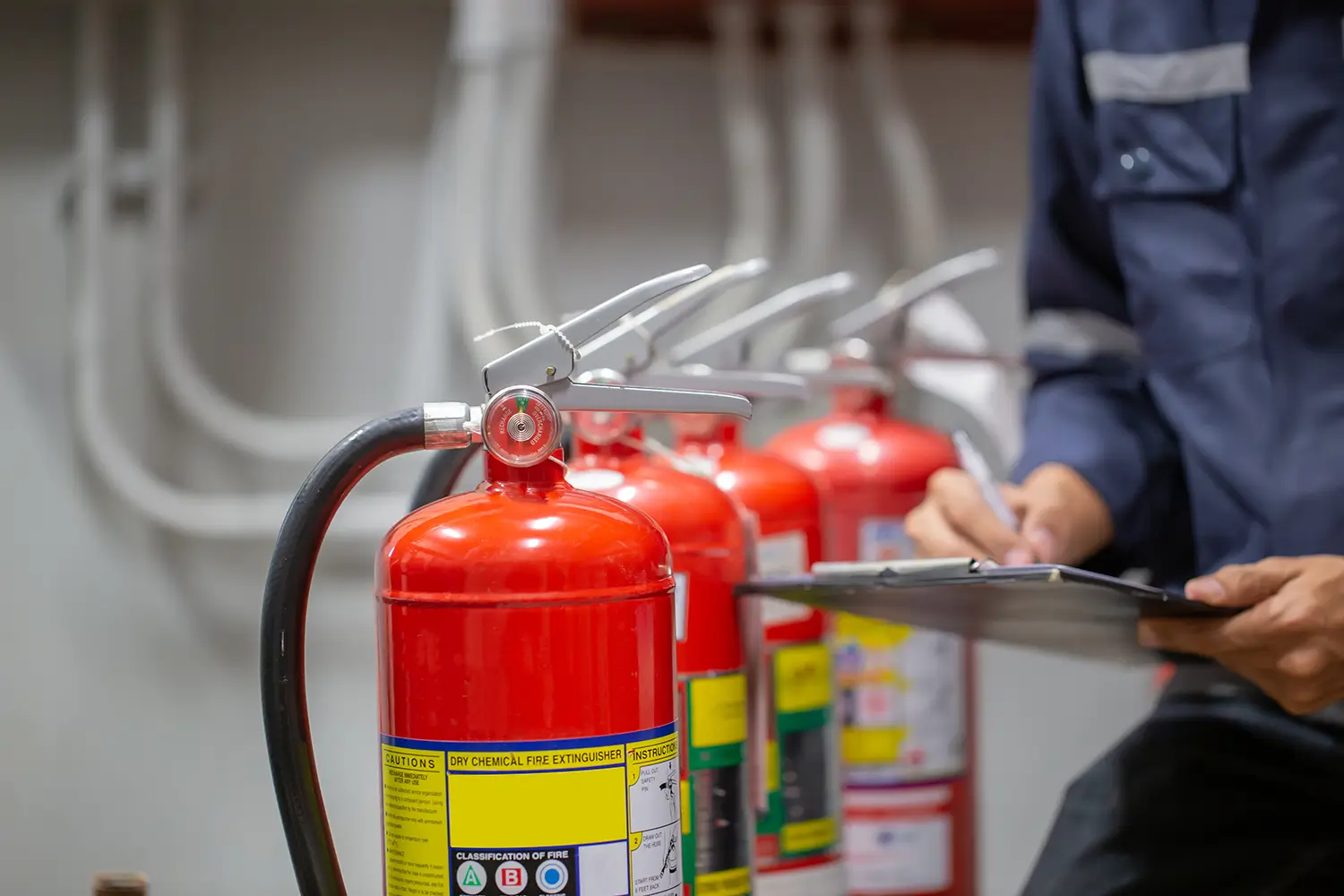
NFPA 10 is the National Fire Protection Association’s Standard for Portable Fire Extinguishers, the rulebook for which extinguishers a business needs, where they hang, and how they are inspected, maintained and tested. For a business owner it comes down to four duties, the right extinguisher within reach, a quick check every month, a yearly fire extinguisher service by a qualified technician, and the longer internal and pressure tests when they fall due. Texas enforces the 2018 edition, and Boss Fire Protection works to it across Dallas-Fort Worth.
- The building owner or occupant is responsible for inspection and maintenance
- A visual check every month, at roughly 30-day intervals, which anyone may do
- Maintenance at least once a year
- Pressure tests every 5 or 12 years, depending on the extinguisher
What Does NFPA 10 Cover?
NFPA 10 covers the selection, installation, inspection, maintenance, recharging and testing of portable fire extinguishers. It does not cover fixed systems such as a kitchen hood system or sprinklers. It tells a business how many extinguishers it needs, of what type, where they go and how they are looked after.
The current text is on the NFPA 10 standard page, where NFPA offers a free read-only copy after sign-up. Which type of extinguisher fights which fire is set out in the guide to fire extinguisher classes, types and uses.
Where NFPA 10 Says Extinguishers Must Go
- Within reach. Nobody should walk more than 75 feet to an extinguisher for ordinary combustibles, and no more than 30 feet from a cooking hazard to a Class K extinguisher.
- At the right height. The top of an extinguisher of 40 pounds or less sits no more than 5 feet above the floor, a heavier one no more than 3 1/2 feet, and the bottom at least 4 inches up.
- In view. Extinguishers are installed where they are visible, or marked by a sign where they cannot be, as explained in fire extinguisher signs and what the code requires.
- On a proper mount. A hanger or bracket made for that extinguisher, or an approved cabinet, with the operating instructions facing out.
How Often Does NFPA 10 Require Inspection?
NFPA 10 requires every extinguisher to be inspected when it is first put in service and then at least monthly, at roughly 30-day intervals. The monthly check is visual and the person doing it does not need to be certified. Maintenance by a qualified technician follows at least once a year.
The monthly check covers whether the extinguisher is in its place, visible, easy to reach, showing a pressure gauge in the green, full, and free of obvious damage. What that walk looks like in practice is in monthly fire extinguisher inspections.
30 days
The inspection interval for a portable fire extinguisher in the NFPA 10 edition Texas enforces. The 2022 edition restates it as once per calendar month, never more than 31 days apart.
Sourced to NFPA 10, Standard for Portable Fire Extinguishers
What Is Table 8.3.1 in NFPA 10?
Table 8.3.1 is NFPA 10’s list of hydrostatic test intervals, how often each type of extinguisher shell must be pressure-tested to prove it is still safe. Water, foam, carbon dioxide and wet chemical extinguishers are tested every 5 years. Most dry chemical extinguishers, the common ABC type, are tested every 12 years.
| Extinguisher type | Which ones | Hydrostatic test every |
|---|---|---|
| Water types | Stored-pressure water, water mist, loaded stream or antifreeze | 5 years |
| Wetting agent and foam | All | 5 years |
| Stainless steel dry chemical | Dry chemical in a stainless steel shell | 5 years |
| Carbon dioxide | All | 5 years |
| Wet chemical (Class K) | All | 5 years |
| Stored-pressure dry chemical | Mild steel, brazed brass or aluminum shell, the common ABC type | 12 years |
| Cartridge dry chemical | Cartridge or cylinder operated, mild steel shell | 12 years |
| Halogenated agents | All | 12 years |
The federal workplace rule carries a matching table. The OSHA portable fire extinguisher rule sets the same 5 and 12 year intervals for the common types and also requires the monthly visual check and the annual maintenance check.
What Is the Six-Year Maintenance?
Every 6 years, a stored-pressure extinguisher that is on the 12-year test cycle, which covers most ABC dry chemical units, must be emptied, examined inside and refilled. A new label records the month and year it was done. The clock restarts whenever that work is done during a recharge or a hydrostatic test.
The six-year date is easy to miss because the extinguisher looks fine from outside. It is one of the first things a technician reads on the label at the yearly service, and when a unit reaches the end of its service life is explained in do fire extinguishers expire.
What NFPA 10 Expects of Your Staff
NFPA 10 is mostly about equipment, but an extinguisher is only useful in trained hands. The OSHA rule requires employers who expect staff to use extinguishers to train them when they are hired and at least once a year after that, and how to use a fire extinguisher covers that training in plain steps.
How Boss Fire Applies NFPA 10 in Dallas-Fort Worth
At each yearly service, Boss Fire Protection’s technicians check every extinguisher against NFPA 10, its type for the hazard, its height and location, its gauge, seals and hose, its six-year and hydrostatic dates, and its tag, and they flag any unit coming due before it becomes a violation. Units that need a recharge, an internal examination or a pressure test are handled the same way, with the reason explained first.
Sources: NFPA 10, Standard for Portable Fire Extinguishers (National Fire Protection Association), on scope, placement, inspection, maintenance and the hydrostatic test intervals in Table 8.3.1. OSHA 29 CFR 1910.157, Portable Fire Extinguishers, including Table L-1. Texas Department of Insurance, State Fire Marshal’s Office, adopted rule listing NFPA 10, 2018 edition (2023).
Put a Licensed Fire Protection Team on Your Side
Inspections, service, red-tag repair, and new installs for commercial kitchens across Dallas-Fort Worth. Photo-documented work and a written report, every visit.
