
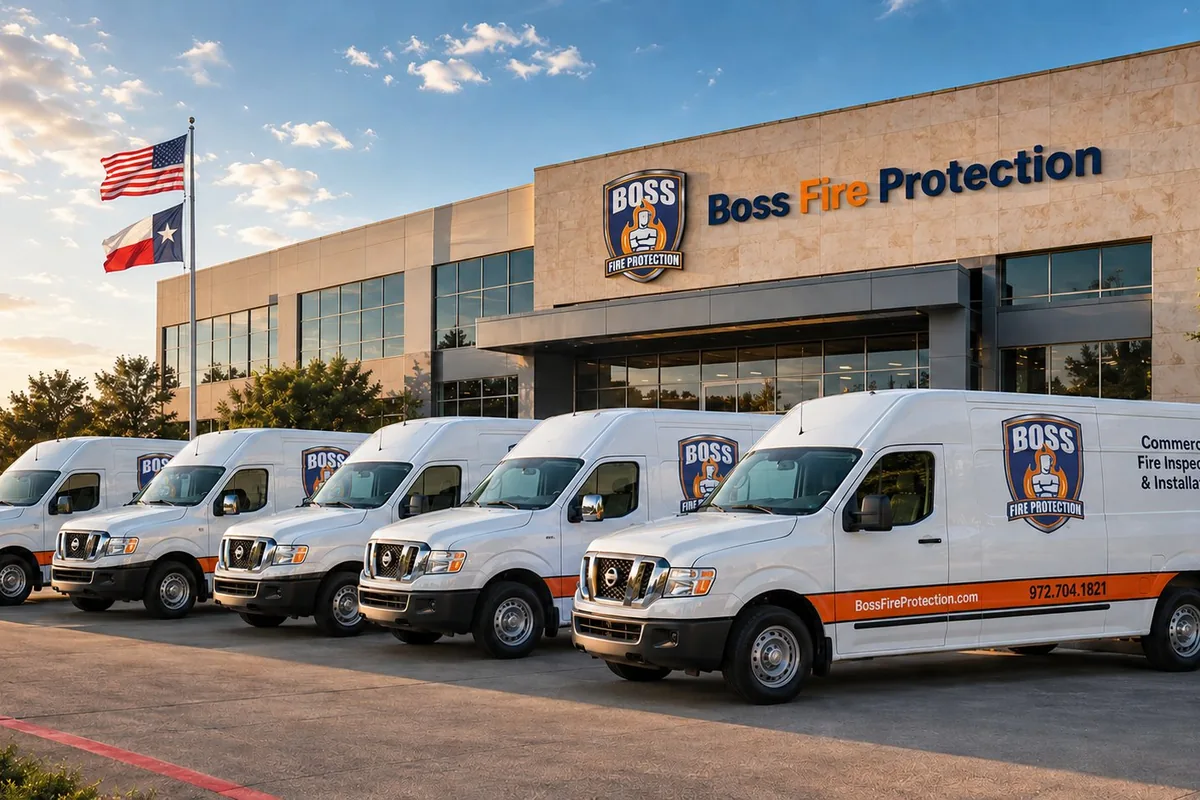
To keep fire suppression compliant across several restaurant locations, run every site on one written schedule built from NFPA 96, keep the same proof of each visit for every site in one place, and check each site against its own city’s fire marshal rather than assuming they all match. The state standard is the same across Dallas-Fort Worth, but each city applies it through its own fire code and the kitchens differ, and a group’s weakest location is the one that fails. Boss Fire Protection runs semiannual kitchen fire suppression inspections for single kitchens and restaurant groups across the area.
- Every hood suppression system is serviced at least every six months
- Grease buildup is checked monthly to yearly, depending on how each kitchen cooks
- Staff are trained on hiring and every year, at every site
- Each city’s fire marshal decides what it accepts at its own locations
How Do You Verify NFPA 96 Compliance Across Several Locations?
Ask for the same evidence from every site and read it in one place. That means the last suppression service date, the next due date, the fusible link dates on the tag, a report of each item checked, the hood cleaning record and the staff training record. Any site missing one of those is the one to visit first.
A tag on the system proves a visit happened, not what was checked. A report with photographs of each nozzle, link and cylinder lets a manager in another city see the state of a kitchen without driving to it, which is the case made in why a photo-documented fire suppression inspection matters. NFPA 96 also allows inspection and maintenance certificates to be shared with the fire marshal on paper or electronically, so one digital record per site serves the owner and the inspector alike.
What NFPA 96 Requires at Every Location
| Requirement | How often | Who does it |
|---|---|---|
| Hood suppression maintenance | At least every 6 months | A trained, qualified and certified technician acceptable to the fire marshal |
| Metal fusible links replaced | At least every 6 months | The same technician, with the dates marked on the tag |
| Grease buildup inspection | Monthly for solid fuel, quarterly for high volume, every 6 months for moderate volume, yearly for low volume | A trained, qualified and certified person |
| Staff training | On hiring and every year, on extinguishers and the manual pull station | Site management, with records kept for the fire marshal |
| Posted pull station instructions | Always in place | Site management |
High volume, in NFPA 96’s own words, includes 24-hour cooking, charbroiling and wok cooking, so two locations under the same brand can sit on different cleaning schedules if one runs a charbroiler late into the night. The six-month suppression service is explained step by step in fire suppression inspection and what NFPA 96 requires, and the wet chemical system standard behind it in NFPA 17A in plain words.
6 months
The longest any location’s hood fire suppression system may go between maintenance visits by a qualified technician.
Sourced to NFPA 96, Standard for Ventilation Control and Fire Protection of Commercial Cooking Operations
Do All Dallas-Fort Worth Cities Follow the Same Rules?
They start from the same standards but are not identical. Texas adopts NFPA 96 and NFPA 17A, both 2021 editions, for the State Fire Marshal, and each city’s fire marshal is the local authority who decides what it accepts, who may do the work and whether certificates must be sent to its office.
The state list is in the Texas Department of Insurance rule adopting the NFPA standards, in force since 1 September 2023. On top of that, Dallas, Fort Worth, Plano, Frisco and the other cities adopt their own fire codes with local amendments. A group with sites in several of them should keep a short note for each location saying which fire marshal covers it, how that office wants reports, and when its last visit was.
Where Multi-Site Compliance Usually Breaks Down
- Staggered due dates. Sites opened in different months drift apart, and one slips past six months unnoticed. Put every site on one calendar, or on two fixed rounds a year.
- A changed cook line. A new fryer or a moved charbroiler at one site leaves nozzles and links aimed at the old layout. Tell the service company before the change, not after.
- Different paperwork from different vendors. Each local company writes a different report, so nobody at head office can compare them. One standard report across all sites fixes that.
- Training that only happened at the first store. NFPA 96 makes management at each location responsible for training its own staff, and for keeping the record.
When one location does fail, the cost lands on the whole group in lost trading days and a re-inspection, as what happens if your business fails a fire inspection sets out.
How Boss Fire Supports Restaurant Groups in Dallas-Fort Worth
Boss Fire Protection services hood fire suppression systems at restaurants across Dallas-Fort Worth, single kitchens and groups alike. Every inspection produces a photo report in the same format, so a group can see the state of every location side by side, and due dates can be lined up so each site is serviced on a schedule the group sets.
Sources: NFPA 96, Standard for Ventilation Control and Fire Protection of Commercial Cooking Operations (National Fire Protection Association), on six-month maintenance, fusible links, the grease buildup inspection schedule, staff training and records. Texas Department of Insurance, State Fire Marshal’s Office, adopted rule listing NFPA 96 and NFPA 17A, 2021 editions, effective 1 September 2023.
Put a Licensed Fire Protection Team on Your Side
Inspections, service, red-tag repair, and new installs for commercial kitchens across Dallas-Fort Worth. Photo-documented work and a written report, every visit.
