
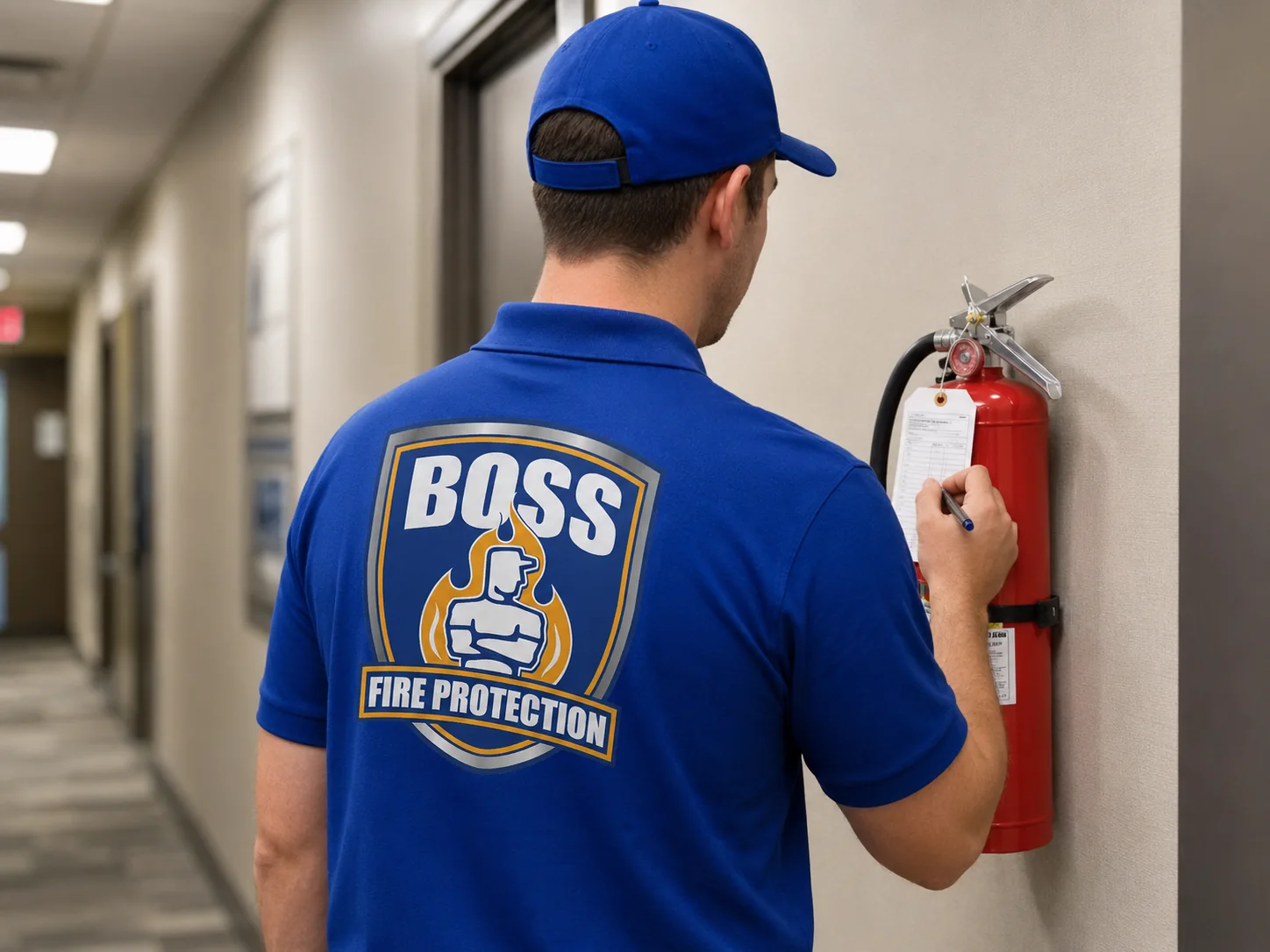
What fire extinguisher service costs depends on how many extinguishers you have, what kind they are, and which of the four jobs each one is due for this year, the annual inspection (NFPA 10 calls it maintenance, and keeps the word inspection for the monthly look at the gauge and seal), an internal examination, a hydrostatic test or a recharge. Boss Fire Protection does not publish a fixed price for commercial fire extinguisher service in Dallas-Fort Worth, because two buildings with the same number of extinguishers can owe very different work. This article explains what each job is, when NFPA 10 makes it due, and what moves the price, so you can read any quote line by line.
- How many extinguishers you have, and where they are
- Their types, from dry chemical to Class K and carbon dioxide
- Which units are due a 6-year examination or a hydrostatic test
- Any units used, damaged, recalled or past their service life
The Four Jobs a Quote Can Include
Every commercial extinguisher gets the annual inspection. The other three jobs come around on their own schedules, which is why one year’s bill can look nothing like the next.
| Job | When it is due | What drives its cost |
|---|---|---|
| Annual inspection | At intervals of not more than 1 year, every extinguisher | The number of units, plus any parts a unit needs to pass |
| 6-year examination | Every 6 years on stored-pressure dry chemical units with mild steel, brass or aluminum shells | The unit is emptied, examined inside and refilled |
| Hydrostatic test | Every 5 or 12 years, depending on the type | Pressure testing the cylinder, then recharging it |
| Recharge | After any use, or when an inspection finds it needed | The agent and the size of the unit |
What happens at the yearly visit is covered step by step in the annual fire extinguisher inspection.
Which Extinguishers Need a Hydrostatic Test, and How Often?
NFPA 10 sets two intervals. Water, foam, wet chemical, carbon dioxide and stainless steel dry chemical extinguishers are tested every 5 years. Stored-pressure dry chemical units with mild steel, brass or aluminum shells, the common ABC extinguisher on most walls, are tested every 12 years. The test is done within the calendar year it falls due.
Because the common dry chemical extinguisher runs on a 12-year cycle with a 6-year examination in the middle, a building whose extinguishers were all bought together can see most of them come due in the same year. Spreading new purchases out, or knowing which year that will be, avoids a surprise.
12 years
The longest NFPA 10 allows between hydrostatic tests on a stored-pressure dry chemical extinguisher with a mild steel, brass or aluminum shell. Water, wet chemical and carbon dioxide units are tested every 5 years.
Sourced to NFPA 10, Standard for Portable Fire Extinguishers
Why a Recharge Is Never Optional
NFPA 10 says every rechargeable extinguisher is recharged after any use, or when an inspection or servicing shows it needs it. That includes a unit that was only partly discharged, or one fired off in a training session. A unit that has lost pressure on its own also comes off the wall for recharging, because a gauge out of the green means it may not work when someone needs it.
Disposable, nonrechargeable extinguishers are a different case. They are never refilled, and NFPA 10 takes them out of service no later than 12 years after the date of manufacture. How those dates add up over an extinguisher’s life is explained in do fire extinguishers expire.
Is It Cheaper to Replace an Extinguisher Than to Service It?
Sometimes, and a good quote shows you both. A disposable unit cannot be serviced at all, so it is simply replaced. A rechargeable unit that is due a hydrostatic test or a recharge can be priced either way. A unit that fails its test, is recalled or is on NFPA 10’s obsolete list is replaced, never repaired.
The other replacement cost to watch is the wrong extinguisher in the wrong place. A unit too small for its area, or a dry chemical unit where a cooking line needs Class K, will be flagged at inspection whatever condition it is in. Choosing the right size from the start is covered in fire extinguisher sizes.
How to Compare Two Quotes
Whoever does the work, OSHA’s portable fire extinguisher rule makes the employer responsible for the inspection, maintenance and testing of every extinguisher in the workplace, so the quote is worth reading closely. Ask each company to list, per extinguisher or per type, which of the four jobs it is pricing and why. Then check these points.
- The count matches. Both quotes cover the same number of extinguishers, Class K and carbon dioxide units included.
- The due dates are shown. A hydrostatic test or 6-year examination is tied to the date on that cylinder, not added across the board.
- Parts are named. A new hose, gauge, pin or tamper seal is listed rather than folded into a vague extra.
- Replacements are explained. Each unit marked for replacement says why, whether failed, recalled, obsolete or past 12 years.
- The tag is included. Every serviced unit leaves with a tag showing the month and year, who did the work and the company.
Getting a Quote in Dallas-Fort Worth
Boss Fire Protection inspects, recharges, hydrostatically tests and replaces commercial extinguishers across Dallas-Fort Worth. Tell us how many extinguishers you have, what types they are and roughly how old, and we will quote the work that is actually due and explain anything we recommend replacing.
Sources: NFPA 10, Standard for Portable Fire Extinguishers (National Fire Protection Association), on maintenance at intervals of not more than 1 year, the 6-year internal examination, the hydrostatic test intervals in Table 8.3.1 and testing within the calendar year due, recharging after any use, nonrechargeable extinguishers removed from service at 12 years, obsolete and recalled extinguishers, and the maintenance tag. OSHA 29 CFR 1910.157, Portable Fire Extinguishers, on employer responsibility for inspection, maintenance and testing.
Put a Licensed Fire Protection Team on Your Side
Inspections, service, red-tag repair, and new installs for commercial kitchens across Dallas-Fort Worth. Photo-documented work and a written report, every visit.
