
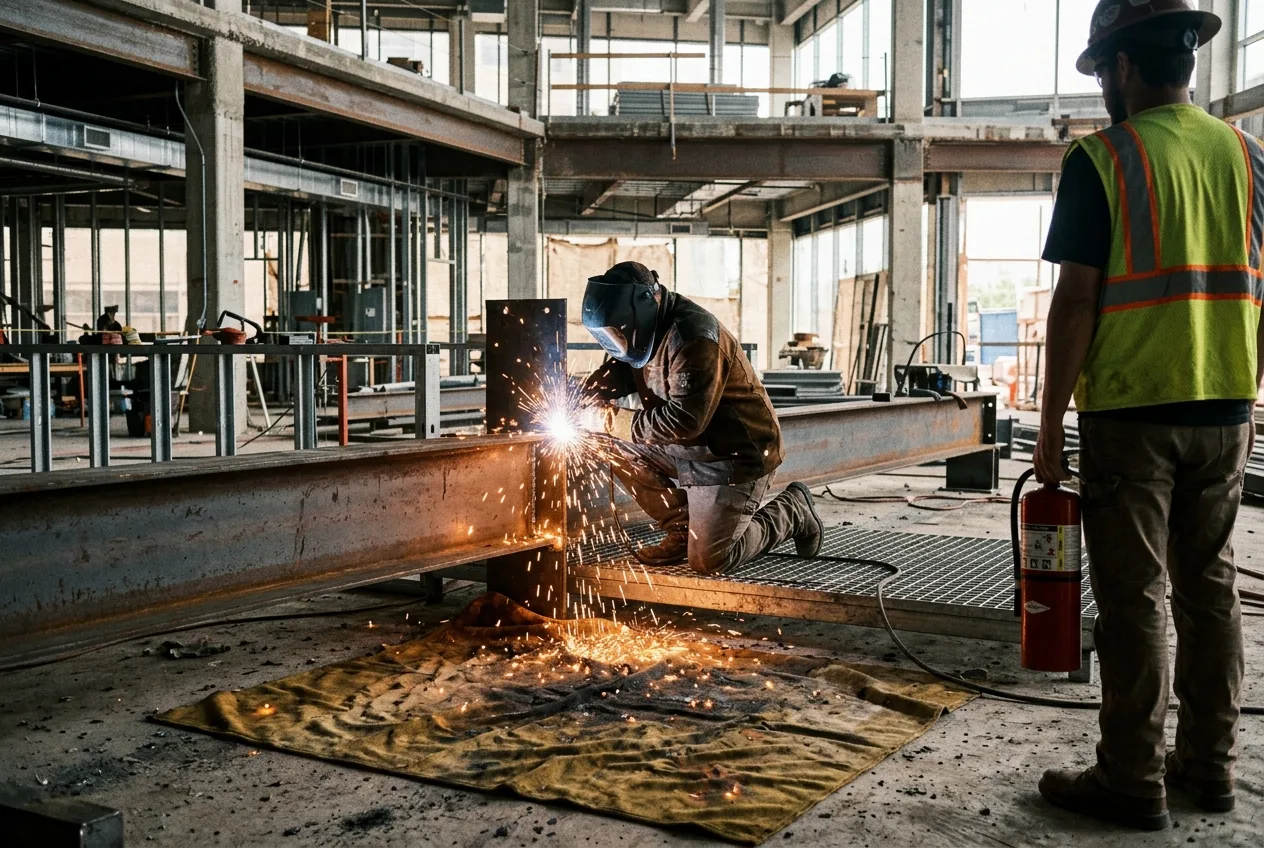
A hot work permit is the written sign-off a building gives before anyone welds, cuts, brazes or grinds on site, after the area has been checked and made safe. Under OSHA’s welding rule it names the precautions, puts a ready fire extinguisher at the work, and often calls for a fire watch that stays at least 30 minutes after the sparks stop. Boss Fire Protection supplies and services the fire extinguishers that hot work depends on across Dallas-Fort Worth, and the extinguisher is the part of a permit most easily taken for granted.
- The area is inspected and authorized before any welding or cutting
- Combustibles are moved 35 feet away, or covered and shielded
- An extinguisher is at the work, ready for instant use
- A fire watch stays at least 30 minutes after the work ends, often 60
What Is a Hot Work Permit?
A hot work permit is a written authorization to weld, cut or do other spark-producing work in a place not built for it. The person responsible for the building inspects the area first and lists the precautions on the permit. OSHA’s welding rule calls for that inspection and says the authorization should preferably be a written permit.
The rule is OSHA 29 CFR 1910.252, and it puts the duty on the building’s management as well as on the welder. Management names the person who authorizes hot work, sets the areas where it may happen, and tells the crews doing the work about any flammable materials or hazards they may not know about. Many fire codes and insurers also point to NFPA 51B, the national standard for fire prevention during hot work, and your permit form may follow it.
What the Permit Has to Cover
A good permit walks through the same checks OSHA’s welding rule lists, in the order a supervisor would do them on the floor.
| Check | What OSHA’s welding rule says |
|---|---|
| Combustibles | Moved at least 35 feet away where practicable, otherwise covered or shielded |
| Floors | Swept clean of paper, shavings and similar material for 35 feet |
| Openings | Floor cracks, wall holes and open doors protected so sparks cannot fall through |
| Ducts | Ducts that might carry sparks protected or shut down |
| Sprinklers | No welding or cutting while the building’s sprinklers are impaired |
| Extinguishing equipment | Suitable equipment kept ready for instant use |
| Fire watch | Required where more than a minor fire could develop |
The duct line matters in a restaurant. Welding near a kitchen hood or its grease duct puts sparks next to the very place grease collects, so the hood, its filters and its duct are part of the area the permit has to clear.
When Is a Fire Watch Required for Hot Work?
OSHA requires a fire watch whenever more than a minor fire could develop. That includes combustible material within 35 feet of the work, or wall and floor openings within 35 feet that expose combustibles nearby. A fire watch is also needed when combustibles sit on the far side of a metal wall, ceiling or roof being welded.
The fire watcher has fire extinguishing equipment close at hand, is trained to use it, and knows how to sound the alarm. They watch every area the sparks could reach, try to put out only a fire clearly within the equipment’s capacity, and otherwise raise the alarm. A fire watch for hot work is a different job from the fire watch the fire code calls for when a suppression system is out of service, which is explained in fire watch when your suppression system is out of service.
30 minutes
The least time a fire watch stays in place after welding or cutting ends, to find and put out any smoldering fire the sparks started.
Sourced to OSHA 29 CFR 1910.252, Welding, cutting and brazing, general requirements
Thirty minutes is OSHA’s minimum. NFPA 51B, which many permit forms follow, has asked for at least 60 minutes since its 2019 edition, so check which one your permit names.
Which Fire Extinguisher Does Hot Work Need?
Hot work needs an extinguisher suited to whatever could catch, kept charged and at the work for instant use. OSHA allows water, sand, hose or portable extinguishers depending on the material exposed. For wood, paper, cardboard and packaging, that commonly means a multipurpose ABC dry chemical extinguisher rated for ordinary combustibles.
Three things go wrong with the extinguisher on a hot work permit.
- It is the wall unit, not one brought to the work. The nearest mounted extinguisher may be across the building when the fire starts behind the welder.
- Nobody has checked it. A gauge out of the green, a missing pin or an out-of-date tag is found when the handle will not squeeze.
- The fire watcher has never used one. OSHA expects the watcher to be trained, and the steps are set out in how to use a fire extinguisher.
Closing Out the Permit
A permit is closed, not just filed. Under NFPA 51B practice, after the fire watch has stayed its time, the supervisor or the fire watcher walks the area again, including the floor below and the far side of any wall that was welded, and signs the permit off. If your permit form or your insurer asks for a longer watch or a later check, follow the longer one.
Getting Extinguishers Ready for Hot Work in Dallas-Fort Worth
Boss Fire Protection inspects, tags and recharges portable extinguishers for buildings across Dallas-Fort Worth, and can supply the right type and size for the work your site is planning. If welding or cutting is booked, have the extinguishers checked before the work starts, not after.
Sources: OSHA 29 CFR 1910.252, Welding, cutting and brazing, general requirements, on authorization and the written permit, relocating or shielding combustibles within 35 feet, sweeping floors, floor and wall openings, ducts, the ban on welding in sprinklered buildings while sprinklers are impaired, suitable extinguishing equipment, when fire watchers are required, their duties, and the half hour fire watch after the work, and management’s duties. NFPA 51B, Standard for Fire Prevention During Welding, Cutting, and Other Hot Work (National Fire Protection Association), named as the standard many permit forms follow.
Put a Licensed Fire Protection Team on Your Side
Inspections, service, red-tag repair, and new installs for commercial kitchens across Dallas-Fort Worth. Photo-documented work and a written report, every visit.
