
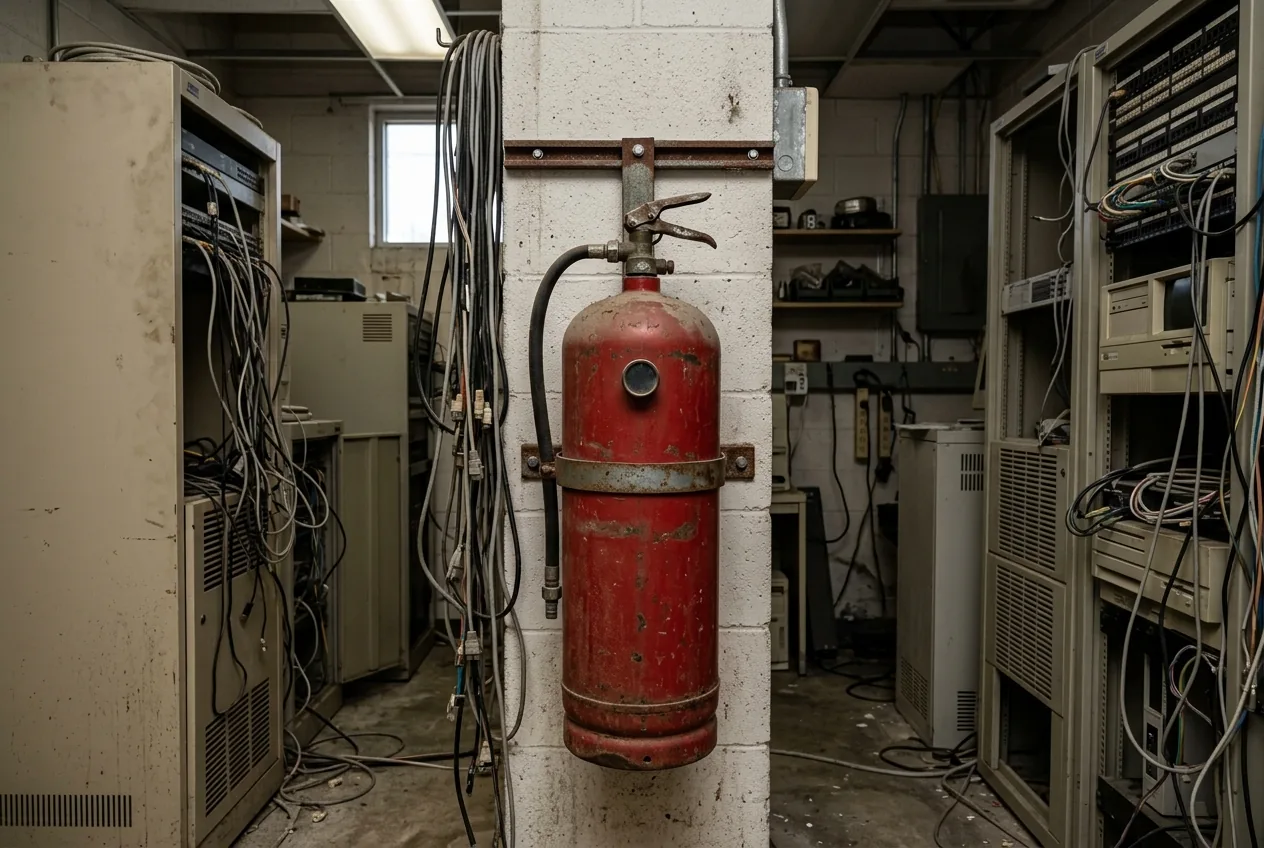
A halon fire suppression system can legally stay in service, but no new halon has been made or imported in the United States since 1994, the gas cannot be vented for testing or servicing, and every refill now comes from recycled halon. That leaves an owner three honest choices, which are to keep it maintained, to have it decommissioned and the halon recovered, or to replace it with a clean agent system. Boss Fire Protection installs Kidde clean agent fire suppression systems across Dallas-Fort Worth, and the first step with any halon system is finding out what is actually in the room.
- Production and import of new halon ended in the United States in 1994
- An existing system may stay in service on recycled halon
- Venting halon for routine testing, servicing or removal is prohibited
- Old equipment goes to a recovery or recycling facility, never the trash
Is a Halon Fire Suppression System Illegal?
No. A halon fire suppression system is not illegal to own or keep in service in the United States. What the Clean Air Act banned in 1994 was making and importing new halon. An existing system can still be maintained and recharged, but only with recycled halon, and the halon may not be vented during routine testing, servicing or disposal.
The U.S. Environmental Protection Agency’s halons program sets out the rules that do apply. Releasing halon while testing, maintaining, servicing, repairing or disposing of the equipment is prohibited, and so is a release caused by an owner failing to maintain the equipment to the industry standards. The prohibition does not cover a real discharge on a fire, which is what the system was built for.
1994
The year production and import of new halons ended in the United States. Since then recycled halon has been the only supply for existing fire suppression systems.
Sourced to U.S. Environmental Protection Agency, Halons Program
How to Tell Whether You Have a Halon System
Most halon systems still found in commercial buildings are Halon 1301 total flooding systems, typically installed in computer rooms, telecom rooms, archives and control rooms from the 1970s into the early 1990s. The cylinder label is the reliable answer. It names the agent, often as Halon 1301 or bromotrifluoromethane, and the service tag beside it shows when it was last checked. A cylinder whose label you cannot read, or a tag that is years out of date, is the first thing to get looked at.
Your Three Choices
| Choice | What it involves | What to weigh |
|---|---|---|
| Keep it in service | Regular inspection, and a recharge from recycled halon after any discharge or loss | The supply is finite, and an aging system may need parts that are hard to find |
| Decommission it | The halon and the equipment go to a recovery or recycling facility | The room is left unprotected until something replaces it |
| Replace it | A clean agent system designed for the room as it is today | A new design, new cylinders and often new piping and detection |
Replacement is a new design rather than a swap of one gas for another. Clean agents are used at different concentrations from halon and flow differently through pipe, so the agent quantity, the cylinders and the nozzles are worked out for the room from scratch. Choosing the agent itself is covered in FM-200 or Novec 1230, and what a modern server room system needs is covered in server room fire suppression.
What Happens to the Halon When a System Comes Out?
The halon is recovered, not released. EPA rules require halon-containing equipment at the end of its life to go to a recovery or recycling facility working to NFPA 10 and NFPA 12A, such as a manufacturer, a fire equipment dealer or a recycler. The recovered halon is cleaned and returned to the supply for systems that still need it.
EPA also requires technicians who handle halon to be trained in handling and disposing of it, within 30 days of hire. In 2025 EPA stepped in to stop a plan to destroy 30,000 pounds of Halon-1301 in exchange for climate credits, calling halon a strategic chemical. Halon is still used on civil aircraft and in legacy military systems, and recycled halon is their only supply. That is why a decommissioned cylinder is worth recovering properly rather than scrapping.
Is Halon Safe for People in the Room?
Halon 1301 is permitted in occupied rooms at the concentrations used to put out a fire, within limits. OSHA’s rule for gaseous systems caps Halon 1301 at 7 percent where people cannot get out within one minute, and at 10 percent where it takes 30 seconds to a minute. Higher concentrations are allowed only in rooms not normally occupied.
OSHA 29 CFR 1910.162 also requires a halon system to reach its design concentration within 10 seconds of discharge. As with any total flooding system, everyone should leave when the alarm sounds, because a fire produces smoke and breakdown products of its own.
Replacing a Halon System in Dallas-Fort Worth
Boss Fire Protection installs Kidde clean agent systems for server rooms, telecom rooms and archives across Dallas-Fort Worth. If you have found an old halon cylinder, send us a photo of its label and tag. We will tell you what it is, and before any work starts you get the replacement agent, the cylinder count and the cost in writing.
Sources: U.S. Environmental Protection Agency, Halons Program, on the end of production and import in 1994, recycled halon as the only supply, the ban on halon blends, the venting prohibition and its exemptions, technician training within 30 days of hire, proper disposal to facilities working to NFPA 10 and NFPA 12A, and the 2025 halon destruction case. U.S. Environmental Protection Agency, Questions and Answers About SNAP, on the 1994 ban under the Clean Air Act and existing systems relying on recycled halon. OSHA 29 CFR 1910.162, Fixed extinguishing systems, gaseous agent, on the 10 second discharge for halon systems, pre-discharge alarms, and the 7 percent and 10 percent limits on Halon 1301 by how quickly people can leave.
Put a Licensed Fire Protection Team on Your Side
Inspections, service, red-tag repair, and new installs for commercial kitchens across Dallas-Fort Worth. Photo-documented work and a written report, every visit.
