A commercial kitchen fire suppression system in Dallas-Fort Worth must be inspected at least once every six months, under NFPA 96, by a licensed fire suppression technician, not by kitchen staff and not on an annual schedule. That single requirement drives everything below: what gets checked, who is allowed to check it, and what happens when a system does not pass.
- The standard. NFPA 96, the National Fire Protection Association standard for ventilation control and fire protection of commercial cooking operations
- The interval. Every six months, twice a year, with no exception for a clean-looking kitchen
- Who can perform it. A licensed technician working for a company registered with the Texas Department of Insurance State Fire Marshal’s Office
- What you get. A tag on the system recording the date, the technician, and the next due date
How Often Does NFPA 96 Require a Fire Suppression Inspection?
NFPA 96 requires a commercial kitchen fire suppression system to be inspected every six months, twice a year, by a licensed technician. The interval applies however many covers the kitchen does and however new the equipment is, so one griddle three nights a week runs on the same clock as a full line.
Every six months. NFPA 96, the Standard for Ventilation Control and Fire Protection of Commercial Cooking Operations, is the code that sets this interval, and it applies regardless of how many covers the kitchen does or how new the equipment is. A kitchen that runs one griddle three nights a week is on the same six-month clock as one that runs a full line seven days a week.
Every 6 months
How often a commercial kitchen fire suppression system must be inspected by a licensed technician, however busy or new the kitchen is.
Sourced to NFPA 96, Standard for Ventilation Control and Fire Protection of Commercial Cooking Operations
It is worth clearing up a common mix-up. UL 300 is not the code that requires the semiannual visit. UL 300 is the testing standard a manufacturer’s system is built and listed against, covering how the system must perform in a fire test. NFPA 96 requires the system to be listed to UL 300 and sets the six-month maintenance on top of that, for as long as the kitchen operates.
Who Is Allowed to Perform a Semiannual Inspection in Texas?
In Texas, the inspection must be done by a licensed technician working for a company that holds a certificate of registration from the Texas Department of Insurance State Fire Marshal’s Office. The company is registered and the technician is licensed, and a check by kitchen staff, however careful, does not satisfy NFPA 96.
The Texas Department of Insurance State Fire Marshal’s Office licenses this work under the fire extinguisher licensing category, which covers both portable extinguishers and fixed kitchen suppression systems. The company must carry a certificate of registration, and the technician who signs the tag must hold a license of their own. Boss Fire Protection is registered with the Texas Department of Insurance under Fire Extinguisher Certificate of Registration TX ECR-2481913.
This is not a paperwork detail. A restaurant’s own staff can run the monthly visual check between visits, looking for obvious damage, a knocked-off nozzle cap or a missing extinguisher, but that is not the semiannual inspection and does not satisfy NFPA 96. Only a licensed technician’s signature and tag do that, and an inspection performed by anyone else will not hold up when the local fire marshal or an insurance adjuster asks to see it.
What the Technician Checks During the Inspection
NFPA 96 treats the suppression system as a set of parts that each has to work together, not as one device to glance at. A semiannual visit works through the same components every time.
| What is checked | What the code requires | What a failure looks like |
|---|---|---|
| Fusible links | Intact, undamaged, and matched to the heat rating of the appliance below them. They are one-time-use parts, and Boss Fire’s own guide to fusible link replacement covers why they are changed on the same six-month cycle even when they still look fine. | A cracked, corroded, or grease-coated link, or one rated for the wrong appliance. |
| Nozzle placement | Each nozzle sits in the exact position and aim called for in the system’s listed design for that specific appliance lineup. | A fryer, griddle, or char broiler swapped for a different size, or an appliance moved, without the nozzle position updated to match. |
| Nozzle caps | Every nozzle carries its blow-off cap, keeping grease out of the nozzle opening until the system fires. | A missing, damaged, or grease-sealed cap that would keep the agent from discharging where it is aimed. |
| Detection line and conduit | An unbroken line runs from the fusible link network to the release mechanism, protected by conduit along its length. | A kinked, crimped, or disconnected line, or conduit that is damaged or missing where it crosses the hot side of the hood. |
| Agent tank and cartridge | The wet chemical tank holds its full charge. A stored-pressure tank’s gauge reads in range, and on a cartridge-operated system the cartridge is weighed against the weight stamped on it and properly seated. | A gauge out of range, a cartridge under its stamped weight or past its date, or corrosion on the cylinder body. |
| Manual pull station | An accessible, unobstructed pull station fires the system when pulled, and on a mechanical system it does so without any electrical power. | A blocked station, a missing pull pin, or a pull that does not trip the release. |
| Gas or electric shut-off | Activating the system automatically cuts gas or power to the protected appliances at the same moment the agent discharges. | A shut-off valve or relay that does not trip, or one that was wired to reset before it should. |
| Hood and duct condition | The hood, plenum, and connected duct show no dangerous grease accumulation at the time of the suppression inspection. | Heavy grease buildup inside the hood or duct, which is its own violation separate from the suppression system itself. |
| Extinguisher beside the line | A correctly rated, fully charged portable extinguisher is mounted within reach of the cooking line, current on its own tag. | A missing, discharged, or expired extinguisher parked near the appliances. |
What the Inspection Tag Actually Records
The tag the technician hangs on the system at the end of the visit is not a sticker for the wall. It is the record the local fire marshal reads on a walkthrough and the record an insurance company asks for after a claim. It carries the date of the inspection, the technician and company that performed it, and the date the next semiannual visit is due. A kitchen operating past that due date on an unmarked or expired tag is operating out of compliance whether or not the system itself still works. For a restaurant group, the same tag and report from every kitchen is what lets head office check each one without a site visit, as fire suppression compliance across several restaurant locations explains.
What Makes a System Fail Its Inspection?
A system fails its inspection when any one item fails, because the components work as a chain. The most common cause is not a broken part but a kitchen change made without telling the suppression company, such as a new fryer, a swapped griddle or an added char broiler that moves the system out of its listed design.
Any one item in the table above failing its check is enough to fail the system as a whole, because the components work as a chain. The most common cause is not a broken part. It is a kitchen change made without telling the suppression company. A new fryer that sits a few inches from where the old one sat, a griddle swapped for a flat-top, or a menu change that adds a char broiler under a nozzle sized for a fryer all move the system out of its listed design, and the system has to be changed to match the equipment underneath it, not the other way around.
What Happens After a Failed Inspection?
When a failed item leaves the system unsafe or inoperable, the company servicing it hangs a red tag. It also tells the owner and the local fire official, and NFPA 96 does not allow cooking under that hood until it is fixed. After the repair, a passed tag with the new date replaces the red tag.
In Texas, when a failed item makes the system unsafe or inoperable, the servicing company hangs a red tag and must report it to the owner and the local fire official, and the kitchen cannot cook under that hood until the failure is corrected. That is a harder stop than it sounds. It is not a warning to fix it soon, it is the system being taken out of service on the spot. Once the repair is made, a re-inspection replaces the red tag with a passed tag showing the new date, and that new tag, not a verbal assurance from the technician, is what satisfies the fire marshal. Our companion piece on the full inspection checklist and code background covers how a restaurant gets from a failed visit back to a compliant one item by item.
How Boss Fire Handles the Semiannual Inspection
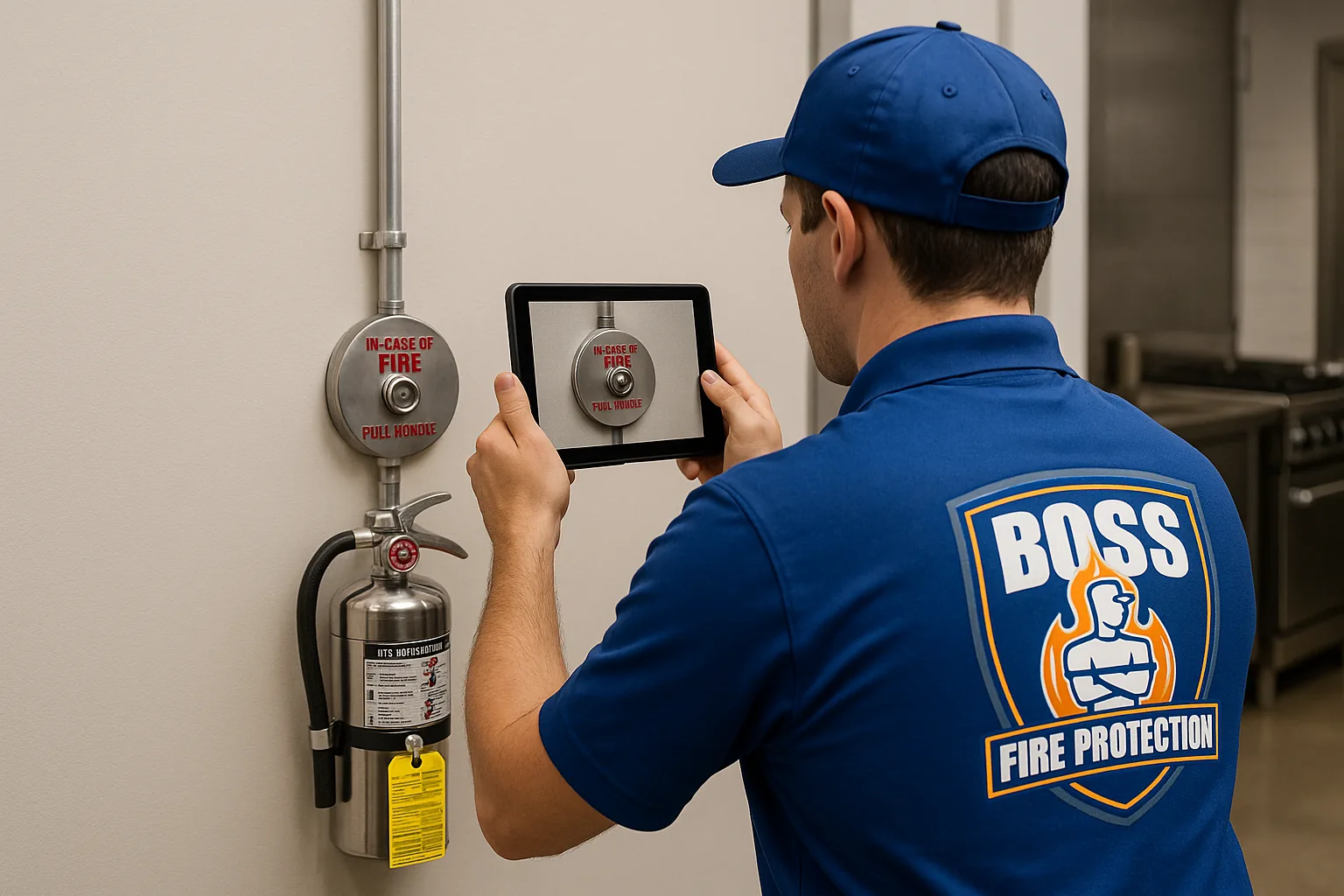
Boss Fire Protection technicians work through the same nine-point check above on every semiannual visit across Dallas-Fort Worth, and the report leaving the kitchen is photo-documented against each item, not just a signed tag. A failed item is repaired and re-tagged the same day whenever the part is on the truck, rather than leaving a kitchen closed while a part is ordered. The company’s own Fire Extinguisher Certificate of Registration, TX ECR-2481913, is on file with the State Fire Marshal’s Office and available to any fire marshal or insurance adjuster who asks to see it.
Sources: NFPA 96, Standard for Ventilation Control and Fire Protection of Commercial Cooking Operations, National Fire Protection Association. Texas Department of Insurance, State Fire Marshal’s Office, fire industry licensing, and rules 28 TAC 34.511, 34.517 and 34.521.
Put a Licensed Fire Protection Team on Your Side
Inspections, service, red-tag repair, and new installs for commercial kitchens across Dallas-Fort Worth. Photo-documented work and a written report, every visit.