Kitchen fire suppression repair means diagnosing and fixing whatever is stopping a wet chemical system from doing its one job: putting agent on a grease fire the moment one starts. It is a different visit from a routine inspection. A repair starts from a known problem, a failed inspection, a red tag, a discharge, or a fault a technician already found, and it ends when the system is tested and proven to work again. If your system has been tagged, has already discharged, or is showing a fault nobody has explained, here is what is usually wrong, what has to happen before you cook again, and what decides whether the fix is a part or a whole new system. The wider question across every kind of equipment is covered in when to replace versus repair fire protection equipment.
- Twice a year. NFPA 96 requires a qualified technician to inspect and service a kitchen fire suppression system at least every six months
- The usual culprit. A fusible link past its six-month replacement, or coated in grease, is one of the most common reasons a system fails
- A red tag stops cooking. The system is out of service, and NFPA 96 does not allow cooking under that hood until it is repaired and re-tested
- Pre-UL 300 systems. A dry chemical system cannot be repaired into compliance, and an early wet chemical one only sometimes can be upgraded
What Actually Fails in a Kitchen Suppression System
A wet chemical kitchen system, the type covered by NFPA 17A, has only a handful of parts that can actually fail, and a repair call almost always finds one of them.
The fusible link lets the system react on its own, without anyone pulling the manual station. Each link is rated to melt at a set temperature, and it carries a replacement interval because heat and time both degrade it, fire or no fire. A link left past that interval, or coated in grease from the hood above it, may not melt at its rated temperature, or at all. Boss Fire replaces links at every semiannual inspection. If yours has not been changed in longer than that, treat it as a repair item, not a footnote.
The detection line runs from the fusible links, through a small conduit under the hood, to the release mechanism. Grease vapor pulled through the hood filters settles inside that conduit over years of cooking and can stiffen the cable so the line cannot pull when a link melts. It is not a job for kitchen staff or a hood cleaner, because the manufacturers warn that cleaning chemical left on detection equipment is a fault of its own. If an inspector flagged the detection line, or you can see grease where the conduit enters the hood, the fix is a cleared or replaced line and a re-test, not a wipe-down.
Nozzle caps keep grease out of the discharge opening, and they are easy to knock loose during normal kitchen work. A missing cap lets grease into the nozzle, and a clogged nozzle cannot discharge agent even if everything upstream works. Just as often the nozzle is aimed at nothing useful: a fryer was swapped, a griddle moved a foot over, or a new appliance replaced a prep table, and nobody re-pointed the coverage. Any equipment change means the coverage has to be checked against it, not assumed to still match.
What Fails Away From the Nozzles
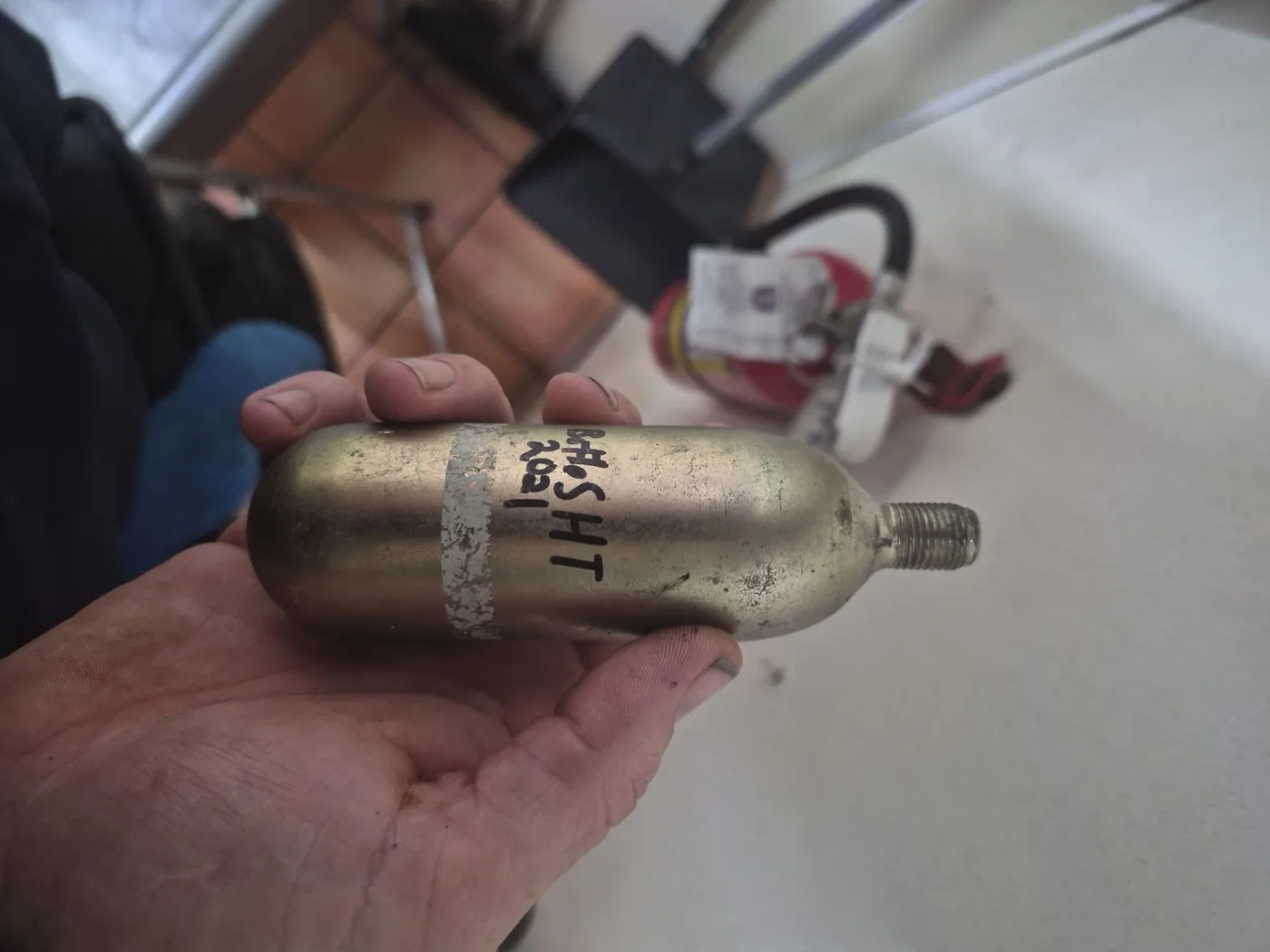
Past the nozzles, the tank and what drives it are the other place a system quietly stops working. A cartridge-operated system uses a small gas cartridge to force agent out of the tank, and a cartridge that has leaked down, which shows as a weight below the one stamped on it, or has passed its replacement date may not push the agent out fully. A stored-pressure tank can lose pressure from a slow seal leak instead, and a gauge reading low is not cosmetic. Either failure means the system might activate and still not deliver a full discharge.
The manual pull station is the backup for every automatic method above it, and it is often the most neglected part because nobody expects to need it. Corrosion, paint, or a seized mechanism can leave a station that looks fine but will not release the system when pulled in an emergency.
A hood system has to shut off the gas or electric supply the moment it activates, so the fire is not being fed while it is being fought. A corroded shutoff valve, or a linkage that has come loose or bent, can fail to latch closed, so the burners stay lit through a discharge.
The micro-switch is the electrical contact that tells the building’s fire alarm, where one is tied in, and an electrically operated gas valve, where one is fitted, that the system has activated. A wiring fault here does not stop the tank from discharging, but it can mean the alarm never sounds or that kind of gas valve never shuts, which is why a full test checks the whole chain, not just the tank.
| Symptom | What It Usually Means | Repair or Replace |
|---|---|---|
| Caps missing or nozzles greased | Caps knocked loose during cleaning, or years of grease buildup blocking the opening | Repair, clean or replace the nozzle and refit the caps |
| Inspector flags the detection line | Grease has stiffened the cable inside the conduit, or a link is past its interval | Repair, clear or replace the line and replace the link |
| Low gauge or light cartridge | A slow leak in a stored-pressure tank, or a cartridge that has leaked down or passed its date | Repair if the tank holds a recharge, replace if it will not |
| Pull station stiff or stuck | Corrosion or a seized mechanism inside the station | Repair, clean, lubricate, or replace the station |
| Gas valve will not latch on test | A corroded valve, or a bent or disconnected linkage | Repair, replace the valve or reset the linkage |
| Alarm or gas shutoff not triggered | A wiring fault at the micro-switch | Repair, replace the switch and re-test the whole chain |
| Nozzles no longer line up | Appliances were moved, swapped, or added since the system was designed | Repair if the system can be reconfigured, replace if coverage has to be redesigned |
| Dry chemical system | No dry chemical kitchen system has ever been listed to UL 300 | Replace, no repair brings it into UL 300 compliance |
| Early wet chemical system | Built before the November 1994 revision of UL 300, so not listed to the current test | Upgrade to the manufacturer’s current UL 300 manual where it allows, otherwise replace |
Can a Pre-UL 300 System Be Repaired?
A dry chemical system cannot be repaired into compliance and is replaced, because no dry chemical kitchen system has ever been listed to UL 300. An early wet chemical system can sometimes be upgraded to the manufacturer’s current UL 300 manual, usually with new nozzles and more agent, but swapping in a few newer parts is never enough.
Sometimes, and this is the one failure a single part cannot fix. UL 300 is the current fire-testing standard for commercial cooking fire suppression systems. It exists because kitchens moved to vegetable oil, which ignites at a higher temperature than the animal fat cooked in before and is harder to keep from reigniting, on appliances that hold their heat longer, and a dry chemical system built for the earlier kitchens does not reliably keep a modern grease fire out. Amerex, one of the suppression manufacturers, records that the current, revised UL 300 standard took effect in November 1994 and that none of the dry chemical systems in use at the time could pass its new fire test. So a dry chemical system cannot be brought into compliance by swapping parts, and it is replaced. An early wet chemical system, built before the November 1994 revision of UL 300, is a different case. Some can be upgraded to the manufacturer’s current UL 300 manual, which usually means new nozzles, more agent and often a rebuild, but only as a whole, because the listing covers the agent, piping and nozzles as one tested assembly. Mixing a few newer parts into an old system voids the listing it had rather than fixing it. If a technician says a system needs replacing rather than repairing, this is almost always why, and it is fair to ask whether it predates UL 300 before assuming the repair is being oversold.
1994
The year the revised UL 300 fire test for commercial kitchen suppression systems took effect, on November 21, 1994.
Sourced to Amerex, What is a Class K fire
What Happens After a Kitchen Suppression System Discharges?
After a discharge, the system has to be recharged with agent, then inspected, tested and re-tagged by a licensed technician, and every surface the agent reached has to be cleaned. Depending on the severity of the fire, the fire marshal may also need to inspect the kitchen, and all of it comes before you cook again.
A discharge does not end a repair, it starts one. Recharging means refilling the tank with agent and replacing the cartridge or restoring the stored pressure, and the fusible links and nozzle caps are replaced at the same time. Recertifying means the system is inspected, tested, and re-tagged by a licensed technician, the same as any other repair. The hood, filters, and every surface the agent reached also have to be cleaned, because the agent is alkaline and its residue is not meant to sit on stainless steel or in a grease trap. Depending on the severity of the fire, the fire marshal may also need to inspect the kitchen before it reopens. Cooking under a discharged, unrecharged system is the same as cooking with no suppression system at all.
What a Red Tag Means for Your Kitchen
A red tag is not paperwork, it takes the system out of service. In Texas the company servicing the system hangs one when an impairment makes the system unsafe or inoperable, and must report it to the owner and the local fire official, and NFPA 96 does not allow cooking under a hood whose system is out of service. Beyond the closure, a red tag creates a record that follows the location into its next inspection, and a fire while the system was out of service can put the insurance coverage at risk. While it is out of service, the fire official may require a fire watch, as fire watch when a suppression system is out of service explains. Clearing a tag means fixing the failure the inspection found, then having the system re-tested and re-tagged, not patched to look right for one visit. Regular fire suppression inspections are what usually catch these failures before a fire does.
What Drives the Cost of a Kitchen Suppression Repair
Boss Fire Protection quotes every repair to the actual failure rather than a flat rate, because the cost drivers are different jobs. A part swap, a link, a nozzle, a cap, is the smallest of them. A full recharge costs more, since it means refilling the tank and testing the whole system, not just swapping one part. Replacing the tank is a bigger job again, needed when it will not hold a recharge or has corroded past what a technician can certify. The largest driver is a coverage redesign: if the equipment layout has changed enough that the nozzles no longer protect what is cooking underneath them, or the system is pre-UL 300, the job is a new or rebuilt system sized to the kitchen you have now, not the one the original installer saw.
What Boss Fire Protection Does About It
Boss Fire Protection diagnoses the failure first, on site, before recommending a fix. Technicians stock parts for every major UL 300 wet chemical system used across Dallas-Fort Worth kitchens, including ANSUL, Protex, Pyro-Chem, Kidde, Amerex and Buckeye, so the failed part can usually be replaced from the truck and the system re-tested on the first visit instead of a second trip for parts. Where a repair genuinely will not bring a system into compliance, that gets said plainly, with the reason, rather than patched over so it looks fixed until the next inspection.
Sources: NFPA 96, Standard for Ventilation Control and Fire Protection of Commercial Cooking Operations. NFPA 17A, Standard for Wet Chemical Extinguishing Systems. UL 300, the fire-testing standard for extinguishing systems on commercial cooking equipment. Amerex, What is a Class K fire. FEMA, Restaurant Fire Protection, UL 300 questions and answers. Texas Department of Insurance, State Fire Marshal rule 28 TAC 34.521.
Put a Licensed Fire Protection Team on Your Side
Inspections, service, red-tag repair, and new installs for commercial kitchens across Dallas-Fort Worth. Photo-documented work and a written report, every visit.