
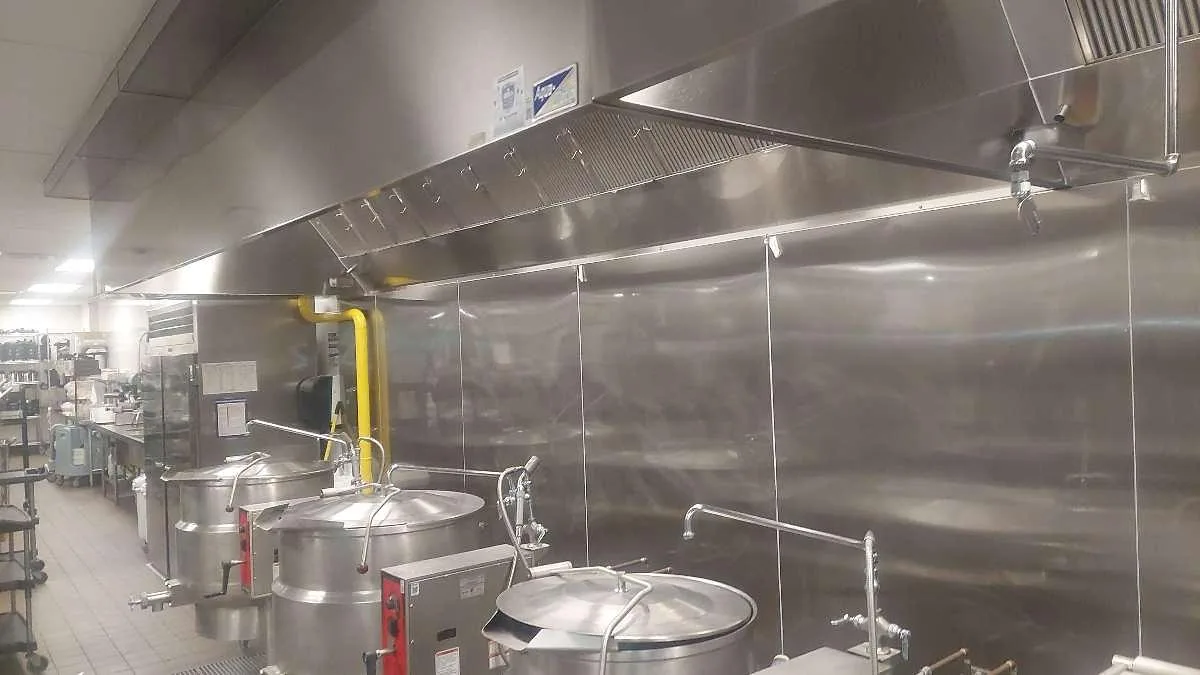
A ventless hood still needs fire suppression. NFPA 96 calls these units recirculating systems, because they clean the air and return it to the room instead of ducting it outside, and it requires each one to be listed to UL 710B with fire protection built into the listing. The appliances under it must be covered by that built-in system or by a standard kitchen suppression system, and the whole unit is tested every six months. Boss Fire Protection inspects and services the suppression built into these units, and handles fire suppression installation for commercial kitchens with ducted hoods, across Dallas-Fort Worth.
- Listed to UL 710B, the standard for recirculating systems
- Fire protection is part of the listing, not an add-on
- Gas or electric appliances only, never solid fuel
- Interlocks stop the cooking if a filter or panel is out
Does a Ventless Hood Need Fire Suppression?
Yes. NFPA 96 requires a recirculating system’s listing to include integral fire protection, and the cooking appliances under the hood must be protected either by that built-in system under UL 710B or by a kitchen fire suppression system meeting the standard’s normal rules. A ventless unit with no working suppression should not be used.
The difference from a ducted hood is what the suppression protects. A ducted hood system covers the appliances, the hood and the duct, and when the codes call for that ducted grease hood is set out in Type I hood requirements and where the suppression system fits. A ventless unit has no duct, but it has grease filters, odor filters and often an electrostatic precipitator inside the cabinet, and NFPA 96 requires the listing to cover those as well as the appliance nozzles. How a ducted system is chosen for a full restaurant line is covered in how to choose the right fire suppression system for your restaurant.
What Does the UL 710B Listing Require?
UL 710B is the safety standard for recirculating systems. A listed unit has been tested to capture grease vapor and keep grease discharge below a set limit, to set its clearance from combustibles, and to stop the appliance from running if any filter or panel is missing. Its label names the appliances it was tested with and their maximum limits.
That label is the rule book for the unit. NFPA 96 says no appliance may be used under a recirculating system if it exceeds the labeled limits for energy input, cooking temperature, or cooking surface area or cavity size, and that no appliance, filter, blower or suppression part may be swapped in a way that breaks the listing. A fryer replaced with a larger one can take a compliant unit out of compliance overnight.
The listing sits alongside the other kitchen fire standards. UL 300 is the test a kitchen system must pass against modern cooking oil, explained in UL 300 and wet chemical kitchen fire suppression, and NFPA 17A is the standard for designing and servicing the wet chemical system itself, explained in NFPA 17A in plain words.
The Safety Features NFPA 96 Requires
| Feature | What it does |
|---|---|
| Interlocks on panels and filters | The appliance cannot run unless every closure panel and every grease and odor filter is in place |
| Airflow switch | Cuts the appliance if airflow drops 25 percent below normal or 10 percent below the listed minimum, whichever is lower |
| Fire-actuated damper | Closes the exhaust outlet in a fire, with an actuator rated no higher than 375°F |
| Detection after the precipitator | A detection point downstream of any electrostatic precipitator |
| Manual pull | A clearly marked way to fire the system by hand from a safe spot |
Texas applies the 2021 edition of NFPA 96, listed in the Texas Department of Insurance rule adopting the NFPA standards. It also limits these units to gas or electric appliances, and leaves where one may be placed to the local fire marshal, after a review of life safety, nearby combustibles, air vents and the total fuel load in the room.
How Often Is a Ventless Hood Serviced?
More often than many owners expect. NFPA 96 calls for any electrostatic precipitator to be cleaned at least weekly, the hood plenum and blower section at least every 3 months, and the whole unit and all its interlocks inspected and tested by qualified service staff at least every 6 months, with a signed log kept on site.
3 months
The longest a ventless hood’s plenum and blower section may go between cleanings, on top of weekly precipitator cleaning and six-month testing.
Sourced to NFPA 96, Standard for Ventilation Control and Fire Protection of Commercial Cooking Operations
The fire suppression part of the unit is serviced on the same six-month schedule as any other kitchen system, with links, nozzles and the release checked. Filters are cleaned or replaced as the manufacturer instructs, and covers on fryers must never block the suppression nozzles.
Is a Ventless Hood Right for Your Kitchen?
A ventless hood suits a small, fixed menu cooked on the exact appliances the unit was listed with, in a space where a duct to the roof is impossible or too costly. It does not suit a kitchen whose line changes often, or one that wants a wood-fired oven, and most listings do not include a charbroiler.
Typical homes for one are a kiosk, a stadium stand, an office kitchen or a store inside a larger building. Ask the fire marshal early, because the location needs that office’s approval before the unit is bought.
How Boss Fire Handles Ventless Hood Suppression in Dallas-Fort Worth
Boss Fire Protection installs, inspects and services kitchen fire suppression in Dallas-Fort Worth, and on a ventless unit the technician compares the appliances under it with its listing label, so you know they match what the unit was tested with. If a menu change means a different appliance, the time to call is before it arrives.
Sources: NFPA 96, Standard for Ventilation Control and Fire Protection of Commercial Cooking Operations (National Fire Protection Association), on recirculating systems, their listing to UL 710B, interlocks, location and maintenance. UL 710B, Standard for Recirculating Systems. Texas Department of Insurance, State Fire Marshal’s Office, adopted rule listing NFPA 96, 2021 edition (2023).
Put a Licensed Fire Protection Team on Your Side
Inspections, service, red-tag repair, and new installs for commercial kitchens across Dallas-Fort Worth. Photo-documented work and a written report, every visit.
