
The cost of a commercial kitchen fire suppression system is set by the cooking line it protects, not by a catalog price. The appliances under the hood, the length of hood and duct, and the number of agent tanks all move the figure. So do the gas and power shutoff and what the local fire marshal requires for permits and testing. That is why every fire suppression system installation Boss Fire Protection quotes in Dallas-Fort Worth starts with a look at the kitchen itself.
- The appliances, hood and duct that need nozzle coverage
- How many agent tanks that coverage takes
- The gas valve or power shutoff and any fire alarm tie-in
- Plans, permit and the acceptance test, then service every 6 months
How Much Does a Commercial Kitchen Fire Suppression System Cost?
There is no honest single price, because two kitchens rarely need the same system. A short line with one fryer and one griddle needs far less agent, piping and labor than a long line with charbroilers, woks and a long duct run. A fair quote comes after someone has measured the hood and listed every appliance under it.
Be wary of any price given before anyone has seen the kitchen. The system has to be designed to the manufacturer’s listing for exactly the appliances, hood and duct in front of it, so a figure quoted blind is either padded or about to change. If you are still choosing between system types, how to choose the right fire suppression system for your restaurant walks through the options first.
The Cooking Line Under the Hood
NFPA 96, the standard for commercial cooking operations, requires fire-extinguishing equipment for the grease removal devices, the hood plenum and the exhaust duct, and for any cooking equipment that produces grease-laden vapors and could ignite grease in the hood or duct. Every one of those areas needs nozzles aimed at it, so the layout drives most of the cost.
- Appliance count and type. Fryers, griddles, charbroilers, upright broilers, range tops, woks, salamanders and open-face ovens each need their own nozzle coverage. A wok or a charbroiler generally needs more than a flat griddle of the same width.
- Hood length and duct run. A longer hood means more plenum to cover, and a longer or more complicated duct means more nozzles and more pipe.
- Appliance moves. Moving or adding an appliance later can mean moving nozzles, which is a change to the system and is cheaper to plan for now.
The current edition of the standard is on the NFPA 96 standard page.
Agent Tanks, Flow Points and Piping
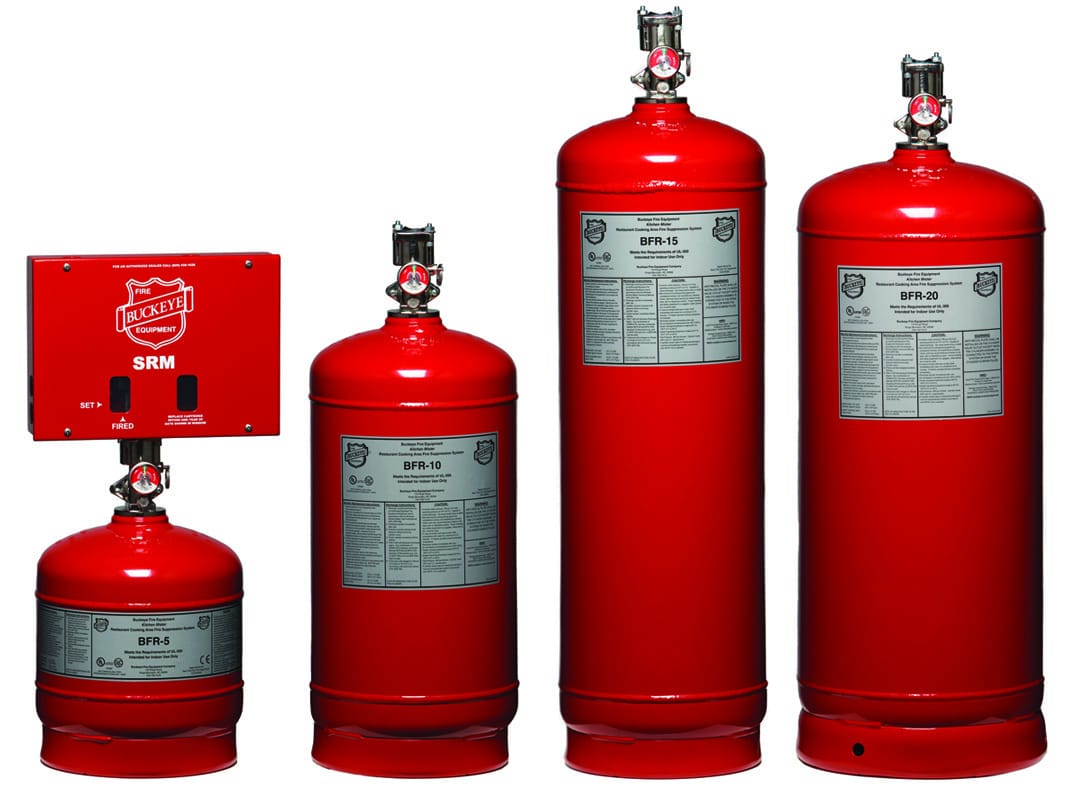
Each agent tank can only feed a set number of nozzles, which the listing counts as flow points, through a set maximum length of pipe. When the line needs more coverage than one tank allows, a second or third tank is added, with its own release mechanism or linked to the first. This is the single biggest jump in price between a small kitchen and a large one, and it is why the photo above shows tanks in several sizes.
The fire marshal checks this arithmetic. The City of Arlington’s construction guide for kitchen hood suppression systems, for example, asks for the total flow points and pipe length used, and the maximum allowed, on every plan set it reviews.
6 months
How often NFPA 96 requires a commercial kitchen fire-extinguishing system to be serviced by a trained, qualified and certified person, so the system’s cost does not stop at installation.
Sourced to NFPA 96, Ventilation Control and Fire Protection of Commercial Cooking Operations
Shutting Off the Gas and Power
When the system fires, NFPA 96 requires every source of fuel and electric power that heats the protected equipment to shut off automatically, and to stay off until someone resets it by hand. On a gas line that means a mechanical or electrical gas valve sized to the pipe. On electric fryers and griddles it means a way to cut their power. Gas appliances that sit under the same hood but need no protection of their own must shut off too.
A kitchen with a large gas line, several electric appliances, or both, costs more to tie in than a small all-gas line with one valve.
The Fire Alarm, Pull Station and Class K Extinguisher
Several parts of the job sit outside the hood but are still part of the price.
| Item | What is required | Why it affects cost |
|---|---|---|
| Manual pull station | At least one, in the path of exit, plus automatic release | Cable runs from the pull station to the release, longer on a big line |
| Fire alarm tie-in | Where the building has a fire alarm, the system connects to it | Often a separate alarm permit and an alarm technician at the test |
| Alarm without a panel | Some cities require a local horn or bell when the system fires | A notification device and its wiring |
| Class K extinguisher | A portable backup near the cooking line, with a placard beside it | The extinguisher, mount and sign |
Arlington’s guide, for example, places the pull station 10 to 20 feet from the hood and no more than 5 feet above the floor, requires a Class K extinguisher within 30 feet, and asks for one alarm device in the kitchen and one in the seating area where there is no building alarm. Other Dallas-Fort Worth cities set their own versions, which is one reason a quote depends on the address.
Permits, Plans and the Acceptance Test
In Texas the plans are drawn and signed by a technician licensed by the Texas Department of Insurance, working for a firm that holds a Texas Department of Insurance Fire Extinguisher Certificate of Registration (an ECR number), and the city reviews them before any pipe goes up. After installation the fire marshal watches an acceptance test, pulling the station, checking the gas and power shut off, and confirming the alarm signals. Permit fees, plan review time and the test visit are all part of what a new system costs.
Brand matters less than most owners expect. Whichever brand you choose, among them ANSUL, Pyro-Chem, Kidde, Amerex and Buckeye, the fire code, as quoted in the International Code Council’s guide to Type I hoods, requires each to be tested to UL 300 and installed to NFPA 96, its listing and the manufacturer’s instructions. Boss Fire Protection is registered with the Texas Department of Insurance under Fire Extinguisher Certificate of Registration TX ECR-2481913.
Is It Cheaper to Repair an Old System Than Replace It?
Often, if the system is a current wet chemical design and the problem is a part, such as a fusible link, nozzle or gas valve. Not if it is an old dry chemical design that does not meet UL 300, or if the cooking line has changed so much that the old coverage no longer fits.
The trade-off is set out in when to replace or repair fire protection equipment, and why older dry chemical systems no longer qualify is explained in UL 300 and wet chemical kitchen fire suppression.
How Much Does a Fire Suppression Inspection Cost?
Boss Fire Protection’s fire suppression inspection starts at $599 per semi-annual visit for a kitchen with one hood and one cylinder. Larger kitchens are quoted by system, because the price scales with the number of hoods and nozzles. NFPA 96 requires that service at least every 6 months.
Each visit tests the pull station, the release and the shutoffs, and replaces the fusible links, which NFPA 96 also requires at least twice a year. Budget for it when you budget for the system, because it is part of owning one. What that visit covers, and how to compare two quotes for it, is in what a fire suppression inspection costs.
Getting a Quote in Dallas-Fort Worth
Boss Fire Protection quotes kitchen suppression systems after a site visit, with the appliances, hood, duct, tanks, shutoffs, the alarm tie-in it coordinates and the permit listed line by line, so you can see what each part costs and why. Ask for a quote with the kitchen layout and any planned equipment changes, and the figure you get will be the one you pay.
Sources: NFPA 96, Standard for Ventilation Control and Fire Protection of Commercial Cooking Operations (National Fire Protection Association), on what must be protected, fuel and power shutoff, manual and automatic actuation, the Class K extinguisher and placard, service every 6 months and fusible link replacement at least semiannually. City of Arlington Fire Rescue, Fire Marshal’s Office, Construction Guide for Kitchen Hood and Spray Booth Suppression Systems (2021 IFC edition, updated March 2025), on plan contents, flow points, pull station location, alarm connection, licensing and the acceptance test. International Code Council, Type I Hoods, Commercial Cooking Operations, quoting the fire code on UL 300 listing and installation. Boss Fire Protection’s published inspection price, as shown on its fire suppression inspection page.
Put a Licensed Fire Protection Team on Your Side
Inspections, service, red-tag repair, and new installs for commercial kitchens across Dallas-Fort Worth. Photo-documented work and a written report, every visit.
