
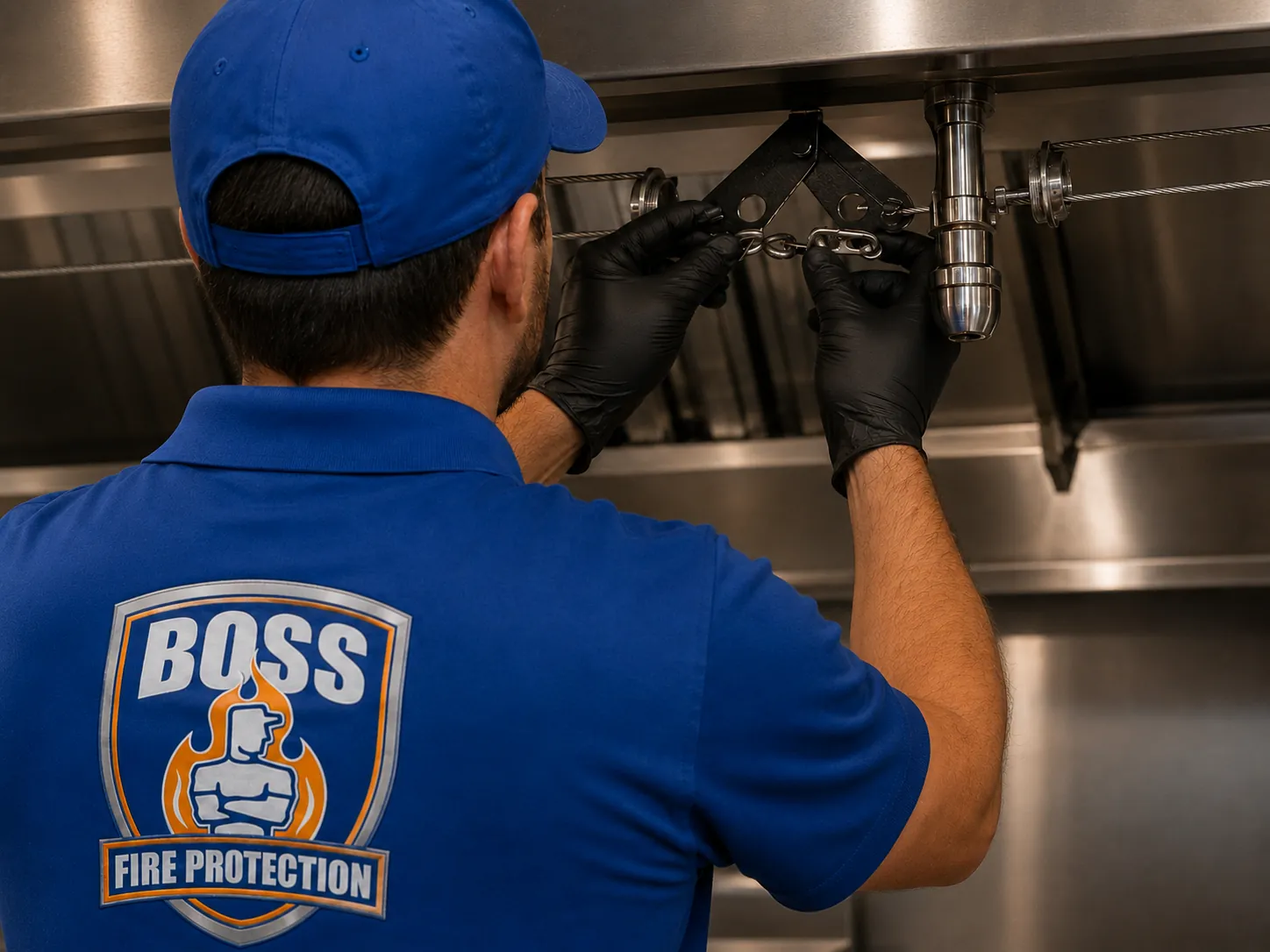
Cooking causes most commercial kitchen fires. The U.S. Fire Administration found that cooking started 64% of reported restaurant fires, with heating and electrical malfunctions about 7% each, and that restaurant fires peak between 10 and 11 in the morning, while kitchens heat up for lunch. Behind the word cooking sit a few repeat causes, which are oil left to overheat, grease built up in the hood and duct, and appliances moved or added where the fire suppression system cannot reach them. Boss Fire Protection’s fire suppression system service across Dallas-Fort Worth exists to keep that last line of defense matched to the kitchen it protects.
- Cooking starts about two in three restaurant fires
- Heating and electrical faults start about 7% each
- Fires peak from 10 to 11 a.m., during lunch preparation
- Most stay on the appliance where they start
What Is the Most Common Cause of Kitchen Fires in Restaurants?
Cooking is the most common cause by a wide margin. The U.S. Fire Administration found cooking caused 64% of reported restaurant fires from 2011 to 2013, about nine times the share of heating or of electrical malfunctions. Within cooking, the usual starting points are hot oil and grease, on a fryer, a griddle, a range or a charbroiler.
| Cause | Share of restaurant fires |
|---|---|
| Cooking | 64% |
| Heating | 7% |
| Electrical malfunction | 7% |
| Careless actions | 4% |
| Appliances | 4% |
| All other causes | About 15% |
The figures come from the U.S. Fire Administration’s restaurant fire snapshot, which counted an estimated 5,600 restaurant fires a year reported to fire departments from 2011 to 2013, causing about 100 injuries and $116 million in property damage each year.
The Repeat Causes Behind Cooking Fires
- Oil left to overheat. A fryer or a pan of oil left on a high burner during a rush can reach the point where the oil ignites on its own.
- Grease in the hood, filters and duct. Grease-laden vapor condenses on every surface above the line, and a flare-up can carry fire into it.
- Filters out or damaged. NFPA 96 says a filter-equipped exhaust system is never run with the filters removed, because the filters keep flame and grease out of the duct.
- Appliances moved or swapped. A new fryer, a range pulled forward or a charbroiler added under the hood can leave it outside the nozzles that were aimed at the old layout.
- Cooking equipment not serviced. NFPA 96 asks for the cooking equipment itself to be inspected and serviced at least once a year by trained people.
10 to 11 a.m.
The hour when restaurant fires peaked, as kitchens prepared to serve lunch, in fires reported to U.S. fire departments from 2011 to 2013.
Sourced to U.S. Fire Administration, Restaurant Fires (2011 to 2013)
How Often Does Grease Buildup Need to Be Checked?
NFPA 96 sets the schedule by how hard the kitchen cooks. The exhaust system is checked for grease buildup monthly for solid fuel cooking, quarterly for high-volume kitchens such as 24-hour, charbroiling and wok cooking, every six months for moderate volume, and once a year for low volume. Any contaminated part is then cleaned.
Grease does not only collect in the duct. It can also build up inside the conduit that carries the suppression system’s detection line, which is explained in grease accumulation in detection line conduit.
The Cause Most Advice Leaves Out
Most fire prevention advice for restaurants stops at keeping the kitchen clean and training the staff. Both matter. The cause that gets missed is the change nobody reports. A kitchen system is designed for one set of appliances in one position, and every fryer swap, menu change and rearranged line is a chance for a fire to start where no nozzle is aimed. NFPA 96 requires the system to be re-evaluated whenever the cooking hazard it protects changes. Telling your fire suppression company about a change before the next semiannual inspection is the cheapest fire prevention a kitchen has.
Why Most Kitchen Fires Stay Small
The same USFA snapshot found 68% of restaurant fires stayed on the object where they started and another 18% stayed in the room. A working hood system, a Class K extinguisher beside the line and a crew who know where the pull station is are a large part of why. The habits and equipment behind that are set out in keys to fire safety in a commercial kitchen, and NFPA 96 asks for staff to be shown the extinguishers and the manual pull station on hiring and every year after.
Keeping Your Kitchen Protected in Dallas-Fort Worth
Boss Fire Protection inspects and services kitchen hood suppression systems across Dallas-Fort Worth every six months, and checks that every appliance under the hood is still covered by a nozzle. If your line has changed since the last visit, tell us before we arrive and we will check the coverage against the new layout. Kitchen exhaust cleaning is its own trade, and Boss Fire Protection’s trusted partner for hood and duct cleaning is Hood Boss.
Sources: U.S. Fire Administration, Restaurant Fires (2011 to 2013), Topical Fire Report snapshot, on the estimated 5,600 restaurant fires a year, injuries and property loss, causes (cooking 64%, heating 7%, electrical malfunction 7%, careless actions 4%, appliances 4%), the 10 to 11 a.m. peak, and fire spread (68% confined to the object of origin, 18% to the room). NFPA 96, Standard for Ventilation Control and Fire Protection of Commercial Cooking Operations (National Fire Protection Association), on the schedule of inspection for grease buildup, cleaning contaminated exhaust systems, never operating filter-equipped systems with filters removed, annual inspection and servicing of cooking equipment, and staff instruction on hiring and annually.
Put a Licensed Fire Protection Team on Your Side
Inspections, service, red-tag repair, and new installs for commercial kitchens across Dallas-Fort Worth. Photo-documented work and a written report, every visit.
