
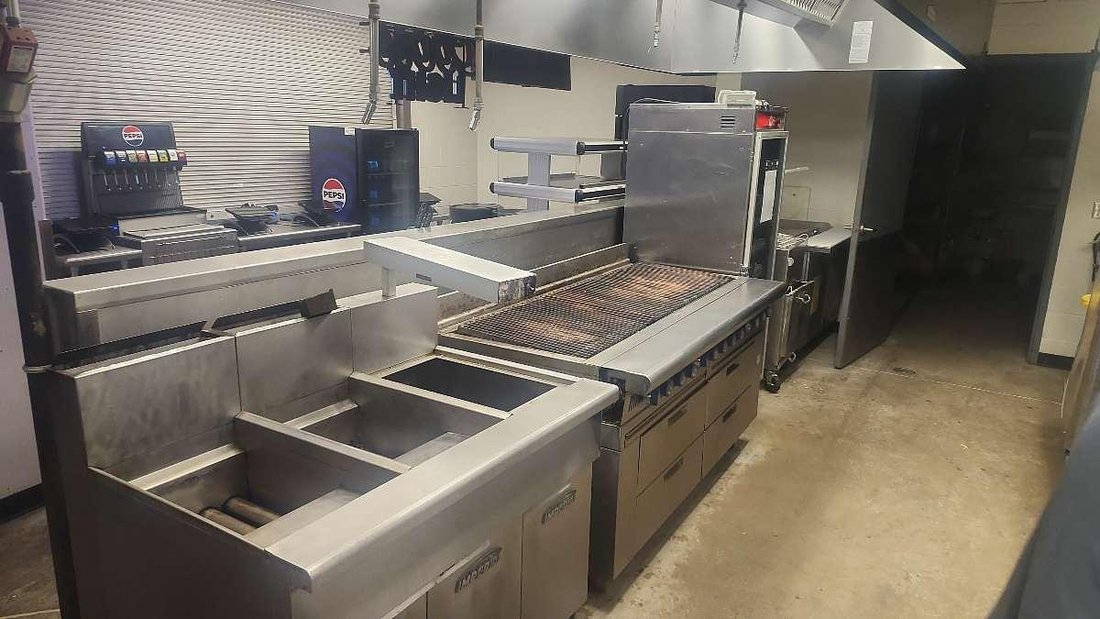
A second-generation restaurant space comes with a hood, a duct and usually a fire suppression system already on the wall, and that saves real money. But the system was designed for the last tenant’s cooking line, not yours. Before you sign, have a fire suppression inspection done on the system you would inherit, so you know whether it can protect your menu or needs changing first. Boss Fire Protection does these checks across Dallas-Fort Worth.
- It is designed for one set of appliances in one arrangement
- Nearly any change to that line means the system is re-evaluated
- In Texas every existing system has had to meet UL 300 since 2008
- It needs service every 6 months, starting with you
Can You Use the Hood System the Last Restaurant Left Behind?
Often, yes. A system that meets UL 300, is still supported by its manufacturer, is in good condition and covers the appliances you will actually cook on can stay. If your line differs from the last tenant’s, NFPA 96 requires the system to be re-evaluated by a trained, qualified and certified person, and it may need new nozzles or tanks.
Whether your concept needs a suppression system at all, and what Texas requires, is covered in when a kitchen fire suppression system is required in Texas. If the space had a commercial cooking line under a Type I hood, the answer is almost always yes.
Your Cooking Line Is Not Their Cooking Line
A kitchen suppression system is designed nozzle by nozzle for specific appliances in specific positions. NFPA 96 is direct about what happens when that changes.
- Cooking appliances that need protection shall not be moved, modified or rearranged without the system being re-evaluated first by the installer or servicing agent, unless the system’s design allows it.
- Any change to the hazard after the system is installed means the design is re-evaluated by a properly trained, qualified and certified person.
- Shelves, baffle plates or any other change that blocks a nozzle’s spray pattern are not permitted.
Swapping a griddle for a charbroiler, adding a wok station or moving the fryers to the other end of the hood are all changes to the hazard. So is adding a smoker box to an existing appliance, which NFPA 96 does not allow until the system has been checked for it.
Is the Inherited System UL 300 Compliant?
In Texas it has to be. Since 1 January 2008 the State Fire Marshal’s rule has required every existing pre-engineered kitchen system to meet UL 300 or carry a red tag. Older systems built before UL 300, most of them dry chemical, do not, and bringing one up usually means a new system.
NFPA 96 on its own is narrower. It requires kitchen fire-extinguishing systems to comply with UL 300 or an equivalent standard and to be installed to their listing, and it lists four events that force an older system that does not comply to be brought up to UL 300.
- The cooking medium changes from animal fats to vegetable oils.
- The cooking equipment is moved.
- Cooking equipment is replaced.
- The system is no longer supported by its manufacturer.
A new tenant often triggers two or three of those at once, and the model on the tank tells a technician which kind of system you have. Why older dry chemical systems fail the test is explained in UL 300 and wet chemical kitchen fire suppression.
2008
The year after which Texas requires every existing pre-engineered kitchen suppression system that does not meet UL 300 to be red tagged, not only new ones.
Sourced to Texas Department of Insurance, State Fire Marshal rule 28 TAC 34.517
What to Check Before You Sign the Lease
| What to check | What to look for |
|---|---|
| The service tag | A visit in the last 6 months, with the fusible link year of manufacture and installation date marked on it |
| Brand and model | A UL 300 system its manufacturer still supports |
| Nozzle coverage | Nozzles over the appliances you will use, with nothing blocking their spray |
| Abandoned pipe or conduit | None left inside the hood, plenum or duct, and old holes sealed with listed devices |
| Gas and power shutoff | Every appliance under the hood shuts off when the system fires, and stays off until reset by hand |
| Manual pull station | In a means of egress or where the fire marshal accepts, labeled for the hazard it protects, with instructions |
| Class K extinguisher | Present, with the placard saying to activate the system first |
Get the findings in writing before the lease is signed. If the system needs work, that cost belongs in the negotiation, not in your opening budget after the keys are handed over.
What If the System Has a Red Tag?
A red tag means the last inspection found a deficiency that takes the system out of compliance. It has to be repaired and pass before you cook under it, and a fire marshal can order a kitchen with a non-compliant system closed until it is corrected. Find out what the tag was for before you sign.
A red tag can be as simple as an expired tag or a missing link, or as serious as a missing cartridge or mismatched parts. What a repair involves is set out in commercial kitchen fire suppression repair.
Permits and the Fire Marshal
Changing the system to suit your line is installation work. In Texas it is done by a company registered with the Texas Department of Insurance, using licensed technicians, to the 2021 edition of NFPA 96 and NFPA 17A that the Texas Department of Insurance 2023 rule adopted. Cities set their own permit steps. Arlington, for example, asks for plans showing the hood, the appliances under it and the nozzles before work starts, and an acceptance test with the fire marshal afterwards. Boss Fire Protection is registered with the Texas Department of Insurance under Fire Extinguisher Certificate of Registration TX ECR-2481913.
Getting an Inherited System Checked in Dallas-Fort Worth
Boss Fire Protection will inspect the system in a space you are considering, tell you whether it fits your planned cooking line, and put what it needs in writing before you commit. Send us your equipment list and the address, and we will check the hood against it.
Sources: NFPA 96, Standard for Ventilation Control and Fire Protection of Commercial Cooking Operations (National Fire Protection Association), on UL 300 compliance and the four events that require an older system to be upgraded, re-evaluation after any change to the hazard or before appliances are moved, obstructions to spray patterns, abandoned pipe and conduit, solid fuel holders, fuel shutoff and manual reset, manual actuation devices, the Class K extinguisher and placard, service every 6 months, and fusible link dates on the tag. Texas Department of Insurance, 2023 adopted rule, adopting NFPA 96 and NFPA 17A, 2021 editions. Texas Department of Insurance, State Fire Marshal rule 28 TAC 34.517(f), on UL 300 for every existing pre-engineered commercial cooking system after 1 January 2008, or a red tag. City of Arlington Fire Marshal’s Office construction guide for kitchen hood suppression systems (March 2025), on plans and the acceptance test. Boss Fire Protection’s inspection page, on a fire marshal closing a kitchen with a non-compliant system.
Put a Licensed Fire Protection Team on Your Side
Inspections, service, red-tag repair, and new installs for commercial kitchens across Dallas-Fort Worth. Photo-documented work and a written report, every visit.
